Strap : What is Strap | Luxyora
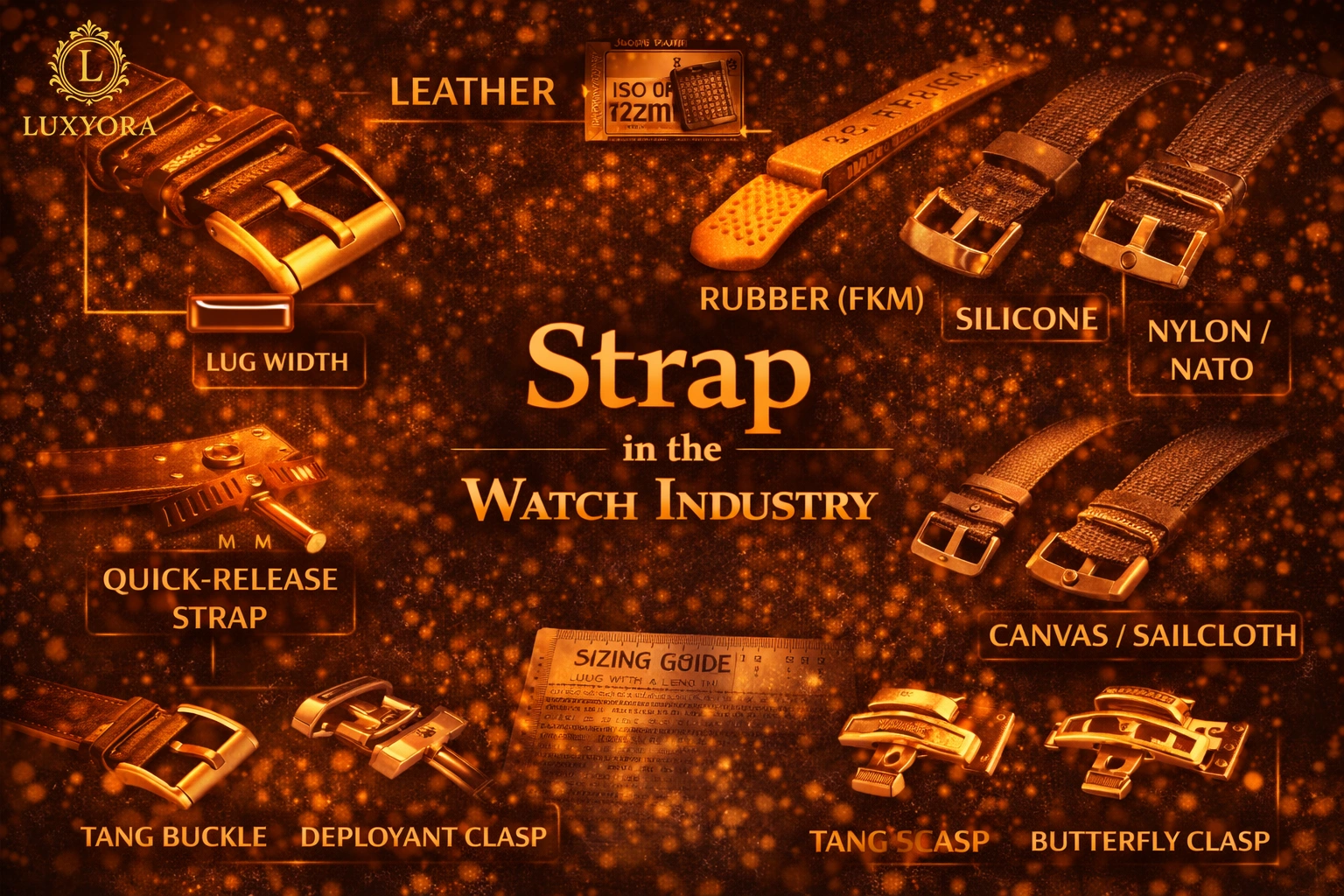
In watch-industry terminology, a strap is the wearable band, typically non-metal, that secures a watch case to the wrist. (A bracelet usually refers to a metal band, though many consumers casually call both “straps.”) A strap is not just an accessory: it directly affects comfort, durability, water suitability, case security, and the overall style identity of a watch.
In retail listings and service notes, you’ll see strap-related keywords like lug width, taper, spring bars, quick-release, deployant clasp, NATO, FKM rubber, and perforated rally strap, all of which describe how a strap fits, functions, and wears.
Why the Strap Is a Big Deal
A strap influences a watch in four practical ways:
- Security: The strap and attachment system (spring bars or screws) keep the watch from falling off.
- Comfort: Material, thickness, curvature, and lining determine all-day wearability.
- Function: Swimming, diving, sports, or office wear each demands different materials and construction.
- Aesthetics: The strap can shift a watch from dressy to rugged in seconds.
Strap vs Bracelet: The Industry Distinction
- Strap (non-metal): leather, rubber, silicone, nylon/NATO, canvas, sailcloth, etc.
- Bracelet (metal): steel, titanium, precious metals; often with solid links and end links.
Many watch guides explicitly treat straps as the category where personalization is easiest because strap swaps dramatically change the “character” of a watch.
Core Strap Types and What They’re For
1) Leather straps (classic dress + smart casual)
Leather is prized for comfort and elegance. Within the leather industry, terms include:
- Calfskin (common, versatile)
- Suede/nubuck (soft, casual texture)
- Alligator/croc (high-end dress)
- Shell cordovan (dense, durable, premium)
Best use: office, dress, everyday dry conditions
Watch-outs: leather dislikes water, and sweat longevity depends on care and rotation.
2) Rubber straps (tool watches and modern sport-luxury)
Rubber is a staple for dive watches and heat/sweat conditions. Modern strap talk often distinguishes FKM rubber (fluoroelastomer) from silicone because FKM is marketed as more durable and resistant to wear and deformation.
Best use: swimming, humid climates, sports
Keywords: FKM rubber, vented rubber, tropic strap, integrated rubber strap
3) Silicone straps (soft comfort, often budget-friendly)
Silicone is often described as very flexible and comfortable, but some guides note that it may wear sooner than premium rubbers, depending on formulation and use.
Best use: casual, fitness, lightweight comfort
Watch-outs: can attract dust/lint and may tear or stretch in some lower-cost builds (varies by manufacturer)
4) Nylon straps and NATO straps (rugged, washable, versatile)
The NATO strap is one of the most recognized strap categories in modern watch culture. It’s popular because it’s affordable, durable, and easy to change, plus many enthusiasts value the “pass-through” structure as a practical safety advantage if one spring bar fails.
Best use: outdoor wear, travel, casual daily use
Keywords: NATO, Zulu, pass-through strap, seatbelt nylon
5) Canvas, sailcloth, and hybrid straps (modern everyday tool style)
These straps aim to combine the look of fabric with the practicality of rubber-lined construction. They’re popular on field and sports watches, where leather feels too formal, and nylon feels too light.
Strap Hardware and Attachment Systems
Buckles and clasps
- Tang buckle (pin buckle): classic, simple, easy to replace
- Deployant clasp: folds under the wrist; reduces strap bending and can extend the leather’s lifespan
- Butterfly clasp: symmetrical deployant style, often dress-focused
How straps attach to the case
Most straps attach using spring bars (or sometimes screws). Fit guides emphasize that straps are not universal: you must match lug width and the correct attachment mechanism.
Keyword cluster: spring bar, quick-release spring bar, drilled lugs, curved spring bar, screw bars.
Sizing and Fit: Lug Width, Taper, Length, and Thickness
Lug width (the non-negotiable measurement)
Lug width is the internal distance between the lugs (commonly 18/20/22 mm). A strap must match this; otherwise, it won’t seat correctly and may compromise security.
Taper (for comfort and proportion)
Taper is the reduction from lug width to buckle width (example: 20 mm → 16 mm).
- A strong taper can feel dressier and lighter.
- Minimal taper often feels sportier and sturdier.
Length (wrist circumference)
Straps are sold in length ranges (e.g., short/standard/long). For NATOs, many are intentionally long and meant to be tucked back through keepers.
Thickness (watch balance and wear)
A thick strap can stabilize a heavy watch head but may feel stiff. Thin straps drape easily but may wear faster depending on construction.
Tool-Watch Standards: Why Strap Strength Matters in Diving
For dive-style reliability, the strap/attachment must withstand real forces. Watch-standard explainers referencing ISO 6425 note that a force of 200 N is applied to each spring bar/attachment point in opposite directions in strap/bracelet solidity testing.
Practical takeaway: Even the best dive watch is only as secure as its spring bars and strap fit.
Care and Maintenance (What Owners Should Know)
- Leather: keep dry; wipe sweat; rotate straps; condition occasionally.
- Rubber/silicone: rinse after saltwater or sweat exposure; mild soap; air-dry.
- Nylon/NATO: wash gently; dry fully before wearing to avoid odor and mildew.
- General: Replace spring bars periodically on frequently worn watches, especially tool watches.
How to Choose the Right Strap
A practical “best match” framework:
- Environment: water/sweat → rubber/FKM or nylon; office → leather or refined hybrid
- Comfort priorities: soft silicone/nylon for lightness; lined leather for skin comfort
- Watch style: diver → rubber/NATO; dress → leather/alligator; field → canvas/nylon
Fit precision: confirm lug width, spring bar type, and compatibility with the quick-release.
References
Clam Cases. (2024, September 28). A guide to buying and replacing watch straps.
Ethos Watches. (2020, February 4). Types of watch straps: Bands, fittings, and styles.
Hodinkee. (2020, June 26). NATO strap hacks and tricks.
Hodinkee. (2021, October 1). What watch strap should I wear?
Hodinkee. (2022, April 30). The Hodinkee guide to watch straps.
Kapoor Watch. (2024, August 14). Material matters: Understanding types of watch straps.
Kaplan, B. B. (2022). Horology: An illustrated primer on the history, philosophy, and science of time, with an overview of the wristwatch and the watch industry. Schiffer Publishing.
Primer Magazine. (2024, February 21). A comprehensive guide to watch straps.
Stone, G., & Pulvirent, S. (2018). The watch, thoroughly revised: The art and craft of watchmaking. Abrams.
Worn & Wound. (2018, July 13). Making a tool watch: A basic guide to ISO, DIN, and related industry standards.
Zealande. (2026, January 26). FKM rubber straps vs silicone straps.
International Organization for Standardization. (2018). ISO 6425:2018—Horology—Divers’ watches (International standard). (ISO)
-