Sprue : What is Sprue
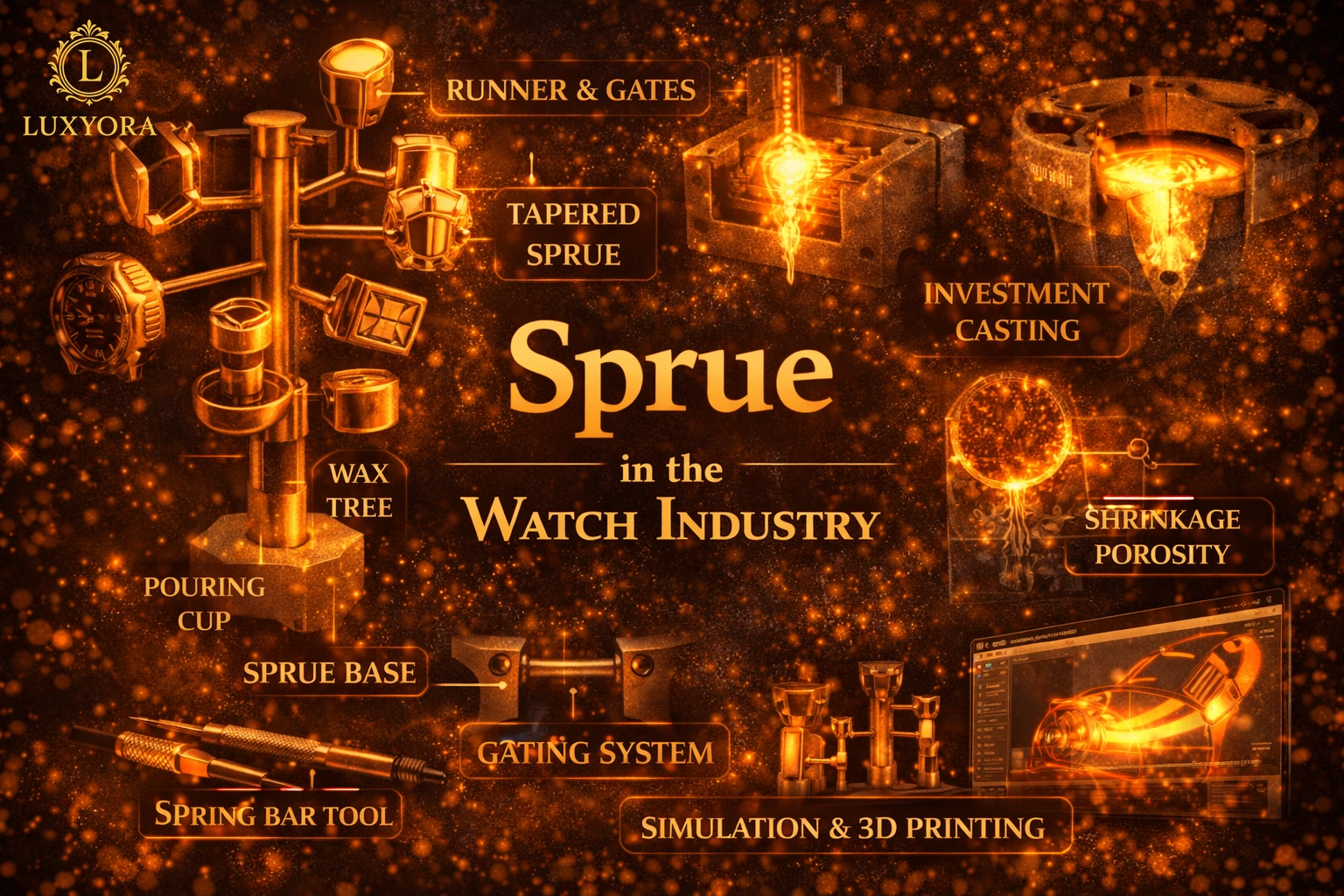
In manufacturing, especially investment casting (lost-wax casting), a sprue is the main channel that carries molten metal from the pouring entry point into a mold. In simple terms, the sprue is the primary metal highway that feeds the rest of the gating system (sprue → runner → gates → mold cavity).
In the watch industry, the term “sprue” most often appears in contexts where precision metal parts are cast or formed using casting-inspired workflows, such as watch cases, case components, clasps, buckles, crown guards, decorative hardware, and certain prototypes or small-batch components.
While many modern watch cases are CNC-machined, sprue-based casting remains important in:
- Accessory hardware (buckles, clasps, jewelry-like components)
- Prototyping and low-to-mid volume production
- Complex geometries where casting can be efficient before final machining/finishing
- Precious-metal and decorative parts where lost-wax methods are traditional.
Why the Sprue Matters in Quality Watch Components
A sprue is not “extra metal.” It is a process-critical structure that influences:
- Fill quality (whether the part fills completely without misruns)
- Surface finish and cleanliness (turbulence can entrain oxides/gas)
- Porosity risk (shrinkage voids and gas porosity can be sprue/gating-related)
- Yield and cost (sprue metal is later cut off; large sprues reduce yield).
In luxury watchmaking, defects that may be tolerable in hidden industrial castings can be unacceptable because cases, clasps, and hardware are frequently polished, brushed, and visually inspected under strong light. A poor sprue design can cause localized porosity or turbulence-driven defects that manifest during finishing.
Sprue vs Runner vs Gate: Key Vocabulary
Watch and jewelry casting discussions often use these terms together:
- Sprue (downsprue/main sprue): The main vertical feed channel from the pouring cup to the distribution system.
- Runner: Horizontal channels distributing metal from the sprue to multiple gates.
- Gate (ingate): The final opening where metal enters the part cavity.
- Riser/feeder (in some processes): A reservoir that feeds metal during solidification shrinkage.
Many references describe the gating system as the combined network that controls delivery rate, flow direction, and turbulence
“Sprueing” and the Sprue Tree in Investment Casting
In lost-wax casting, multiple wax patterns are often attached to a central wax sprue, forming a tree. The tree allows multiple parts to be cast from a single pour, common in jewelry and small precision components.
Common spruce tree terms you’ll hear
- Sprue base/sprue button: The base reservoir where patterns attach and where metal pools.
- Pouring cup: A funnel-like entry that guides molten metal into the sprue.
- Wax tree: Assembled patterns + sprues before investing.
Practical casting guides describe sprue attachment as a dedicated step, emphasizing correct placement and stable connections.
How Sprue Design Affects Defects (The “Why It Failed” Section)
Many casting defects trace back to how the sprue system feeds and controls the melt:
1) Turbulence and oxide/gas entrainment
If molten metal enters too rapidly or changes direction abruptly, it can trap gas or oxides, increasing the risk of defects. Research and design guidelines discuss sprue-related turbulence and methods to reduce it.
2) Aspiration (air being sucked into the stream)
Poor sprue geometry can create low-pressure regions that draw air into the molten stream, increasing the risk of porosity. One reason sprues are often tapered rather than straight is that tapered sprues reduce stress concentrations.
3) Misruns and incomplete fill
If the sprue and gating system do not deliver metal quickly enough before freezing starts, thin sections may not fill. Investment casting gating articles emphasize controlling delivery and preventing premature solidification
4) Shrinkage porosity (feeding problem)
As metal solidifies, it shrinks. If the sprue/gating system does not support proper feeding and directional solidification, voids can form.
Best-Practice Sprue Concepts (Easy to Understand, Widely Used)
Across casting references and guidelines, several practical ideas recur:
Tapered sprue
A tapered sprue can help maintain a stable flow and reduce turbulence and aspiration. Casting design guidelines explicitly discuss the benefits of tapered sprues versus untapered sprues at similar flow rates and heights.
Central and balanced feeding
Guidelines also recommend placing the sprue centrally on the runner and using balanced gating to improve flow distribution.
Control the choke and flow rate
Modern gating literature describes how choke regions and geometry control melt speed and filling behavior.
Modern Sprue Engineering: Simulation, 3D Printing, and Novel Shapes
From 2018 onward, sprue design has increasingly benefited from:
- casting simulation software to predict filling and solidification defects.
- additive manufacturing (3D sand-printing) enabling sprue profiles not practical with traditional tooling; one study reports redesigned sprue profiles reducing inclusions/defects significantly compared with traditional gating.
- 3D-printed patterns that enable rapid iteration in investment casting workflows are useful for watch prototyping and small-batch production.
For watch and accessory makers, this means faster development cycles: prototype a clasp or case component, adjust sprue/gate placement, re-cast, and refine finishing outcomes.
Sprue Removal and Finishing: Where “Sprue Marks” Come From
After casting, the sprue is cut off (often called sprue cutting, divesting, or cutoff). This leaves a sprue scar or sprue mark, a region that must be ground, sanded, or polished away. In watch-visible parts, sprue placement is chosen to minimize:
- visible scars on show surfaces
- excessive grinding that could alter geometry
- finishing time and cost
This is why sprue location is often treated as both an engineering and an aesthetic decision.
What to Remember
A sprue is the primary feed channel that enables casting. In watch-related manufacturing, the sprue influences not only whether a part forms correctly, but also whether it can be finished to luxury standards without hidden porosity or cosmetic defects. Understanding sprues gives readers real insight into why certain components cost more, why prototypes fail, and why casting expertise is still valuable in a highly CNC-driven industry.
References
Formlabs. (n.d.). Lost-wax casting: Technique, process, and applications. (Formlabs)
He, B., et al. (2022). Optimal design of the gating and riser system for casting (Open-access article). PMC. (PMC)
Impro Precision. (2021, October 12). What to understand about gating system design for investment casting. (Impro Precision)
Jin, C. K., et al. (2023). Gating system design and casting simulation application. SAGE Journals. (SAGE Journals)
PPCP Inc. (2018, November 20). Investment casting definition: Sprue. (PPCP Inc.)
Reliance Foundry. (2018). Investment casting (Metal casting resources). (Reliance Foundry Co. Ltd)
Sama, S. R., et al. (2019). Novel sprue designs in metal casting via 3D sand-printing. ScienceDirect. (ScienceDirect)
The Crucible. (2021, June 30). How to cast jewelry in 7 steps. (The Crucible)
Casting Process Design Guidelines. (n.d.). Casting process design guidelines (PDF). (Amazon Web Services, Inc.)
Note: A few web sources above do not clearly display publication dates on-page (marked “n.d.”). All included references are widely used technical resources cited here for definition and process context.