Vintage : What is Vintage
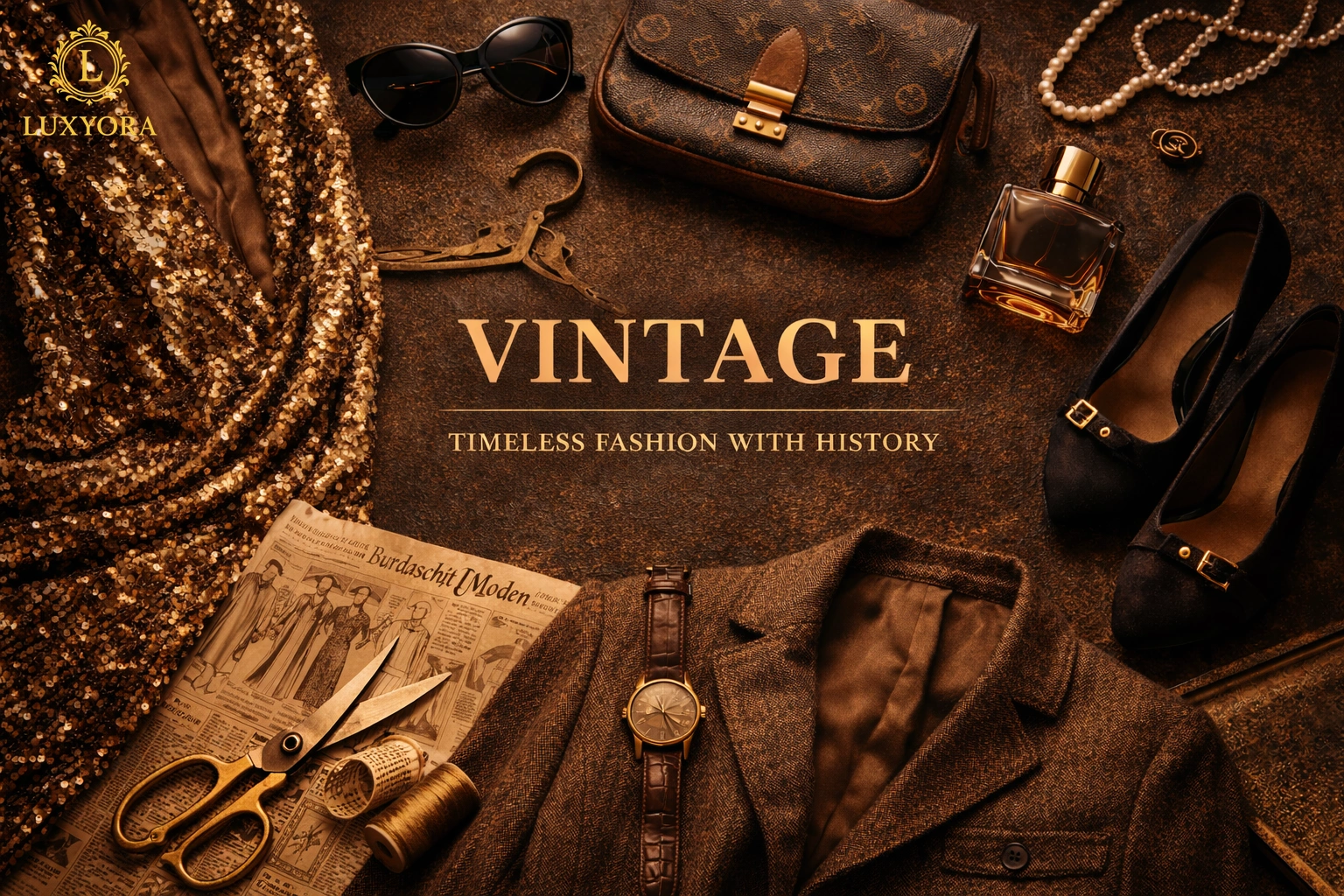
“Vintage” in the fashion industry is more than a style adjective; it’s a category of clothing and accessories defined by age, story, and cultural context, valued for authenticity, craftsmanship, rarity, and sustainability. In practical terms, vintage most often refers to garments from a previous era that reflect the design language, materials, and construction standards of that time and that are distinct from modern “secondhand” basics. Many sustainability-focused fashion sources commonly describe vintage as around 20 years or older, with older pieces sometimes classified as “antique.”
Over the last decade, vintage has moved from a niche thrift culture into a mainstream fashion force visible on red carpets, on resale platforms, and in brand-led circular initiatives.
This shift is driven by consumer demand for unique personal style, rising awareness of fashion’s environmental impact, and a growing re-commerce economy that makes it easier to buy, sell, authenticate, and repair pre-loved pieces.
What “Vintage” Means in Fashion (and What It Doesn’t)
Vintage vs. Secondhand
- Secondhand: Any previously owned clothing could be last season, last year, or yesterday.
- Vintage: Generally older pieces that reflect a particular era’s design, fabrication, or cultural moment, often described as 20+ years old in many fashion sustainability explanations.
Vintage vs. Retro
- Vintage: Made in the period it represents (authentic era piece).
- Retro: New product made to look like an older style (a modern reproduction inspired by the past).
Vintage vs. Archive / Archival
- Archival fashion typically refers to highly collectible, historically significant designer pieces, often runway, limited, or museum-grade items. The term is frequently used in luxury contexts where provenance and documented collections matter.
Why Vintage Became a Major Fashion Movement
1) Individuality and “treasure-hunt” style
Vintage fashion offers something modern mass retail often cannot: one-of-one style. Shoppers don’t just buy clothing, they curate identity through era silhouettes (70s tailoring, 90s minimalism, Y2K streetwear) and distinct fabrications. Research on secondhand and vintage consumption repeatedly highlights drivers like nostalgia, uniqueness, and style consciousness.
2) Sustainability, circular fashion, and extending garment life
Vintage fits naturally into circular fashion principles: reuse, repair, and resale, all of which extend a garment’s life and can reduce demand for new production. Scholarly work on secondhand markets notes reuse as a pathway to circular economy transitions, as it prolongs product lifespans.
At the same time, credible sustainability voices stress that resale works best when it actually displaces new purchases rather than adding to consumption.
3) The rise of resale platforms and the “re-commerce” infrastructure
A major reason vintage accelerated is convenience: digital resale platforms make discovery, pricing, and shipping dramatically easier than old-school thrifting. Industry reports and coverage show resale growing quickly and becoming increasingly embedded in retail strategy. For example, ThredUp reports strong growth expectations for secondhand apparel through the late 2020s.
Scholarly and industry discussions also examine how business forms (for-profit and not-for-profit) shape secondhand markets and how profits and flows of used goods affect circular outcomes.
4) Cultural cycles: nostalgia waves (Y2K, 2010s revival, etc.)
Trend cycles are shortening, and nostalgia is accelerating. In 2026 coverage, fashion outlets describe experts predicting renewed interest in specific eras (including 2010s “archive-worthy” designer moments).
This is why “vintage” isn’t one trend, it’s a system that keeps reactivating different decades.
The Value Proposition of Vintage Fashion
1) Craftsmanship and materials
Many vintage garments were made with construction details that are expensive today: substantial fabric weight, better linings, dense stitching, and durable hardware. While not every old piece is well-made, “good vintage” often reveals quality through:
- seams and finishing
- fabric hand-feel and drape
- stability after washing
- repairability
2) Rarity and provenance
Scarcity is built into many vintage pieces that exist in limited quantities because the original production is long over. For designer vintage, provenance (documented origin, era, collection) becomes part of the value.
3) Price-to-value (and sometimes investment potential)
Vintage is not always cheap, but it can be more cost-effective than buying new equivalents of similar quality. Some categories (classic luxury bags, fine jewelry) are also discussed as having resale durability.
How Vintage Works as a Fashion Category Today
Curated vintage
Curated sellers edit inventory for condition, era, fit, and style relevance, often cleaning, repairing, and presenting pieces with measurements and styling guidance.
Upcycled vintage
Upcycling uses older garments or textiles to create new silhouettes, cutting, reworking, patching, and combining pieces. Brands have also leaned into repurposing and post-consumer sourcing, such as Coach launching repurposed capsules made from vintage/secondhand denim.
Brand-led resale and partnerships
Fashion brands increasingly treat resale as both a sustainability narrative and a customer-retention channel. Past examples include resale initiatives and collaborations referenced in fashion journalism (e.g., Levi’s resale, Gucci collaborations, and resale programs through resale partners).
A Practical Guide: How to Evaluate Vintage Like an Industry Insider
1) Authenticity checks
- Labels & tags: period-correct fonts, RN numbers (where relevant), “made in” conventions
- Hardware & finishing: zippers, buttons, rivets often reveal era and quality
- Stitching & construction: consistent seams, clean finishes, reinforced stress points
2) Condition grading (common professional categories)
- Deadstock/NWT: never worn, sometimes with tags
- Excellent: minimal wear, no major repairs needed
- Good: visible wear consistent with age; minor flaws acceptable
- Fair: repair project or significant wear (price should reflect this)
3) Fit and alterations
Sizing conventions change by decade. Always check:
- shoulder width, chest, waist, rise, inseam
- seam allowance (some pieces can be let out; some cannot)
4) Care and longevity
Older fabrics can be delicate (silk, wool, early synthetics). Build longevity with:
- gentle cleaning
- proper storage (breathable garment bags)
- timely repairs (buttons, hems, lining tears)
Vintage in 2026: Where the Category Is Headed
- More “expert-led” vintage: stylists and specialist dealers defining what counts as collectible.
- Resale as retail infrastructure: industry commentary frames resale as a core growth engine rather than a side category.
- Smarter shopping with tech: search, recommendations, and discovery increasingly supported by AI tooling in resale experiences.
- Accountability pressure: sustainability advocates continue to call for durability, repair, reuse, and reduced overproduction, not just marketing claims.
References
- Blum, P. (2021). Circular fashion: Making the fashion industry sustainable. Pavilion Books. (Google Books)
- Henninger, C. E., Alevizou, P., Ryding, D., & Goworek, H. (Eds.). (2024). The Palgrave handbook of sustainability in fashion (Corrected publication 2025). Palgrave Macmillan / Springer Nature.
- Ryding, D., Henninger, C. E., & Blazquez Cano, M. (2018). Vintage luxury fashion: Exploring the rise of the secondhand clothing trade. Springer. (Google Books)
- Evans, F. (2022). Consumer orientations of secondhand fashion shoppers. Journal of Retailing and Consumer Services. (ScienceDirect)
- Persson, O. (2023). Second-hand clothing markets and a just circular economy: Exploring the role of business forms and profit. Journal of Cleaner Production. (ScienceDirect)
- Representations of vintage consumption (2025). Journal of Business Research. (ScienceDirect)
- Mizrachi, M. P. (2025). Secondhand fashion consumers exhibit fast fashion behaviors. [Open-access article]. (PMC)
- Fashion re-commerce: A state-of-the-art review and future research agenda (2026). International Journal of Retail & Distribution Management. (Emerald)
- Fashion Revolution. (n.d.). Policy and transparency resources on durability, repair, reuse, and resale in fashion. (fashionrevolution.org)
- ThredUp. (2024). 2024 resale report. (cf-assets-tup.thredup.com)
- ThredUp. (2025). 2025 resale report. (cf-assets-tup.thredup.com)
- Vogue India. (2026, January 3). The biggest vintage trends of 2026, according to the experts. (Vogue India)
- Forbes. (2025, December 16). Resale market 2026: From thrift to retail’s next growth engine. (Forbes)
- The Guardian. (2025, March 19). AI and US tariffs expected to fuel fresh surge in secondhand fashion sales. (The Guardian)
- Vogue. (2020). The year in secondhand, vintage, upcycling, and sustainable fashion. (Vogue)