How to Protect Your Handbag from Rain and Water Damage | Luxyora
There are two kinds of handbag people: the ones who carry a tiny umbrella like it’s a fashion accessory, and the ones who swear they’ll “just dash to the car” and end up sprinting through a monsoon with their prized bag clutched to their chest like a romantic lead in a period drama. If you’re reading this, you’ve probably been in at least one of those scenes.
Water is sneaky. It doesn’t need to fully soak your bag to cause trouble; one rain-speckled commute can leave behind tide marks, stiffness, dullness, or that slightly stressed, “I’ve been through something” texture. And because luxury handbags are often made from natural materials (hello, leather), they react to moisture the way silk reacts to spaghetti sauce: dramatically.
The good news? You don’t need to wrap your bag in plastic like leftover dessert. With a little strategy and the right kind of calm, confident routine, you can weather-proof your handbag life while keeping things chic.
Step One: Know Your Bag Like You Know Your Skincare
Before you do anything, identify what you’re working with. Water behaves differently depending on the material and finish, and treating everything the same is how well-meaning people accidentally create bigger problems.
Smooth or “finished” leather
This includes many pebbled and structured leathers with a protective topcoat. They tend to resist light rain better, but can still spot or blister if moisture lingers.
Aniline or semi-aniline leather
These are the buttery, touch-me-now leathers with minimal coating, gorgeous, luminous, and more absorbent. They can stain from water faster than you can say “limited edition.”
Suede and nubuck
Velvety, plush, and basically allergic to surprise weather. They’re the first to show spots and the last to forgive you.
Canvas, jacquard, coated fabrics
These vary widely. Coated canvas can be quite resilient; uncoated fabrics can absorb water and dry with marks. Trims (leather corners, piping, handles) still need special attention.
Exotics (croc, lizard, etc.)
These are high-maintenance royalty. Even small moisture exposure can affect texture and finish. If this is your bag category, your best protection is prevention and a trusted specialist when things go wrong.
The Rain-Ready Ritual: Prep Before the Clouds Roll In
Think of this like priming your face: invisible effort, visible payoff.
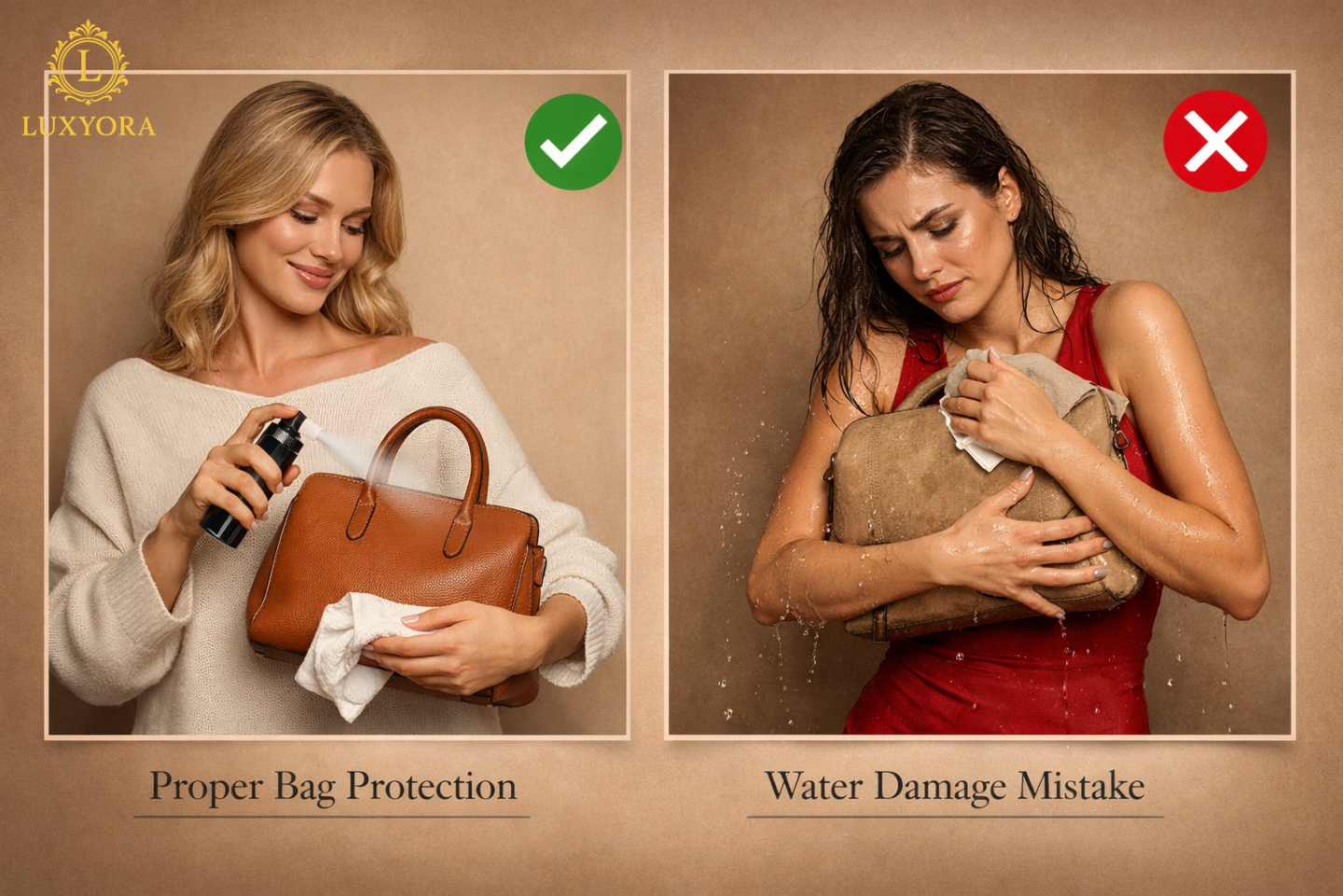
1) Use a protective spray carefully and correctly
A reputable protector spray can help repel water and reduce staining, especially on suede/nubuck and many leathers. The keyword is reduce, not “make invincible.”
How to do it like a pro:
- Clean the bag gently first (dust and grime can lock in stains).
- Test on a hidden spot (inside flap, underside, seam).
- Spray lightly from a distance, in even passes, no soaking.
- Let it dry fully in fresh air.
- Apply a second light coat if the product directions recommend it.
If your bag is very delicate (aniline, special finishes, hand-painted leathers), you may decide to skip sprays and focus on smart carrying and storage instead. When in doubt, less is more.
2) Condition leather so it doesn’t panic when wet
Leather is skin-adjacent in behavior: when it dries out, it becomes less supple and more prone to damage. A good conditioner (used sparingly) helps keep fibers flexible, which can reduce how harshly leather reacts after incidental moisture.
The golden rule: condition occasionally, not constantly. Over-conditioning can make leather sticky, darkened, or overly soft, especially on structured bags.
3) Upgrade your bag storage game
Rain protection isn’t only about rain. It’s about what happens after rain.
- Store in a breathable dust bag (not plastic).
- Stuff the bag with acid-free tissue or clean soft inserts to maintain shape.
- Avoid humid closets and avoid direct heat or sunlight.
- If you live in a humid area, consider placing moisture absorbers nearby (not touching the bag).
The “Oh No, It’s Raining” Moves: What to Do Mid-Downpour
If you’re caught outside, your goal is simple: minimize exposure and prevent water from settling.
- Keep the bag under your coat or scarf if possible.
- Avoid setting it on wet surfaces (café chairs, puddle-adjacent sidewalks, damp car floors).
- If you have a tote liner or an extra scarf, wrap the bag loosely; think “protective drape,” not “compression wrap.”
And yes: if you know it’s going to pour and you’re carrying a bag that hates water, this is the moment for a chic backup bag. Luxury is also about wisdom.
Emergency Care: The First 30 Minutes After Your Bag Gets Wet
You don’t need to perform a complicated ritual. You need to do the right few things and avoid the wrong ones.
1) Blot. Don’t rub.
Use a clean, soft, lint-free cloth and gently blot moisture. Rubbing pushes water deeper and can distort texture, especially on suede or delicate leathers.
2) Let it air dry naturally
No hair dryer. No radiator. No “sunbathing” near the window. Heat can cause stiffness, cracking, warping, or changes in finish.
3) Support the shape while drying
Stuff the bag lightly so it doesn’t slump as it dries. This is particularly important for structured silhouettes and bags with softened leather interiors.
4) Don’t panic-clean immediately
When leather is wet, it’s more vulnerable. Let it dry first, then evaluate.
How to Handle Water Spots Without Making It Worse
Water spots are often less about “dirt” and more about uneven drying or uneven absorption. Your approach should match the material.
Smooth, finished leather (minor spotting)
Once dry, you may find the mark fades naturally. If it’s still visible:
- Gently wipe the entire panel with a barely damp cloth (not just the spot) to even out the moisture distribution.
- Let it air dry again.
- Follow with a light conditioning step if the leather feels tight afterward.
Aniline leather (be extra cautious)
Because it absorbs quickly, spot treatment can create new rings. If the water mark is obvious and sentimental stakes are high, professional care is often the smartest move.
Suede and nubuck
- Let it dry fully.
- Use a suede brush to restore the nap in one direction.
- If marks remain, a specialist suede eraser may help, but heavy pressure can create shiny patches.
If suede has multiple spots or a large darkened area, it’s easy to overwork it at home. That’s your cue to call in a professional.
What Not to Do (Even If the Internet Dares You)
Some “hacks” are really just chaos in a trench coat.
Avoid:
- Vinegar, alcohol, harsh soaps, random household cleaners
- Saturating one small area (creates rings and tides)
- Oils not meant for handbags (they can darken, stain, or go rancid)
- Intense heat drying
- Repeated heavy spray layers (build-up can change color/texture)
Luxury care is less about aggressive fixing and more about gentle, consistent prevention.
Smart Habits That Make Your Bag Quietly Water-Resistant Over Time
You can’t control the weather, but you can become the kind of person whose bag always looks like it travels with a personal assistant.
Rotate bags by season
Rainy months are a love letter to resilient materials: pebbled leather, coated canvas, darker shades, minimal suede. Save your pale aniline beauty for calmer skies.
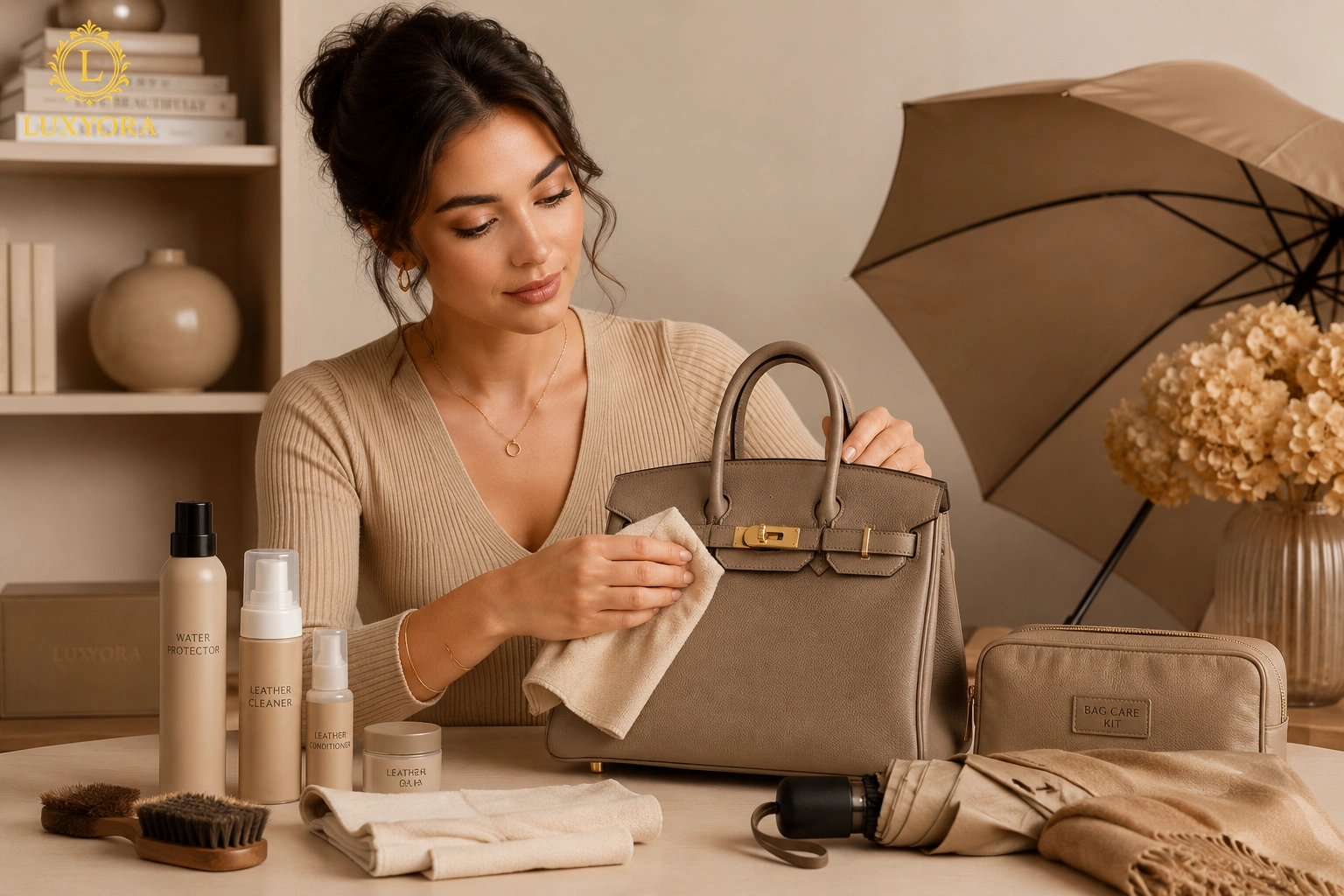
Carry a tiny “bag save kit”
Not a full toolbox, just essentials:
- Lint-free cloth (microfiber works)
- Small foldable tote for emergencies
- Mini umbrella (the kind that actually fits in your life)
Schedule gentle maintenance
A light clean, occasional conditioning (for appropriate leathers), and periodic protection refresh (if you use protectors) can keep the surface in a more stable, less reactive state.
When to Call a Professional (And Why It’s Still a Power Move)
Professional bag spas and leather specialists aren’t only for disasters. They’re for preserving finish, correcting uneven stains, and restoring suppleness without DIY risk.
Consider professional help if:
- The water stain is large, dark, or ringed
- The leather feels stiff or warped after drying
- Color transfer appears after getting wet
- Suede nap looks flattened or patchy
- The bag is exotic, vintage, or exceptionally high-value
Sometimes the most luxurious decision is knowing when to outsource.
Luxyora Philosophy: Luxury isn’t fragile; it’s intentional. Care for what you love with calm precision, and your pieces won’t just last; they’ll evolve beautifully with you.
References:
- Carl Friedrik. (n.d.). Wet leather: Quick guide—What to do when it gets wet! Carl Friedrik Magazine. (Accessed 2026-02-11).
- Hermès. (n.d.). Leather care instructions. Hermès. (Accessed 2026-02-11).
- Leather Working Group. (n.d.). Leather Working Group (LWG): Responsible leather. Leather Working Group. (Accessed 2026-02-11).
- Saphir Médaille d’Or. (n.d.). Super Invulner protector spray. Saphir. (Accessed 2026-02-11).
- Tandy Leather. (2023). The art of waterproofing leather: A comprehensive guide. Tandy Leather Blog. (Accessed 2026-02-11).
- Glamour. (2023, August 14). How to clean leather the right way. Glamour. (Accessed 2026-02-11).
- Hochschule Darmstadt, Sustainable and Experimental Design Lab. (2022). Handbook of leather design for sustainable development (PDF). Hochschule Darmstadt. (Accessed 2026-02-11).