How to Spot a High-Quality Handbag | Luxyora
Plantar fasciitis is one of those quietly disruptive conditions, subtle at first, then suddenly the first step in the morning feels like stepping onto a pebble runway. But while it may be common, it doesn’t have to define your style or your stride. The right shoes can make an extraordinary difference, transforming discomfort into confidence and long days on your feet into something far more elegant.
This is your luxury-minded guide to the best shoes for plantar fasciitis: supportive, refined, and thoughtfully designed for real life.
1. Start With the “Whole-Bag Read”: Does It Look Intentional?
Before you zoom in on stitches, take 5 seconds for a wide-angle assessment.
A quality handbag typically shows:
- Symmetry (handles aligned, panels balanced)
- Consistent proportions (nothing oddly stretched or slumped)
- Clean lines where the bag is meant to look crisp
- Purposeful softness where the silhouette is designed to be relaxed
If a bag looks “tired” on the shelf, slouching in the wrong places, twisting at the seams, gaping at the top, chances are it won’t age gracefully.
2. Leather, Fabric, and Feel: Quality Starts at the Surface
Leather: look for depth, not shine
High-quality leather usually has a natural-looking grain and a soft, substantial hand-feel. It shouldn’t look plasticky or overly glossy, as if a coating is doing all the heavy lifting.
A few easy checks:
- Touch test: supple but not spongy
- Flex test: gentle bend without sharp cracking lines
- Visual test: grain that looks organic rather than stamped-on uniform
Also, words matter. Terms like “genuine leather” can be a broad category rather than a guarantee of top-tier quality. Better signals are clarity around leather type (full-grain, top-grain) and transparency about tanning and finishing.
Canvas and coated fabrics: tight weave and clean structure
For canvas bags (or luxe-coated fabrics), quality shows up as:
- Dense weave
- Even color saturation
- No bubbling, peeling, or sticky-feeling coating
If it’s coated, it should feel smooth and durable, not like it will crack the moment winter arrives.
3. Stitching: The Quiet Proof of Craftsmanship
Stitching is where high-quality bags act like high-quality tailoring: clean, consistent, and calm.
Check for:
- Even stitch length (no random long-short patterns)
- Straight seam lines (especially along edges and curves)
- No loose threads or fuzzy ends
- Strong reinforcement at stress points (handle bases, corners, strap anchors)
Look closely at corners. Corners reveal everything because they’re where leather thickens, curves tighten, and shortcuts become obvious.
4. Edges and Finishing: The Detail That Separates “Nice” From “Heirloom”
Edge finishing is one of the biggest tells of quality, and it’s also one of the most overlooked.
High-quality edges tend to be:
- Smooth and even
- Carefully painted or turned
- Free of bubbles, cracks, and rough fibers
- Consistent in thickness (no lumpy buildup)
If edge paint looks thick, like frosting, uneven, as if it was applied in a rush, or already cracking on a brand-new bag, that’s a durability warning.
5. Hardware: Weight, Alignment, and Finish
Hardware should feel like jewelry, not like a costume accessory.
What to check:
- Weight: substantial, not hollow
- Plating: even tone, no brassy, cheap shine, no flaking
- Engraving: crisp and centered (not blurry, shallow, or crooked)
- Attachment: screws and rivets that sit flush and secure
Open and close everything. A quality clasp shouldn’t fight you, and it shouldn’t feel wobbly. If a turn-lock feels loose or a magnet misaligns, it’s not just annoying; it’s a longevity issue.
6. Zippers: Smooth is Luxury
Zippers are one of the most underrated “quality tells” because they’re pure function. A great zipper glides effortlessly and feels refined every single time you touch it.
Signs of a quality zipper:
- Smooth track movement (no snagging)
- Cleanly finished zipper tape
- Pull that feels solid in the hand
Many premium makers are known for high-end zippers and components. Even if you don’t memorize names, you’ll feel the difference immediately: premium zips don’t chatter, catch, or require two hands and a prayer.
7. The Lining: Don’t Ignore the Interior
A bag can look stunning outside and still be poorly made inside, like a beautiful jacket with a cheap lining.
Quality lining indicators:
- Durable fabric that feels tightly woven (not thin and slippery-cheap)
- Clean interior seams and tidy stitching
- Pockets that feel reinforced, not floppy add-ons
- No exposed raw edges or messy glue marks
Also, check how the lining is attached. A good interior sits neatly and doesn’t pull strangely when you open the bag.
A beautifully crafted handbag is designed from the inside out, making its lining just as important as its silhouette. Explore the details in A Guide to Handbag Lining Materials: What to Look For.
8. Structure and Base: The “Sit Test”
Set the bag down. Does it stand (if it’s designed to)? Does it slump in a controlled way (if it’s designed to)? Or does it collapse into awkward folds?
Look at:
- Base sturdiness
- Corner reinforcement
- Feet placement (if included, are they level, secure, aligned?)
- Overall stability
If the bag tips over easily or buckles at the base, it may be uncomfortable to use, and it may distort faster over time.
9. Strap and Handle Construction: The Comfort + Longevity Zone
This is where quality meets real life.
What you want:
- Comfortable drop length (works with coats, doesn’t slide constantly)
- Reinforced attachment points (often with extra stitching or leather tabs)
- Even handle padding (no thin spots)
- No visible strain where the handle meets the bag
Handles are stress points. If the handle anchors already look stressed on a new bag, imagine them after a year of laptops and life.
Choosing the perfect handbag isn’t only about shape or size; the strap can completely transform the way it looks and feels. Learn more in The Pros and Cons of Different Handbag Straps.
10. Craft Clues You Can Feel: Smell, Sound, and Movement
This might sound dramatic, but luxury is sensory.
- Smell: quality leather tends to smell rich and natural; harsh chemical odor can signal heavy coatings or cheaper processing.
- Sound: hardware shouldn’t jingle loudly like costume jewelry. It should click softly and confidently.
- Movement: straps swing smoothly; closures align; zips glide.
If the bag feels noisy, stiff in the wrong way, or fussy to use, it often means the components are working against each other.
11. Practical Luxury: Does the Design Respect Your Life?
A high-quality handbag isn’t only about materials; it’s about how intelligently it’s made.
Ask:
- Is it easy to get into without spilling everything?
- Does it close securely for travel or crowded places?
- Do pockets fit real essentials, not imaginary tiny items?
- Is the bag comfortable when fully loaded?
The true flex is a bag that looks stunning and functions flawlessly. If it’s gorgeous but impractical, it’s decor, not a daily companion.
12. The “Proof” Layer: Brand Transparency, Care, and Standards
Quality brands tend to be clear about:
- materials and country of manufacture
- care instructions and repair options
- warranties or aftercare services
- component quality and construction practices
There are also published standards for testing leather and handbag components (such as thickness, pH, tear strength, stitch line strength, and corrosion resistance). You don’t need to run lab tests, but it’s reassuring when a manufacturer’s language aligns with measurable quality thinking.
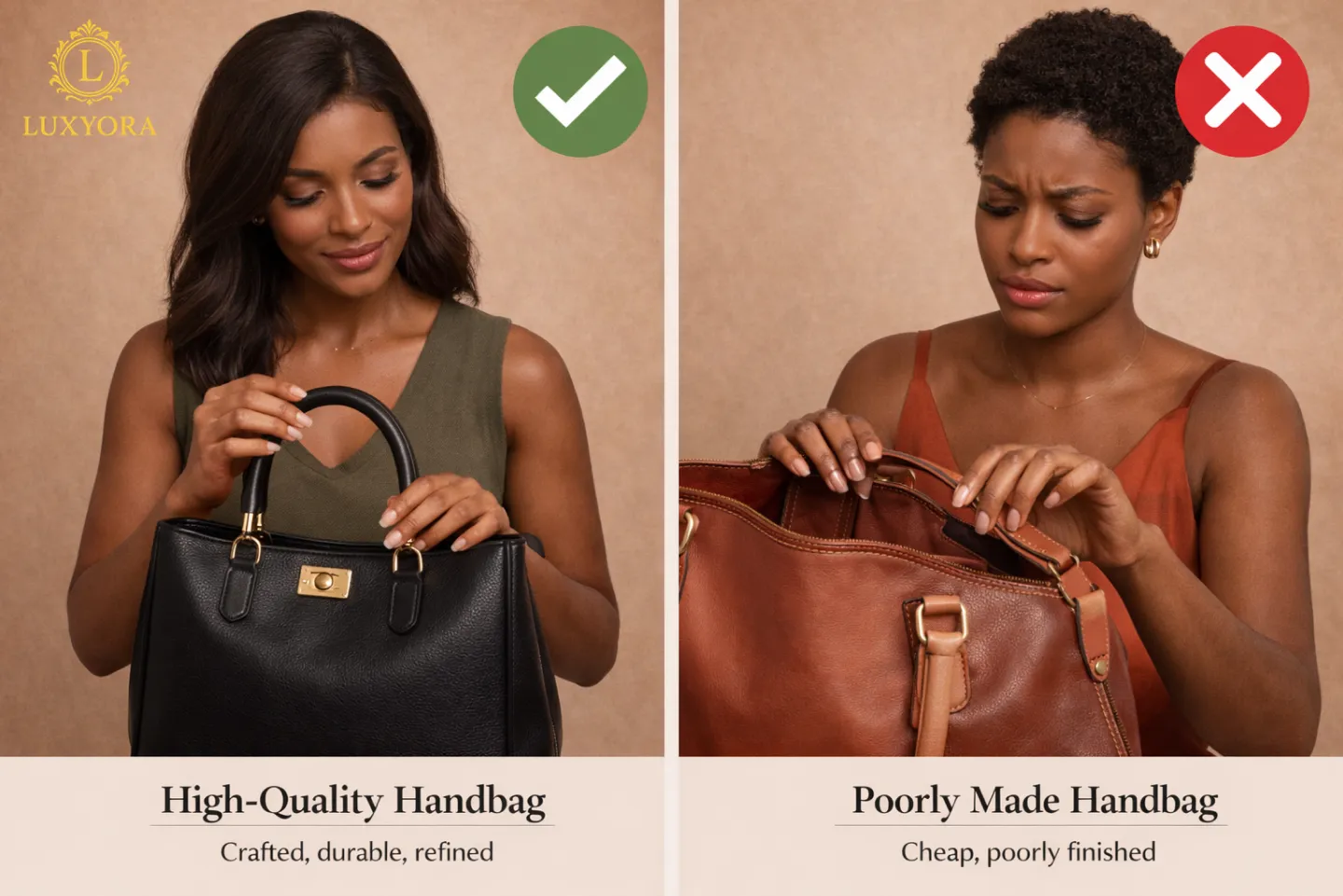
A Quick Luxury Checklist: 30 Seconds in the Mirror, 30 Seconds on the Bag
Green flags
- Leather or fabric feels substantial
- Stitching is even, and corners are clean
- Edges are smooth and consistent
- Hardware is weighty and neatly finished
- Zipper glides effortlessly
- Interior is tidy, durable, and thoughtfully arranged
- The bag sits well and holds its intended shape
- Straps feel secure and comfortable
Red flags
- Plasticky shine, harsh chemical smell
- Crooked seams or uneven stitching
- Thick, cracking edge paint
- Hollow hardware, blurry engraving
- Zipper snagging or gritty movement
- Flimsy lining or messy interior glue
- Weak handle anchors or visible strain
If the bag passes most of the green flags, you’re likely looking at something made with care, built to be worn, not just shown.
Luxyora Philosophy: A high-quality handbag isn’t a trend; it’s a daily ritual of ease, craftsmanship, and confidence. Choose the piece that will keep its elegance long after the moment has passed.
References:
- East African Community. (2022). Draft East African Standard (DEAS): Leather fashion handbag—Specification (PDF). Tanzania Bureau of Standards.(Click Here)
- Gilroy, D.-J. (2023). Fashion bags and accessories: Creative design and production. Laurence King Publishing.
- International Organization for Standardization. (2018). ISO 4045:2018 Leather—Chemical tests—Determination of pH and difference figure.(Click Here)
- Picard Lederwaren. (2024, January 8). Recognizing leather quality levels: Characteristics & standards.(Click Here)
- Riri Group. (n.d.). RIRI: Made in Swiss quality since 1936 (Company brand overview). Retrieved February 10, 2026, from(Click Here)
- YKK. (n.d.). EXCELLA® (Product information). Retrieved February 10, 2026, from(Click Here)
- The Tannery Row. (2021, January 28). Understanding leather grains: Top grain, full grain, corrected grain.(Click Here)
- Carl Friedrik. (2020). What is full-grain leather?(Click Here)
- Popov Leather. (2023, September 1). The ultimate guide to leather grades.(Click Here)