Why Mechanical Watches Still Matter in an AI-Driven World | Luxyora
We live in an age where your phone can unlock your front door, your earbuds can translate a conversation, and your wrist can warn you politely but firmly that you’ve been sitting too long. AI is everywhere, silently optimizing our lives like an invisible stylist who knows our calendars, sleep patterns, and bad habits.
So why, in this ultra-smart era, does a purely mechanical watch, no app, no battery, no software update, still feel so irresistible?
Because a mechanical watch isn’t competing with technology, it’s offering something technology can’t replicate: a tiny, wearable universe of craft, permanence, and meaning.
The Soft Power of Something That Doesn’t Need Charging
Let’s start with the most obvious flex: a mechanical watch doesn’t beg for a charger. There’s no “low battery” anxiety, no frantic rummaging for a cable in a hotel room, no ritual of plugging your life in overnight like you’re docking a spaceship.
But the deeper point isn’t convenience, it’s independence. In an AI-driven world, most devices are only as useful as their connectivity. Mechanical watches are gloriously self-contained. They keep time with springs, gears, and a heartbeat-like oscillation that’s been refined over centuries. It’s not “offline.” It’s beyond online.
And in a culture where everything feels upgradeable (and therefore disposable), the mechanical watch quietly insists: I’m built to last.
Craft You Can Feel, Not Just Consume
AI can generate a painting, write a poem, or even design a product mockup that looks suspiciously expensive. But it can’t give you the sensation of a crown turning with saclasptisfying resistance, or the subtle smoothness of a well-finished , or the thrill of knowing someone adjusted that escapement by hand until it behaved perfectly.
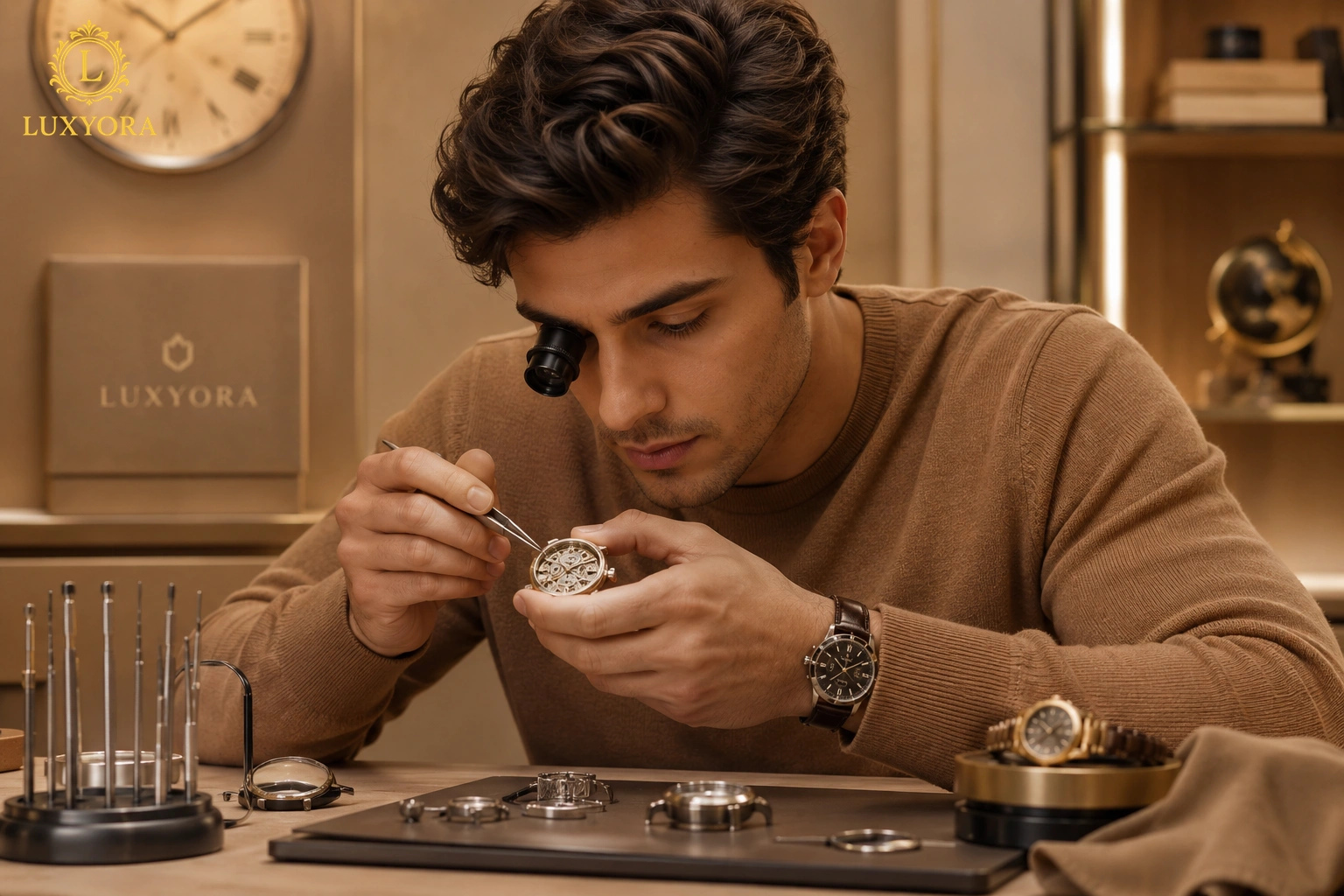
Mechanical watchmaking is an artistry you can wear without having to explain it. The beauty isn’t just on the dial; it’s in the invisible choreography underneath parts polished, bevelled, assembled, and tuned with obsessive patience. Even if you never open the caseback, you feel the intent.
That’s what makes a mechanical watch feel intimate. It’s luxury with a pulse.
In a World of Algorithms, It’s a Human Object
AI is increasingly predictive: it recommends what you should watch, where you should eat, and what you might buy next. The modern consumer is constantly being “understood,” which sounds flattering until you realize it’s also a little exhausting.
A mechanical watch doesn’t try to understand you. It doesn’t measure you. It doesn’t nudge you toward self-improvement with pastel charts. It simply marks time steadily, calmly, like a beautifully dressed friend who never overshares.
That simplicity is not a downgrade; it’s a luxury. A mechanical watch is one of the few personal items left that can be purely emotional. You choose it because you love it. Not because it’s the most efficient.
Status, Yes, but Also Story
Luxury has always been part social signal, part personal ritual. Mechanical watches do both exceptionally well.
On the outside: they’re symbols of taste, success, discernment. On the inside: they’re memory vaults. The watch you wore when you got the job. The one you bought after a heartbreak was a private promise to yourself. The one your father wore, still carrying the warmth of his habits.
This is why mechanical watches remain culturally powerful even when smartwatches dominate utility. A smartwatch is often “current.” A mechanical watch is often yours.
The industry data also suggests that, even amid shifting markets, traditional watchmaking continues to command attention, especially at the higher end, where heritage, scarcity, and craftsmanship carry real weight.
If mechanical watches continue to hold attention in a world built around speed, automation, and constant updates, the next question becomes impossible to ignore: what exactly are people choosing when both worlds exist on the same wrist? Explore Mechanical Watches vs Smart Watches.
The Pleasure of Slowness
AI is fast. Brutally fast. It’s a world of instant answers, accelerated decisions, same-day delivery, and “optimize your morning routine” content that makes breakfast feel like a performance review.
A mechanical watch is slow by design. Not inaccurate, just gloriously unhurried in spirit.
Think of the ritual: setting the time, winding the crown, feeling the mechanism engage. It’s a tiny daily ceremony that says, “I’m not just rushing through time. I’m aware of it.”
And that awareness is becoming a modern form of sophistication. In a world that sells speed, choosing something deliberately slower is its own kind of power.
Sustainability in the Most Elegant Way
There’s a growing shift in luxury away from pure novelty and toward longevity: buy less, buy better, keep forever. Mechanical watches fit that evolution beautifully.
A quality mechanical watch can be serviced for decades. It can be repaired, restored, cherished, and passed on. Even the best consumer tech isn’t built with that kind of lifespan in mind.
And there’s something quietly radical about owning a luxury object that doesn’t become obsolete because a new model was launched in September.
The AI Era Makes “Analog” More Desirable, Not Less
Here’s the twist: the more AI expands, the more we crave objects that feel human.
We want proof of touch, proof of time invested, proof that something wasn’t conjured in seconds from a prompt. Mechanical watches are the antidote to digital sameness. They’re precise without being clinical, luxurious without being loud, and personal without being performative.
They matter because they remind us that time isn’t just data. Time is life, messy, beautiful, finite. And marking it with a mechanical heartbeat on your wrist feels, somehow, more honest.
The appeal of mechanical watches isn’t explained by technology alone. Somewhere between ritual, memory, and permanence lies a reason many people still choose something designed to last rather than update. Discover The Emotional Value of Watches in a Disposable Tech World.
Luxyora Philosophy: Luxury isn’t about having the newest thing; it’s about choosing what deserves to stay. A mechanical watch matters because it turns time from a number into a story you can wear.
References:
- Deloitte. (2023). The Deloitte Swiss Watch Industry Study 2023: A calibre of its own. Deloitte Switzerland.
- Federation of the Swiss Watch Industry FH. (2025). World watchmaking industry in 2024. FH.
- Federation of the Swiss Watch Industry FH. (2025, January 30). Swiss watch exports in 2024. FH.
- Stone, G., & Sisson, J. (2018). The watch, thoroughly revised: The art and craft of watchmaking (Rev. ed.). Abrams.
- Struthers, R. (2023). Hands of time: A watchmaker’s history of time. Hodder & Stoughton.