What the Clothes You Wear Quietly Say About You | Luxyora
You can insist you “just threw something on,” but your clothes are rarely just an outfit. Clothing is one of the most efficient communication tools you own: it travels ahead of you, speaks for you in rooms you haven’t entered yet, and lingers in someone’s memory long after you’ve left. Even when you’re dressing purely for comfort, you’re still making a choice that signals something about your day, your mood, your values, your tribe, and the version of yourself you’re hoping will show up.
Psychologists who study person perception increasingly argue that dress should be treated as a foundational input alongside face, body, and context, because people reliably use clothing to make social inferences.
Translation? Your wardrobe is not background décor. It’s part of the plot.
So what exactly do your clothes quietly say about you? Let’s decode the whispers.
1) “I belong here” (or: I’m not trying to belong at all)
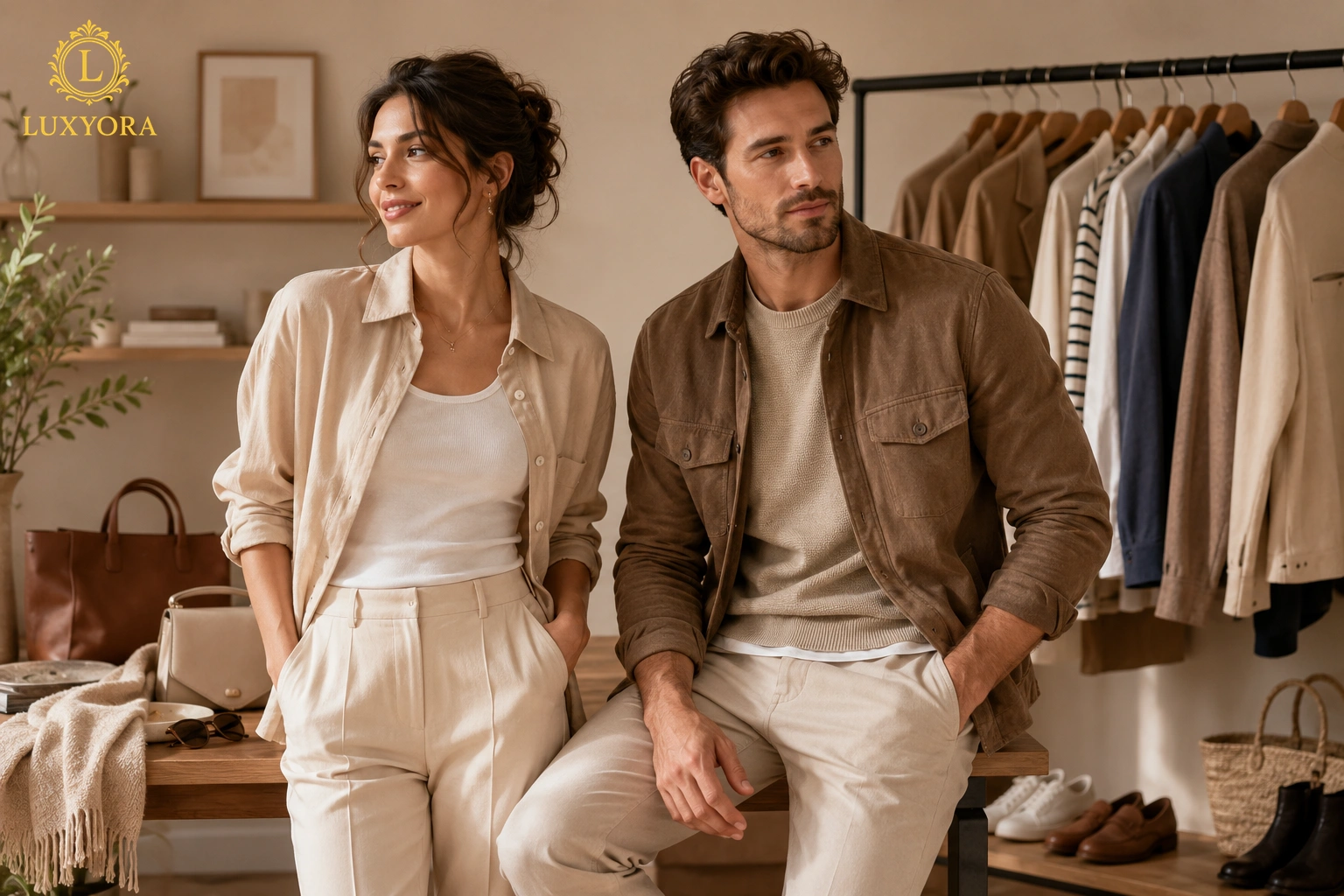
Fashion is a social handshake. The blazer at a gallery opening, the linen set at a beach club, the sneakers at a creative studio: these aren’t just style choices, they’re “I understand the vibe” messages. And when you dress slightly against the setting, that’s communication too. Sometimes it’s confidence. Sometimes it’s a protest. Sometimes it’s simply, “I’m new here.”
Research synthesising dress and person perception indicates that clothing often guides judgments of social categories and group membership. People use dress to infer who you are, who you’re with, and where you fit. Even when those inferences are flawed (often!), they’re common, which is why many of us instinctively “calibrate” our outfits for social safety: not too loud, not too off-script, not too easily misread.
Sometimes confidence isn’t loud, it’s simply the feeling of walking into a room as if you already belong there. And sometimes, clothing is what creates that feeling first. Discover How apparel influences confidence before a word is spoken.
2) “I’m in charge” (or: I’d rather not be perceived today)
And the “why” isn’t purely cultural; there’s evidence that what we wear can influence how we think and feel, because clothing carries symbolic meaning that the brain responds to.
The outfit becomes a cue: Today, we’re focused. Today, we’re untouchable. Today, we’re brave.
3) “Here’s my mood, please read it gently”
Clothing is emotional shorthand. You don’t need to announce “I’m having a fragile day” when you’re wrapped in soft neutrals and knit textures that practically whisper “handle with care.” Likewise, a bright colour moment can be joy or a deliberate attempt at joy.
In the framework proposed by person-perception researchers, people use dress to infer cognitive and emotional states, whether someone seems attentive, relaxed, stressed, or celebratory. It’s not that the outfit proves anything, but it nudges perception. And we often dress with that in mind, consciously or not.
Think of the outfit you wear when you need to feel like yourself again. That’s not vanity. That’s self-regulation.
There are days when clothing feels less like a choice and more like a mood translated into movement. Curious why certain looks change not just how you appear, but how you move through the world? Read more about How apparel shapes the way you carry yourself.
4) “I value craft” (or: I value speed)
Your clothes also telegraph your relationship with time and taste. A beautifully made coat says you notice details. A perfectly worn-in leather bag hints that you’re loyal to your things. A fast-fashion outfit might say you love trend velocity, or you’re dressing pragmatically, or you’re in a life season where convenience is the point.
Carolyn Mair’s work in fashion psychology highlights how fashion choices connect to motivations, identity, and emotion, meaning your style can express not only aesthetic preference, but personal priorities and needs. Sometimes you’re dressing for artistry. Sometimes you’re dressing for survival. Both are real.
5) “I’m playing a role, and I’m good at it”
Uniforms aren’t just for hospitals and airlines. We all have them: the “first date” uniform, the “big meeting” uniform, the “Sunday reset” uniform. These are curated identities you can step into quickly.
There’s a reason professional clothing has such a psychological grip. Research on uniforms and “enclothed cognition” explores how garments can shape self-perception and behaviour through the meanings we attach to them. Even outside formal uniforms, the same mechanism can apply: if you believe a certain outfit makes you sharper, calmer, more charismatic, your body often follows the script.
Recent work continues to explore these effects in contexts like military dress and formality, reinforcing the idea that symbolic clothing can alter cognition and behaviour in measurable ways. Yes: your outfit can be a mental setting.
6) “I’m telling the truth about myself” (or: I’m practicing who I want to become)
Some people dress like they’re curating an exhibit. Others dress like they’re building a home. Either way, clothing can function as identity practice: not only reflecting who you are, but rehearsing who you’re becoming.
This is why style evolutions feel personal. Changing your wardrobe can feel like changing your narrative. You’re not just swapping jeans, you’re adjusting your self-concept. And you don’t need a dramatic makeover montage to do it. Sometimes it’s as simple as choosing a silhouette that matches your current inner climate.
Sometimes the role we wear becomes so convincing, we stop noticing where performance ends and identity begins. The clothes may not just complete the character they may be shaping it. Discover Why clothing becomes part of identity.
A quiet, stylish reality check
Here’s the most truth of all: clothing speaks but it doesn’t tell the whole story. People will always interpret your outfit through their own biases, experiences, and cultural filters. (That’s why the same look reads “minimalist” to one person and “cold” to another.) Still, the power of dressing well isn’t about controlling every interpretation. It’s about choosing what you want to express most and letting your clothes support you while you live the rest.
Because in the end, style is not just an aesthetic it’s a social language, an emotional tool, and a daily way of meeting the world on your terms.
Luxyora Philosophy: Dress like your inner life matters, because it does. When clothing aligns with your values, your presence becomes effortless.
References:
- Adam, H. (2019). Reflections on enclothed cognition: Commentary on Burns et al. Journal of Experimental Social Psychology, 85, 103883.(ScienceDirect)
- Crutzen, C., van der Linden, M., & colleagues. (2022). “What if it’s not just an item of clothing?” A narrative review integrating the white coat effect and enclothed cognition. Psychologica Belgica, 62(1), 1–20. (Psychologica Belgica)
- Hester, N., & Hehman, E. (2023). Dress is a fundamental component of person perception. Perspectives on Psychological Science. (PubMed)
- Mair, C. (2018). The psychology of fashion. Routledge. (Routledge)
- Pech, G. P., & colleagues. (2023). Does the cowl make the monk? The effect of military and formal clothing on cognition and behavior. Frontiers in Psychology. (Frontiers)