A Beginner’s Guide to Decanting Perfume Safely and Elegantly | Luxyora
Decanting perfume is one of those quietly glamorous habits that makes you feel like you have your life together – as you travel with a silk scarf, not a crumpled boarding pass. But beyond the chic factor, decanting is genuinely practical: it lets you take your favourite fragrance on the go, sample a scent before committing to a full bottle, share with friends, and protect a precious perfume from unnecessary air exposure.
The key is doing it safely (because alcohol-based fragrances are flammable and easily contaminated) and elegantly (because nobody wants to spill a pricey scent into a sock drawer). Here’s how to decant perfume with confidence, minimal mess, and maximum polish.
What “Decanting Perfume” Actually Means
Perfume decanting is simply transferring fragrance from its original bottle into a smaller container – usually a travel atomiser, sample vial, or mini spray bottle. It sounds straightforward, but fragrance is sensitive: oxygen, heat, and light can degrade aromatic molecules over time, changing how a perfume smells and performs. That’s why decanting isn’t just a transfer – it’s a tiny moment of fragrance stewardship. (And yes, it can feel a little ceremonial.)
Before You Start: Choose the Right Tools
A smooth decant begins with the right kit. Think: clean, compatible, and made for perfume.
Essentials
- Glass travel atomiser or glass spray bottle (preferably tinted/opaque to reduce light exposure). Glass is generally more chemically inert than many plastics, which can be a concern with aromatic materials and alcohol over time.
- Perfume syringe or pipette (for clean transfer and controlled measurements).
- Mini funnel (useful, but a syringe is usually neater).
- Isopropyl alcohol wipes (for sanitising surfaces and the outside of tools).
- Labels (the most underrated luxury: name, concentration, date decanted).
Optional but fabulous
- A small tray to catch drips
- Nitrile gloves if you’re decanting multiple scents (less cross-contamination)
The Golden Rules: Cleanliness, Compatibility, and Calm
Most decanting disasters come down to one of three things: contamination, incompatible packaging, or rushing.
1. Cleanliness matters more than you think
Even if you’re decanting “just for you,” clean tools help preserve the scent’s integrity and prevent accidental mixing of residues. Hygiene and controlled handling are also central principles in cosmetic good manufacturing practice guidelines (even though you’re doing this at home, the logic still applies).
2. Packaging compatibility is real
Fragrance is typically ethanol-based, with aromatic compounds that can interact with some plastics over time. For longer storage, glass is the safer, more stable choice.
3. Keep away from heat and ignition source
Perfume is alcohol-based, which means it’s flammable. Decant on a cool surface, away from candles, lighters, stoves, or hair tools. Safety data sheets for ethanol emphasise keeping it away from heat, sparks, and open flames.
Step-by-Step: How to Decant Perfume (Two Easy Methods)
Method 1: Syringe/Pipette (Most Controlled, Most Elegant)
- Sanitise your tools and let them air dry.
- Remove the perfume cap. If the spray top comes off, great; if not, you can still decant by spraying into a funnel (less ideal).
- Draw perfume into the syringe slowly to avoid bubbles.
- Dispense into your glass atomiser by placing the syringe tip inside the bottle opening.
- Close immediately to minimise air exposure.
- Label the decant: perfume name, concentration (EDP/EDT if you know it), and date.
Why it works: It’s precise, spill-resistant, and minimises the perfume’s contact with air.
Method 2: Funnel (Simple, But Handle With Care)
- Sanitise the funnel and the bottle.
- Use a very small funnel (perfume openings are narrow).
- Pour slowly with the bottle tilted close to the funnel to reduce splashing.
- Cap and label immediately.
This method looks effortless when done well – but it’s also the one most likely to end in “why does my desk smell like bergamot forever?”
Do’s and Don’ts of Decanting Perfume
A decant should feel like a refined ritual, not a chemistry lab incident.
Do:
- Do choose glass for anything you plan to keep longer than a few weeks.
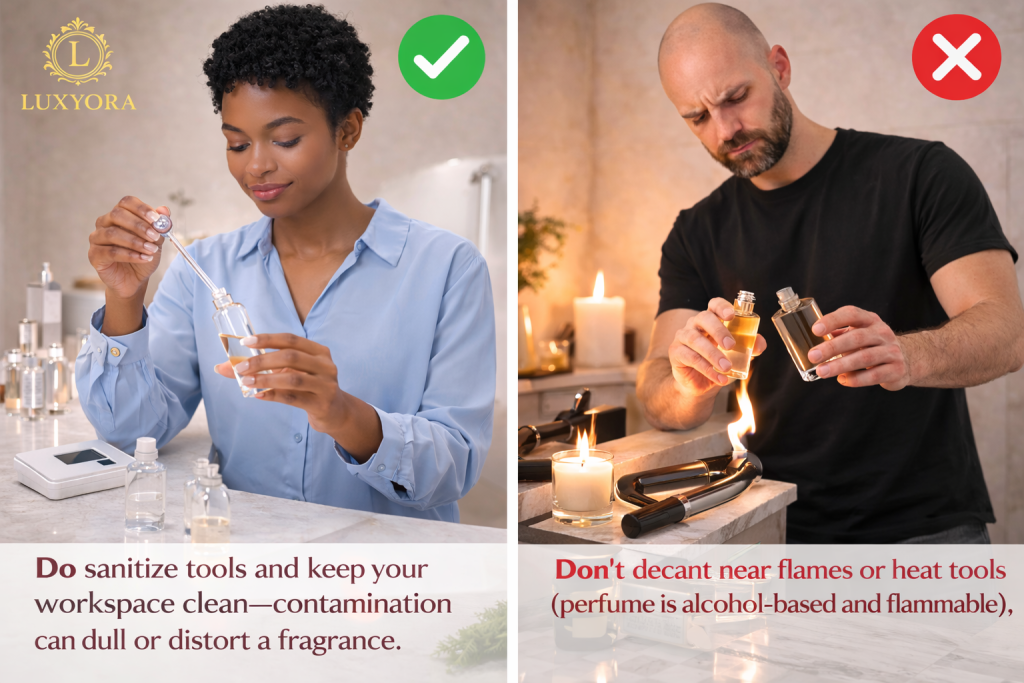
- Do sanitise tools and keep your workspace clean – contamination can dull or distort a fragrance.
- Do decant in a cool, shaded space; heat and light accelerate degradation.
- Do label everything, including the date – future you will be grateful.
- Do keep the container tightly closed between steps to reduce evaporation and oxidation.
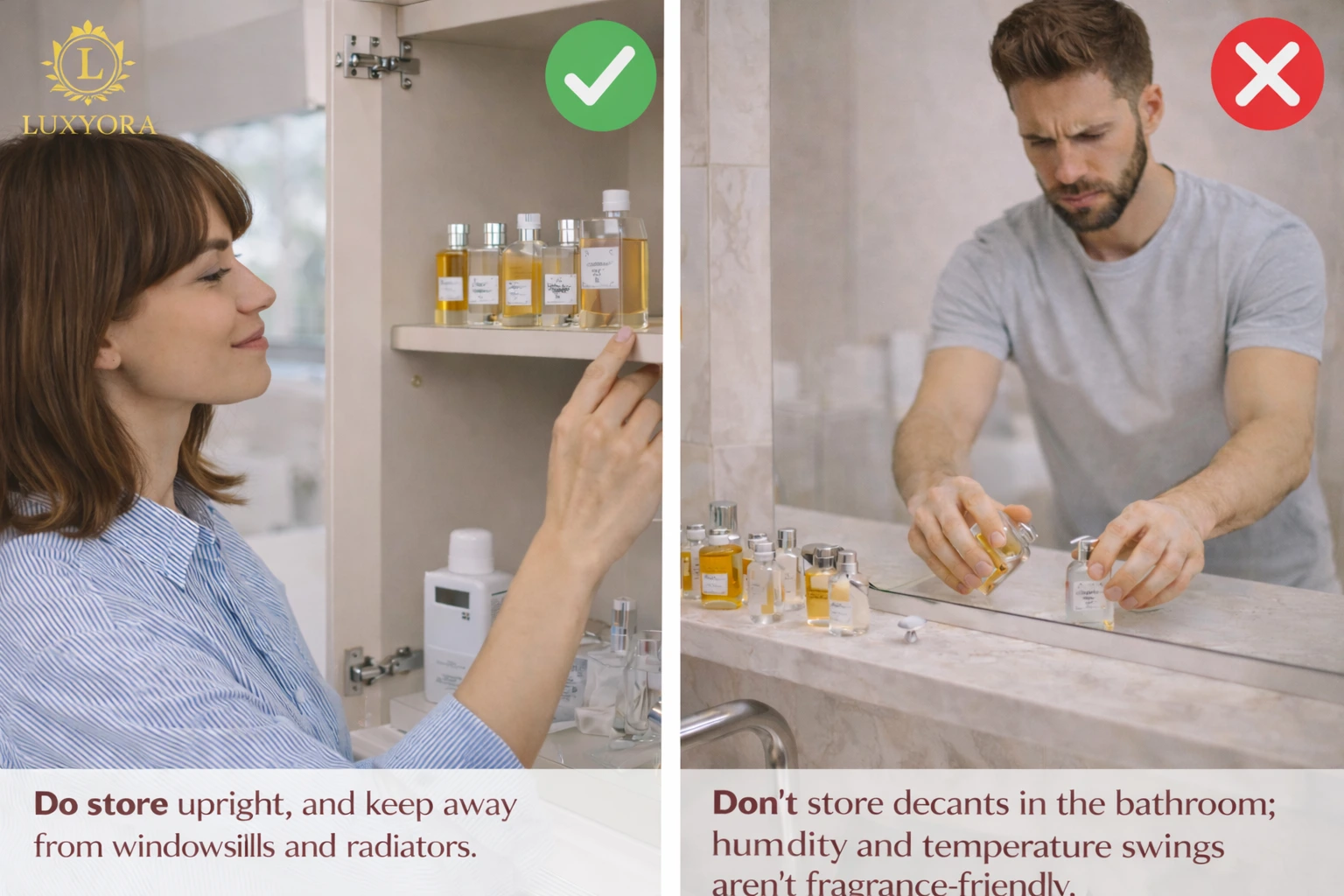
- Do store upright, and keep away from windowsills and radiators.
Don’t:
- Don’t decant near flames or heat tools (perfume is alcohol-based and flammable).
- Don’t reuse old spray mechanisms if you can avoid it – tiny residues are hard to remove fully, and that “mystery note” is rarely a good one.
- Don’t leave the original bottle open while you fuss with the decant – air exposure adds up.
- Don’t store decants in the bathroom; humidity and temperature swings aren’t fragrance-friendly.
- Don’t overfill – leave a little headspace so the atomiser works properly and the cap seals cleanly.
How to Store Decants So They Smell as Good as Day One
Decants are more vulnerable than full bottles because they often have thinner glass, smaller seals, and more frequent handling. Your best approach is boring in the most luxurious way: cool, dark, stable. Experts commonly point to heat, light, and oxygen as the biggest accelerants of perfume ageing once opened.
If you’re decantingfor travel, keep the atomiser in a pouch, avoid leaving it in a hot car, and don’t toss it loose in a bag where the cap can loosen.
A carefully decanted fragrance deserves more than a beautiful atomizer. Heat, light, and even where you keep your bottle can influence the scent in ways that many fragrance lovers never consider. Explore A Complete Guide to Storing Perfume – the Right Way.
The Elegant Touch: Make It Feel Like a Signature Ritual
If you want decanting to feel elevated (not purely functional), try this:
- Use uniform bottles with a minimal label style.
- Keep a small “scent wardrobe” of 5-10 decants: daytime clean, nighttime warm, one bold wildcard.
- Write one line on the label about the mood: clean linen, espresso martini, first date energy.
Because fragrance is never just scent, it’s identity, memory, and atmosphere in liquid form.
Luxyora Philosophy: Elegance is care in small things: a steady hand, a clean bottle, a scent preserved exactly as it was meant to be. Decant with intention, and your fragrance will meet you beautifully every time.
References
- Department for Business and Trade. (2021, October 4). Making cosmetic products available to consumers in Great Britain. GOV.UK. https://www.gov.uk/guidance/making-cosmetic-products-available-to-consumers-in-great-britain
- International Fragrance Association. (n.d.). Using the IFRA Standards. IFRA. https://ifrafragrance.org/using-the-standards
- Registrar Corp. (2024, June 5). ISO 22716: A guide to GMP cosmetics. https://www.registrarcorp.com/blog/cosmetics/iso-22716/gmp-for-cosmetics/
- International Organization for Standardization. (2007). ISO 22716:2007 Cosmetics – Good Manufacturing Practices (GMP) – Guidelines on Good Manufacturing Practices (PDF). https://www.bpu.cc/Uploads/ueditor/file/20190905/5d70675bd9904.pdf
- National Oceanic and Atmospheric Administration. (n.d.). Perfumery products, with flammable solvents (CAMEO Chemicals). https://cameochemicals.noaa.gov/chemical/17461
- Carl Roth GmbH + Co. KG. (2024). Safety data sheet: Ethanol (PDF).
- Real Simple. (2020, August 7). Yes, you should store your perfume cold – here’s why. https://www.realsimple.com/beauty-fashion/makeup/fragrance/how-to-store-perfume
- InStyle. (2020, September 11). How to know when your perfume has expired, according to fragrance experts. https://www.instyle.com/does-perfume-expire-5380451
- The Cary Company. (2022). Why store essential oils in glass? https://www.thecarycompany.com/insights/articles/why-store-essential-oils-in-glass
- O.Berk Company. (n.d.). Should I put essential oils in glass or plastic bottles? https://www.oberk.com/packaging-crash-course/quick-question-monday-should-i-put-essential-oils-in-glass-or-plastic