Watch Movements Explained: Quartz vs Automatic vs Mechanical | Luxyora
A watch movement is the invisible heartbeat behind the dial, and the reason a second hand glides, ticks, or sweeps with that hypnotic confidence. And while three watches can look equally gorgeous from across the room, their movements can make them feel like completely different experiences on your wrist: one is effortless and precise, another is romantic and alive, and the third is pure, old-school ritual.
If you’ve ever wondered why some watches need batteries, why others “wake up” when you wear them, or why certain collectors melt at the phrase manual-wind, let’s decode the big three in plain, stylish language: quartz, automatic, and mechanical.
First, a quick truth: “Automatic” is mechanical
This is the part that trips people up. Mechanical watches are powered by a mainspring and regulated by gears, an escapement, and a balance wheel with no battery involved. Mechanical watches come in two types :
- Manual-wind mechanical (you wind it by hand)
- Automatic mechanical (it winds itself as you move)
So when someone says “automatic vs mechanical,” what they usually mean is automatic vs manual-wind; both are mechanical at heart.
Now, let’s get into personalities.
Quartz: The Clean, Confident Minimalist
Quartz is the movement for people who want their watch to feel like modern luxury: sleek, accurate, and refreshingly uncomplicated.
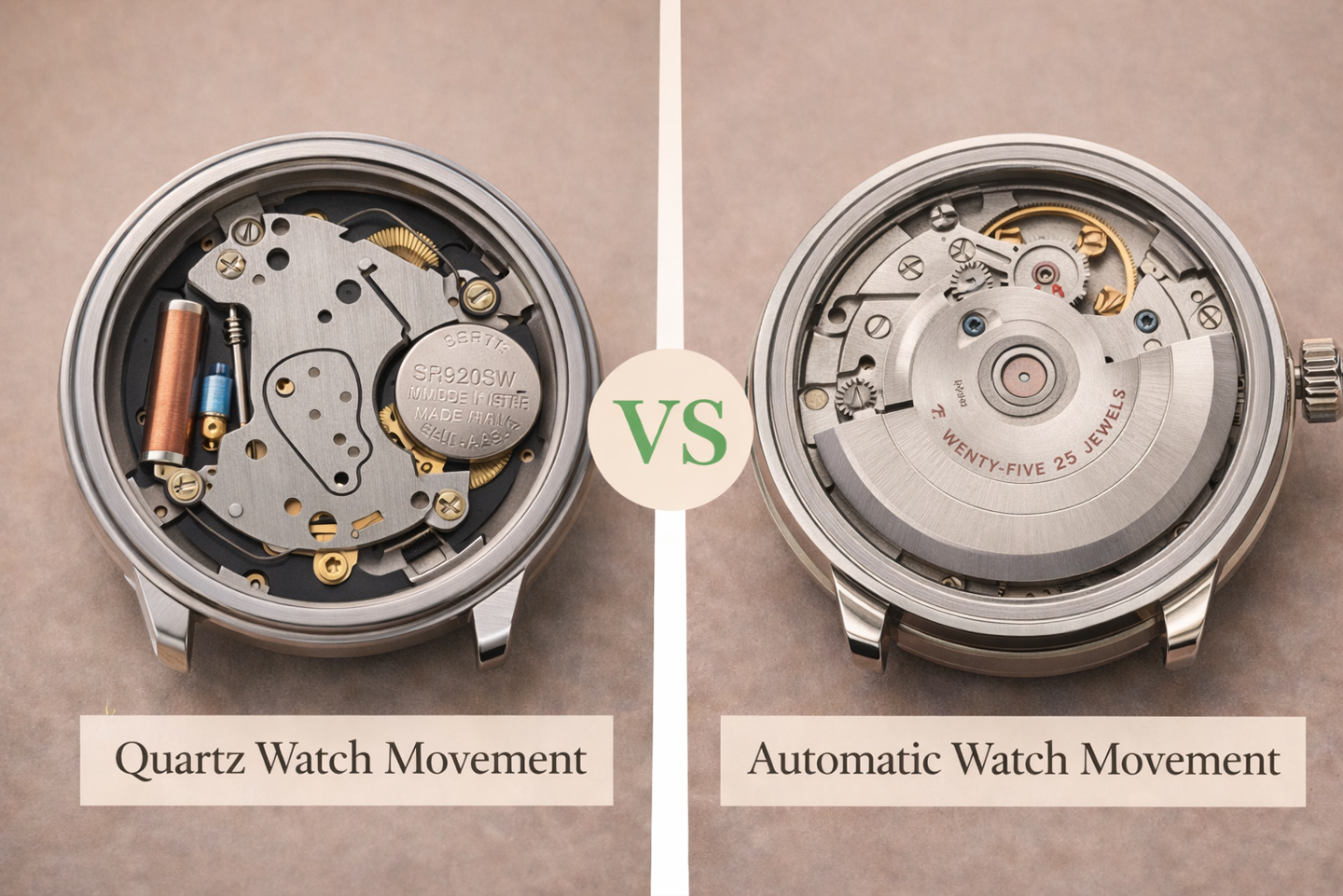
A quartz watch runs on a battery that sends electricity through a tiny quartz crystal. The crystal vibrates at a highly stable frequency, and the circuit converts those vibrations into steady timekeeping, typically advancing the hands with consistent precision.
Why quartz is so loved
- Accuracy: Quartz is famously precise for everyday life, with many standard quartz movements drifting only seconds per month rather than seconds per day.
- Low maintenance: No winding routines.
- Slim profiles: Quartz movements can be thinner, which often means a more refined fit under cuffs.
- A quiet kind of luxury: Quartz doesn’t scream for attention. It simply performs.
The trade-off: Quartz can feel less “romantic” to traditionalists because it’s electronic rather than purely mechanical. And yes, batteries eventually need replacing. But in a world where your schedule is already full, Quartz can be the most elegant choice, because it respects your time.
Automatic: The Social Butterfly with Old-Soul Charm
Automatic watches are the movement equivalent of that perfectly tailored blazer you can throw over anything and instantly look polished. They’re mechanical, but with a built-in convenience: they harness your motion to keep running.
Inside an automatic watch is a weighted rotor that swings as you move your wrist. That motion winds the mainspring little by little, storing energy to keep the watch ticking.
Why automatic feels special
- Craftsmanship you can feel: Wearing an automatic is like carrying a tiny engine of tradition on your wrist.
- No daily winding required: Wear it regularly, and it typically stays powered.
- Collector energy: Automatics are often seen as the gateway into mechanical appreciation, because you get the soul without the full “ritual.”
The trade-off: Automatic watches usually aren’t as accurate as quartz in everyday conditions, and they may need resetting if you leave them off for long enough to run out of power reserve. They also require periodic servicing (think of it like maintenance for a beautiful machine).
If quartz is “sleek and immediate,” automatic is “alive and expressive.”
Mechanical (Manual-Wind): The Purist’s Love Letter
Manual-wind mechanical watches are where the relationship gets intimate. You wind the crown by hand to tighten the mainspring, and that stored energy is released through the gear train, regulated by the balance wheel and escapement. It’s engineering, made poetic.
This is the movement for people who enjoy the ritual: the few seconds of winding in the morning, the tactile connection, the feeling that time is something you participate in, not just measure.
Why manual-wind is irresistible
- A daily ritual: Like making espresso the slow way.
- Often slimmer than automatic: Without the rotor, many manual-wind watches can be beautifully thin.
- Classic heritage: Manual-wind is the oldest “true watch” experience. And it still feels quietly luxurious.
The trade-off: You must remember to wind it. If you don’t, it stops. That’s not a flaw, it’s the point. Manual-wind watches don’t chase convenience. They celebrate intention.
The Big Comparison: Which Movement Fits You?
Accuracy
- Quartz typically wins for “set it and forget it” precision.
- Automatic & manual mechanical can be very accurate, especially with certified testing, but they’re more affected by position, temperature, and real-world wear.
Maintenance and ownership
- Quartz: occasional battery replacement; generally straightforward.
- Mechanical (automatic/manual): periodic servicing to keep lubrication, seals, and components performing their best.
Feel on the wrist
- Quartz: steady, precise, often lighter and thinner.
- Automatic: dynamic, with a living mechanism and sometimes a smoother seconds hand motion.
- Manual-wind: intimate and traditional – luxury as a habit.
Price and value
Price is not only about movement type, but generally:
- Quartz often offers excellent value for money.
- Mechanical watches tend to cost more due to complexity and craftsmanship.
- Some of the most prestigious watches in the world are mechanical because heritage is part of the allure.
So… which one should you choose?
Choose quartz if you value sleek, practical design, frequent rotation between watches, and reliable precision with minimal fuss.
Choose automatic if you want craftsmanship with convenience, something you can wear often and feel connected to without daily winding.
Choose manual-wind mechanical if you’re drawn to tradition, ritual, and the quiet satisfaction of owning something that asks for a little attention, then gives you beauty in return.
Because in the end, the “best” movement isn’t about superiority. It’s about lifestyle and identity. A watch should fit your life the way tailoring fits your body: comfortably, intentionally, and with just enough drama to feel unforgettable.
Luxyora Philosophy: Luxury isn’t choosing the most complicated movement; it’s choosing the one that matches how you live. When your watch feels natural on your wrist, time no longer feels like pressure but rather presence.
References:
- Braun, P., & Radkai, M. (2022). Wristwatch Annual 2022: The catalog of producers, prices, models, and specifications. Abbeville Press.
- Contrôle Officiel Suisse des Chronomètres (COSC). (n.d.). Certified chronometer. Retrieved December 31, 2025.
- Epson. (n.d.). Technology developed for the world’s first quartz watch. Seiko Epson Corporation. Retrieved December 31, 2025.
- International Organization for Standardization. (2010). ISO 22810:2010—Horology—Water-resistant watches (Reviewed and confirmed 2021). ISO. Retrieved December 31, 2025.
- Longines. (n.d.). What is an automatic watch? Retrieved December 31, 2025.
- Financial Times. (2025, September 5). Swiss watch certifier unveils stricter ‘Super-COSC’ standard. Financial Times. Retrieved December 31, 2025.