How a Simple Sketch Becomes a Luxury Jewel | Luxyora
A luxury jewel rarely begins with a red-carpet moment. It begins with something far quieter: a pencil line, a smudge of graphite, a curve that’s almost right, and the designer’s stubborn belief that “almost” can be refined into extraordinary.
If you’ve ever looked at a finished necklace and thought, How did this become… this? Welcome. The journey from sketch to jewel is a blend of artistry, engineering, old-world craft, and modern tech. It’s also a story of patience: the kind of patience that turns a two-minute doodle into a piece that might outlive everyone in the room.
Here’s how it really happens.
1) The idea arrives, but the brief makes it real
Before a single stone is chosen, the design needs a reason to exist. Sometimes it’s a collection concept: “modern heirlooms,” “architectural romance,” “night-sky sparkle.” Sometimes it’s personal: a commission for an anniversary, a family stone being reset, a piece meant to feel powerful but not loud.
This is where luxury begins: not with excess, but with intention. A designer will define the mood, the silhouette, the wearer’s lifestyle, and the non-negotiables: comfort, durability, size, budget, or even “I want it to catch candlelight, not scream under daylight.”
2) The sketch: where emotion meets proportion
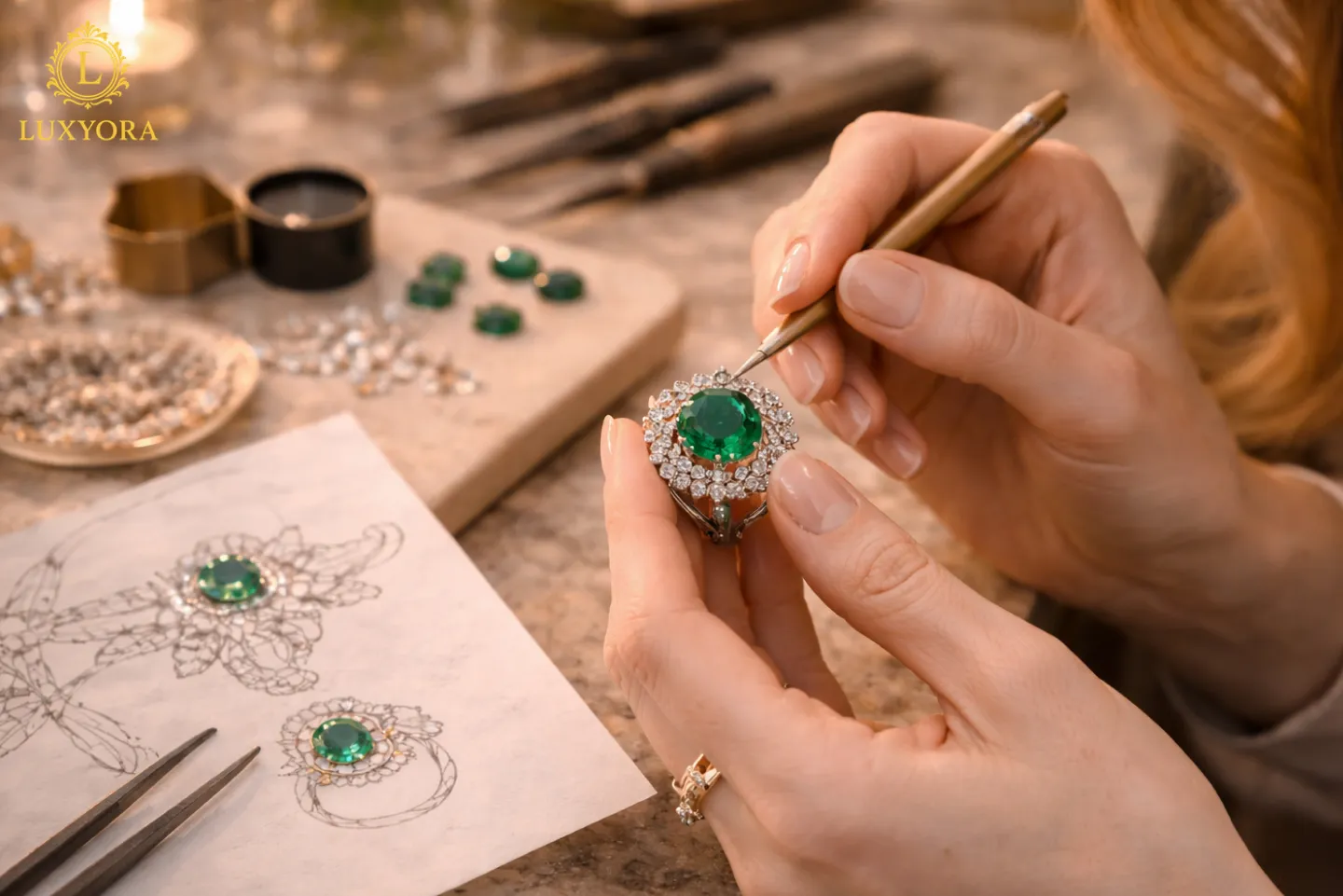
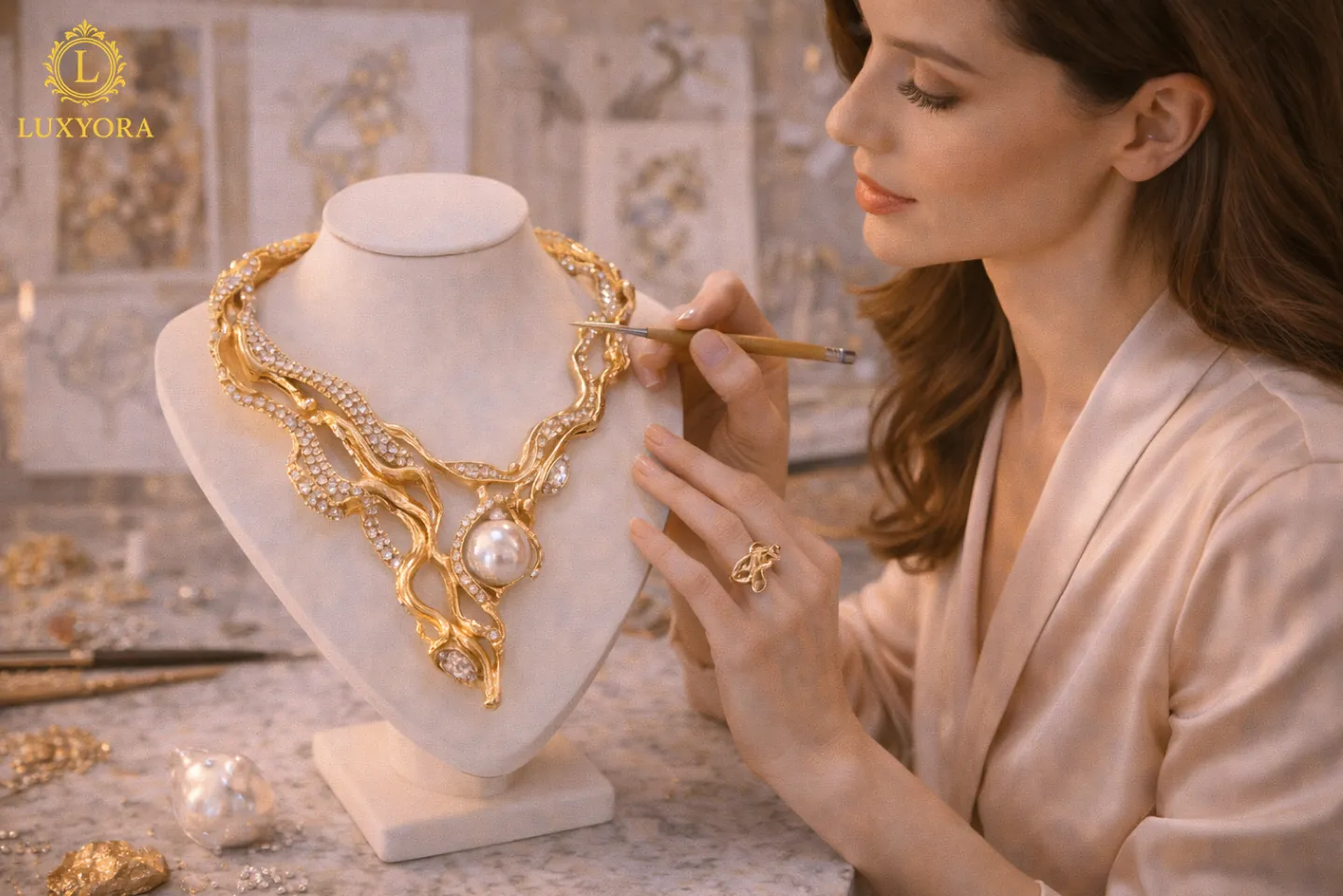
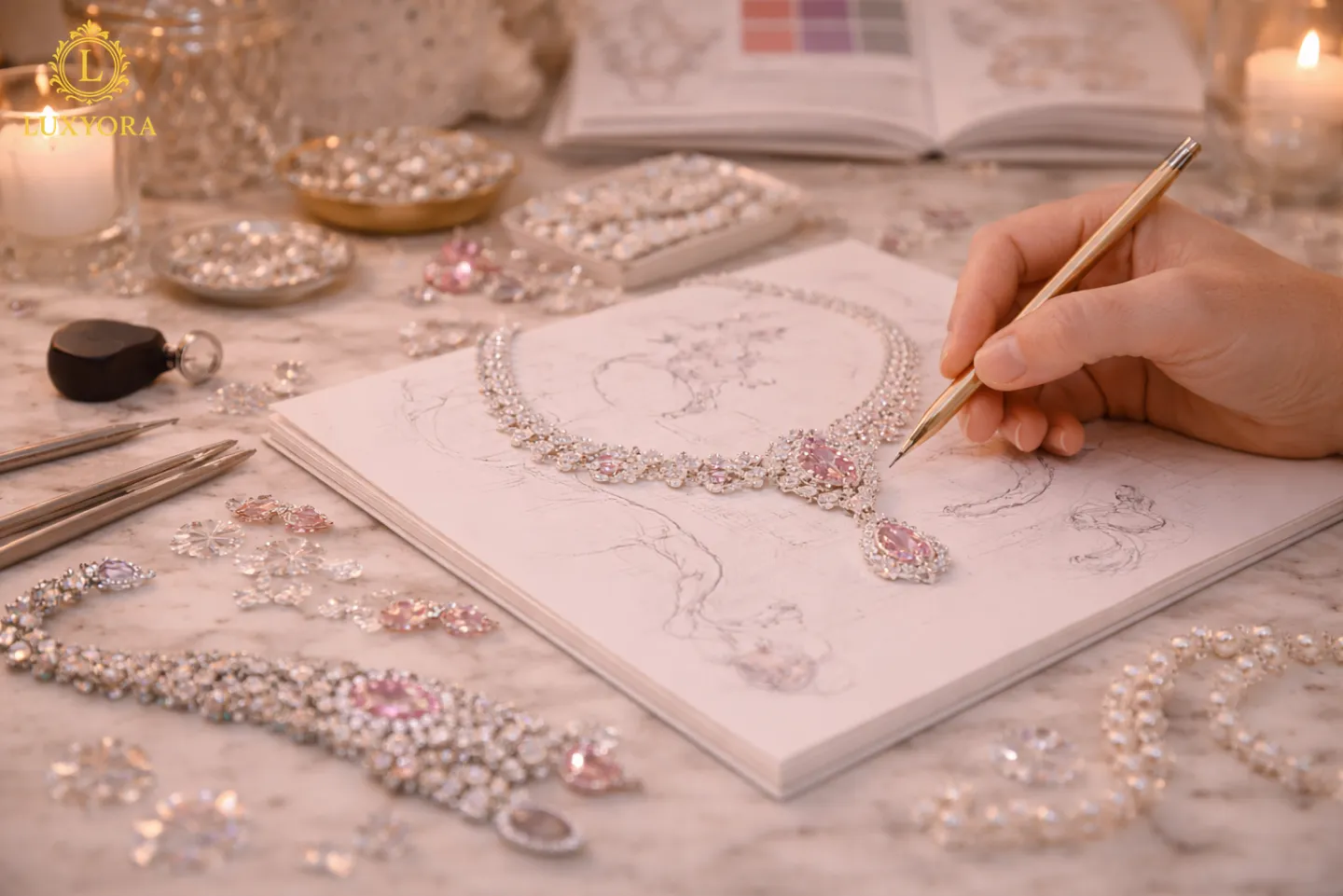
The sketch is the first translation of feeling into form. At this stage, it’s not about technical perfection; it’s about capturing the attitude of the piece.
Designers play with scale (how it sits on the body), negative space (what you don’t fill is just as chic), and focal points (where the eye should land first). Many sketches include quick notes: “more tapered here,” “lighter chain,” “stone needs breathing room,” “clasp must be beautiful.”
Then the sketch evolves: front view, side view, clasp detail, stone placement. Luxury design is rarely one drawing. It’s a conversation between the designer’s eye and the future wearer’s reality.
3) Stones and materials: casting the lead role
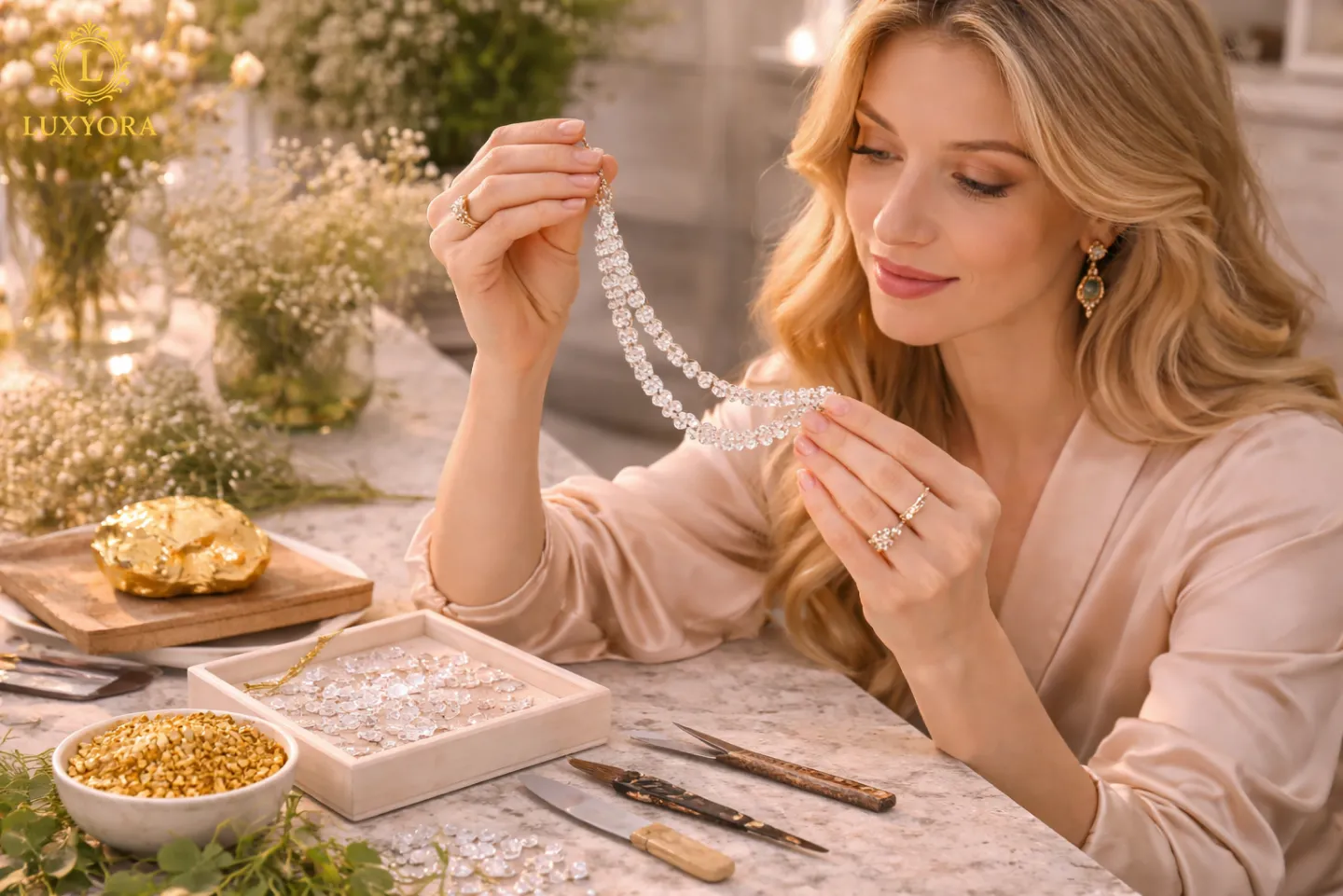
In luxury jewellery, gemstones aren’t just ingredients, they’re characters. Choosing them involves color, cut, clarity, carat, and personality. A slightly warm diamond can feel romantic; an icy one can feel modern. A pink sapphire can whisper. A spinel can flirt. Emeralds can be dramatically high maintenance, but worth it.
Materials are selected with similar care: yellow gold for warmth, white gold or platinum for crisp brilliance, rose gold for softness. Designers also consider how metal interacts with stones, how it wears over time, and which finish (mirror polish, satin, brushed) will make the design feel current yet enduring.
4) From paper to precision: CAD and model-making
Once the design is approved, it often moves into CAD (computer-aided design). This is where glamour meets geometry. CAD allows a designer to refine proportions, check symmetry, and confirm practical details like stone seats, prong thickness, and how a clasp will lock.
For clients, CAD renders can be a revelation: you can “see” the piece before it exists, clean, dimensional, and almost touchable. For artisans, CAD becomes a shared language, translating artistic intent into measurable reality.
Then comes model-making, typically through wax carving or 3D printing in wax/resin. This model is the prototype of the dress rehearsal before the main event.
5) The ancient magic: lost-wax casting
If jewellery had a signature ritual, this would be it. In lost-wax casting, the wax model is attached to a sprue system, encased in investment, and heated so that the wax melts away, leaving a perfect cavity. Molten metal is then cast into that space, capturing every tiny detail.
It sounds straightforward, but it’s a high-stakes moment. Temperature, metal behavior, shrinkage, and finishing allowances all matter. Luxury houses built in expertise here because casting isn’t just about “making it exist,” it’s about making it exist well.
6) Pre-finishing: where the piece learns its manners
After casting, the piece is cleaned, the sprues are removed, and the metal is refined. Surfaces are filed, edges softened, proportions corrected. The jewel at this stage often looks slightly raw, like a sculpture before it’s polished.
This is also where comfort is engineered: making sure a ring doesn’t pinch, earrings aren’t too heavy, and a necklace sits naturally rather than “floating” awkwardly. Luxury feels effortless because someone worked very hard to remove friction from the experience.
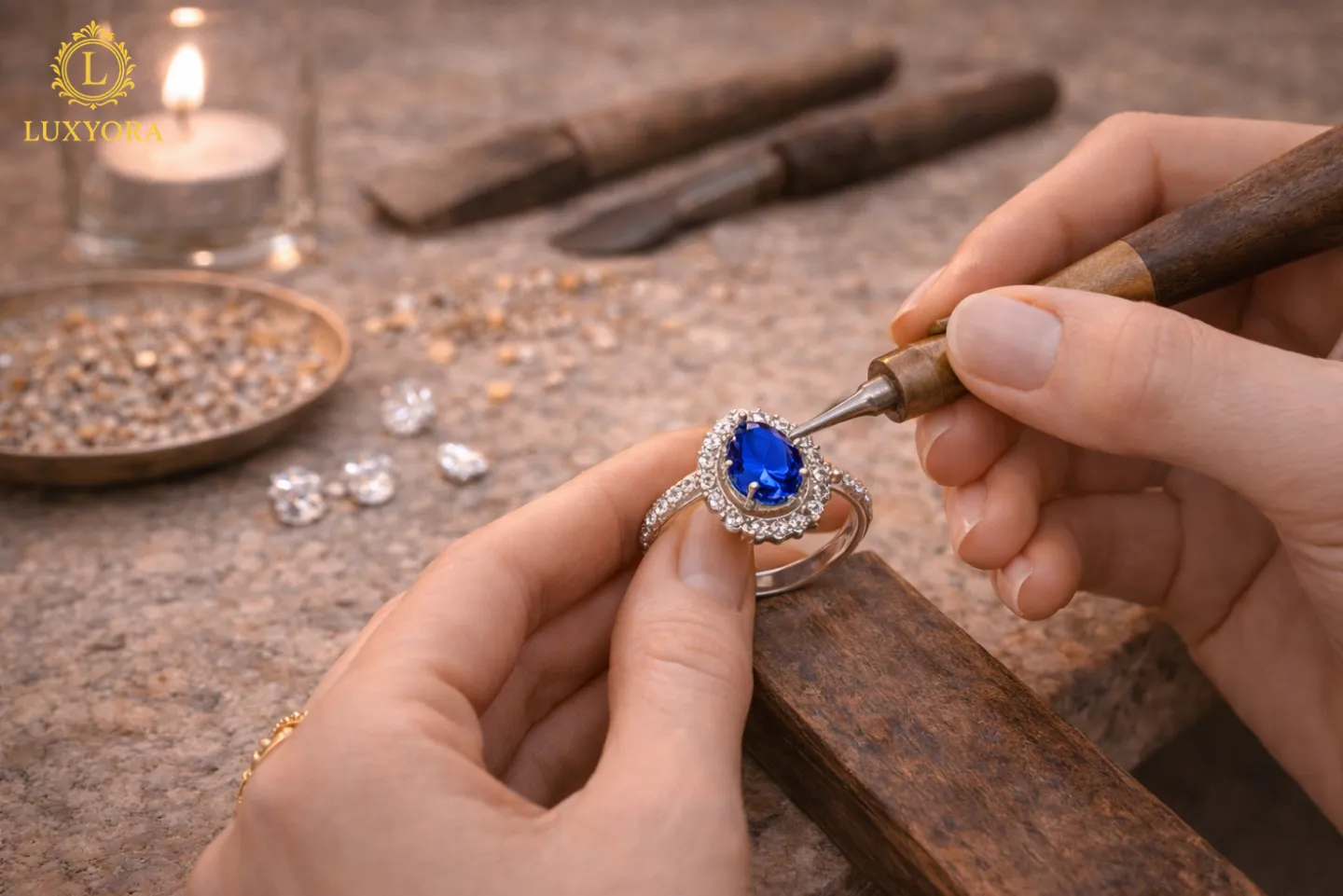
7) Stone setting: the art of making sparkle secure
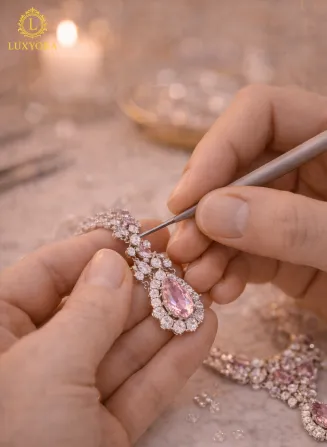
Stone setting is where the piece becomes alive. Prong setting, bezel setting, pavé, and channel setting each have their own look, durability profile, and technical demands. Micro-pavé, for example, is a discipline of its own: tiny stones set with precision so the surface reads like continuous light.
This is also the moment where craftsmanship becomes visible. Clean alignment. Even spacing. Prongs that look delicate but hold like a promise. In luxury jewellery, the setting should never feel like “hardware.” It should feel like part of the design’s poetry.
8) Polishing, finishing, and the final glow
Polishing is not just “making it shiny.” It’s sculpting light. A high polish gives mirror glamour; a satin finish gives modern softness; mixed finishes add dimension and depth.
Then come final details: engraving, hallmarks, clasp testing, hinge tension, stone security checks, and overall quality control. Some pieces may also be sent for independent laboratory services and documentation, depending on the stones and brand standards.
9) Ethics and documentation: modern luxury’s quiet standard
Today, luxury isn’t only about beauty, it’s also about confidence. Responsible sourcing, transparent terminology, and clear disclosure around treatments or lab-grown versus natural materials are increasingly central to trust.
This shift doesn’t make jewellery less romantic. It makes it more meaningful. Because the most irresistible kind of luxury is the kind you can wear proudly without a question mark.
10) The reveal: when design becomes destiny
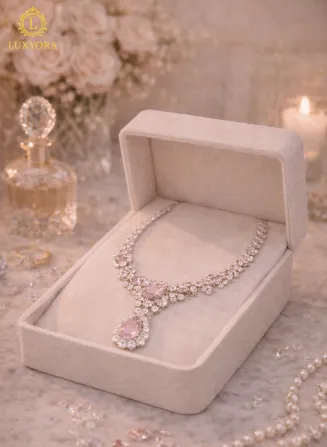
Finally, the piece is cleaned, presented, and packaged often as carefully as it was made. And this is the part no one tells you: once a jewel leaves the workshop, it becomes a personal object. It absorbs a life. It learns a routine. It witnesses milestones. It becomes “that necklace,” “her ring,” “my bracelet I never take off.”
A sketch starts as a private idea. A luxury jewel ends as a public signature.
Luxyora Philosophy: Luxury is the journey from intention to inheritance, where every line, stone, and finishing detail is chosen to last. A jewel becomes timeless the moment craft turns a sketch into something worthy of your story.
References:
- CIBJO. (2022). CIBJO Diamond Blue Book 2022. International Jewellery Confederation. (Click Here)
- CIBJO. (2023). Diamond Terminology Guideline. International Jewellery Confederation. (Click Here)
- Gemological Institute of America. (2020). Natural D-to-Z diamond services (fee schedule): GIA diamond grading reports include determination of natural vs. laboratory-grown and 4Cs assessment (Effective August 20, 2020).(Click Here)
- Gemological Institute of America. (2021). Colored stone services (fee schedule): GIA colored stone reports describe gemstone identity, natural vs. laboratory-grown, and detectable treatments (Effective October 1, 2021).(Click Here)
- Gemological Institute of America. (n.d.). How GIA grades diamonds. GIA 4Cs. (Click Here)
- Grant, M. (2020). Coveted: Art and innovation in high jewelry. Phaidon Press.
- Responsible Jewellery Council. (2019). RJC code of practices (COP) 2019 (Version 1.2). (Click Here)
- Seijen ten Hoorn, L. (2023). Design for jewellery makers: Inspiration, development and creation. Search Press.
- The Crucible. (2022, March 28). Lost wax casting guide: Definition & process. (Click Here)