No products in the cart.

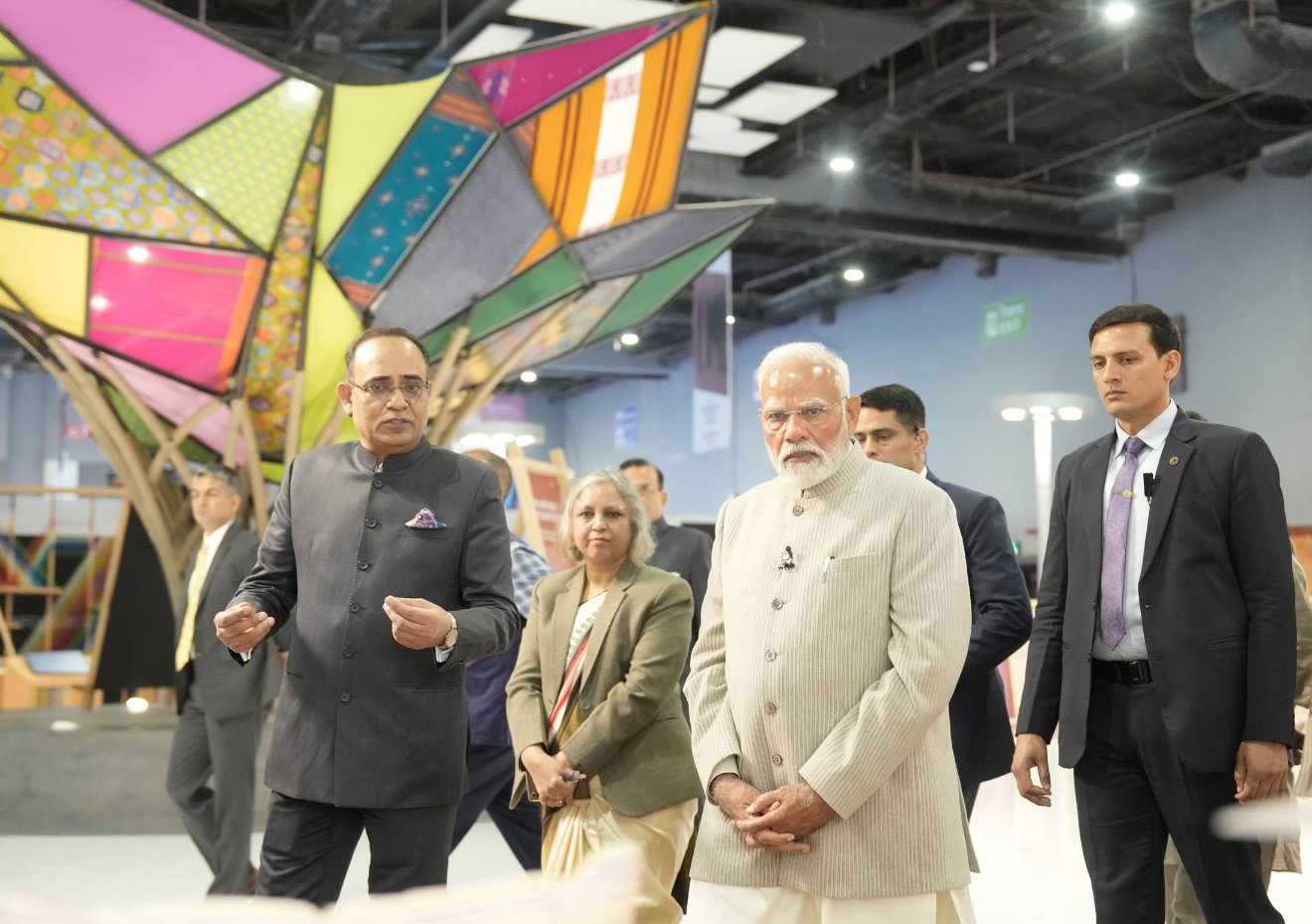
Bharat Tex is India’s flagship international textile event and an integrated trade, sourcing, investment and knowledge platform covering the country’s complete textile and apparel value chain. Organised by the Bharat Tex Trade Federation, an umbrella organisation representing textile export-promotion councils and industry associations, with support from the Ministry of Textiles, Government of India, it brings manufacturers, exporters, global buyers, designers, investors, policymakers, artisans, technology specialists and sustainability organisations into one connected business environment. Its scope extends from fibres, yarns and fabrics to apparel, fashion, home textiles, handlooms, handicrafts, machinery and technical textiles.
Rather than functioning as a narrowly focused trade fair, Bharat Tex presents Indian textiles as an ecosystem. Exhibition halls sit alongside business meetings, policy discussions, investment sessions, masterclasses, fashion presentations, craft demonstrations and international partnerships. This layered format gives overseas visitors a clearer understanding of how India’s agricultural resources, industrial capacity, design intelligence, heritage skills and export infrastructure connect.
Bharat Tex emerged from cooperation between India’s textile industry bodies and the national government. The inaugural 2024 edition was organised by a consortium of 11 textile export-promotion councils with support from the Ministry of Textiles. By 2026, the Bharat Tex Trade Federation was officially identified as the organiser and described as an umbrella body of export-promotion councils and industry associations.
This structure is central to the character of Bharat Tex. It combines the commercial experience of industry organisations with government participation in trade development, investment promotion, skills, infrastructure, sustainability and international engagement. The event therefore works on several levels at once: as a sourcing destination, a meeting place for business leaders, an investment showcase and a forum for discussing the future direction of textiles and fashion.
Bharat Tex is shaped by India’s 5F vision: Farm to Fibre to Factory to Fashion to Foreign. The phrase describes a connected journey beginning with agricultural and fibre resources, moving through manufacturing and design, and ultimately reaching international markets.
This framework explains why the event brings such a wide range of sectors together. Cotton, silk, wool, jute and other fibres appear within the same platform as spinning, weaving, processing, garment manufacturing, fashion design, home furnishings, machinery, dyes, handicrafts and high-performance materials.
For an international sourcing team, this creates an opportunity to study more than individual products. Buyers can explore suppliers at different points in the production chain, compare manufacturing specialisms, meet regional clusters and learn about government-backed programmes supporting infrastructure, skills and innovation.
The 5F vision also places fashion within a broader industrial context. A finished garment is presented not as an isolated product but as the outcome of farming, material development, manufacturing knowledge, design decisions, skilled labour and international commerce.
The first Bharat Tex was held in New Delhi from 26 to 29 February 2024. The exhibition was staged across Bharat Mandapam and Yashobhoomi and covered almost two million square feet. According to the Ministry of Textiles, the four-day event brought together approximately 3,500 exhibitors, 3,000 buyers from 111 countries and more than 100,000 trade visitors.
The scale of the inaugural edition gave the international textile community a broad view of India’s capabilities. Displays covered the industrial value chain while also making space for handloom, handicrafts, artisanship and textile storytelling. More than 10,000 artisans, weavers, students, factory workers, representatives of non-governmental organisations and producer companies participated, helping the event connect large-scale manufacturing with community-based textile production.
Seventy knowledge sessions examined global textile trends, sustainability and related industry priorities. The event also recorded more than 100 product announcements, international memoranda of understanding, research collaborations and investment decisions. These elements established Bharat Tex as a platform where exhibition, knowledge exchange and institutional cooperation could take place together.
The 2024 edition also presented India’s textile heritage through displays such as Vastra Katha, a curated narrative exploring the country’s textile traditions. In doing so, Bharat Tex introduced a defining feature of the platform: the ability to position heritage craftsmanship and modern manufacturing as complementary parts of the same national textile identity.
The principal Bharat Tex 2025 exhibition took place at Bharat Mandapam from 14 to 17 February. Parallel exhibitions relating to handicrafts, garment machinery and ethnic apparel were staged at the India Expo Centre and Mart in Greater Noida from 12 to 15 February. This multi-venue arrangement allowed a wider range of textile sectors and supporting industries to participate.
The second edition attracted participation from more than 120 countries, 33 international trade associations, and 46 global brands. It gave increased prominence to sustainable manufacturing, international trade, digital transformation, start-up activity, craftsmanship and the commercial potential of India’s textile-producing states.
Live demonstrations highlighted techniques including Banarasi weaving, Kanjeevaram silk weaving, Pashmina production and Chikankari embroidery. These presentations gave artisans and traditional textile specialists a visible place within an event also devoted to industrial manufacturing and global sourcing.
Innovation was represented through initiatives such as a dedicated start-up pavilion and Aavartan, a compendium presenting more than 3,000 textile-related start-ups. This reflected the expanding role of entrepreneurship, technology and new business models in India’s textile economy.
A particularly significant development took place on the sidelines of the event, when the European Union and India’s Ministry of Textiles launched seven projects for the textile and handicraft sector. Supported by an EU grant of €9.5 million, the projects were designed to promote resource efficiency, sustainability, livelihoods, inclusive growth and women’s economic empowerment across nine Indian states. The programme identified 35,000 direct beneficiaries, including micro, small and medium-sized enterprises, artisans and farmer-producers, over implementation periods of three to five years.
The third edition of Bharat Tex was held from 14 to 17 July 2026 at Bharat Mandapam in New Delhi. It was organised by the Bharat Tex Trade Federation with the support of the Ministry of Textiles and brought the complete textile value chain together within more than 1.6 million square feet of exhibition space.
In a release issued on the final day, organisers reported that the first three days had attracted 1,647 exhibitors, nearly 95,000 business visitors and more than 20,000 repeat visits. The event recorded 11,315 buyers, including 6,090 international buyers, together with 3,461 delegates and participants from 138 countries. More than 28,500 business-to-business meetings and over 100 business-to-government and government-to-government interactions were also reported.
The same release reported approximately US$2.8 billion in serious business enquiries and around ₹14,300 crore in textile investment commitments associated with state-level agreements. More than 30 memoranda of understanding were signed by participating states, illustrating the event’s growing role as a setting for investment promotion as well as product sourcing.
International participation included ministerial representatives and business delegations from markets across Europe, Asia, Oceania, the Middle East and North America. One hundred knowledge sessions involved more than 600 policymakers, industry executives, academics and specialists, with discussions covering sustainability, circularity, artificial intelligence, technical textiles, responsible sourcing, trade, investment and technological innovation.
A major institutional development was the signing of a Letter of Intent between the Bharat Tex Trade Federation and Première Vision. The collaboration is intended to strengthen textile and apparel connections between India and Europe through market access, sustainable sourcing, design intelligence, innovation and buyer engagement. It also provides a framework for reciprocal participation between Bharat Tex and Première Vision Paris.
Sustainability has become one of Bharat Tex’s central themes. Across its editions, the programme has addressed responsible sourcing, recycling, circular production, resource efficiency, cleaner technologies, agricultural fibres and supply-chain transparency.
At Bharat Tex 2026, the Eco-Stitch Sustainability and Circularity Hub brought recyclers, manufacturers, brands, innovators, technology providers and other organisations together around the theme “Sustainable, Circular and Competitive Bharat.” Its displays explored circular production, textile waste, recycled materials, scalable sustainability solutions and material innovation.
The wider conference programme examined practical subjects such as textile fibres made from agricultural residue, sustainable supply-chain finance, fair commodity pricing, organic cotton, traceability and responsible purchasing. International organisations, manufacturers, retailers and sustainability specialists participated in discussions intended to connect environmental ambition with commercial implementation.
India’s textile heritage also contributes a distinctive perspective to this conversation. Handloom production, repair, material conservation, natural fibres, reuse and skilled craft practices have long histories in different parts of the country. Bharat Tex creates a setting in which this inherited knowledge can be considered alongside industrial recycling, digital traceability, and contemporary circular design strategies.
Bharat Tex increasingly presents technology as an essential part of textile competitiveness. Digital directories, mobile applications, business-matching systems and lead-capture tools are used to help buyers navigate the exhibition and arrange meetings. The 2026 digital platform incorporated exhibitor discovery, meeting scheduling, event navigation, digital badges, QR-based lead capture and AI-assisted support.
The Kasturi Cotton Bharat programme represents India’s work in cotton certification, branding and traceability. Developed through cooperation between the Ministry of Textiles, the Cotton Corporation of India and the Cotton Textiles Export Promotion Council, the programme uses QR-based certification and a blockchain-supported platform to provide traceability for certified cotton across the supply chain.
VisioNxt, developed by the National Institute of Fashion Technology with support from the Ministry of Textiles, adds a fashion-intelligence dimension. The initiative combines artificial intelligence with human and emotional intelligence to identify and analyse India-specific fashion trends. It was conceived to reflect the country’s cultural diversity, regional differences and consumer behaviour while supporting designers, retailers, manufacturers, artisans and fashion businesses.
Together, programmes such as Kasturi Cotton Bharat and VisioNxt demonstrate that India’s textile proposition is extending beyond manufacturing volume. Traceable materials, market intelligence, certification, research and culturally informed design are increasingly visible parts of the sector’s international presentation.
Technical textiles broaden Bharat Tex’s relevance beyond clothing and interiors. This category includes specialised materials created for performance and functional applications in healthcare, agriculture, construction, transport, defence, sport and protective equipment.
At the 2026 edition, the Sanrachna Hackathon showcased student and innovator projects including protective clothing for agricultural workers, textile-based products for diabetic wound care and lightweight insulated materials for extreme climates. The programme demonstrated how collaboration between academic institutions, industry and government can support product development in advanced textile fields.
India’s National Technical Textiles Mission provides a wider policy framework for research, skills, indigenous production and market development in this sector. Launched with an outlay of ₹1,480 crore, the mission has supported efforts to increase innovation and strengthen India’s capabilities in specialised textile applications.
Bharat Tex is reinforced by government programmes addressing infrastructure, manufacturing scale, skills and research.
The PM Mega Integrated Textile Region and Apparel, or PM MITRA, Parks Scheme is developing seven large integrated textile parks. These are intended to bring different stages of textile manufacturing into modern industrial locations, helping enterprises scale up, improve infrastructure, and strengthen competitiveness.
The Production Linked Incentive Scheme for Textiles promotes investment and manufacturing in man-made-fibre apparel, man-made-fibre fabrics and technical-textile products. Its emphasis on these categories supports India’s expansion into higher-value materials and industrial applications.
Samarth, the Scheme for Capacity Building in the Textile Sector, provides demand-driven and placement-oriented training. It supports organised textile and related sectors while also addressing upskilling and reskilling in traditional fields such as handloom, handicrafts, silk and jute.
These programmes give context to the investment and skills discussions conducted at Bharat Tex. The event provides an international-facing stage where companies and buyers can observe how policy, infrastructure, workforce development, and private enterprise are being brought together.
The diversity of India’s textile geography is one of Bharat Tex’s most valuable features. Different states and production clusters bring distinct capabilities in cotton, silk, wool, spinning, weaving, knitwear, apparel, embroidery, carpets, home textiles, handicrafts and technical materials.
State pavilions and investment sessions allow regional governments and industry representatives to explain these specialisms directly to buyers and investors. In 2026, Bihar, Madhya Pradesh, Gujarat, Uttar Pradesh, Punjab, Maharashtra, Karnataka and Tamil Nadu participated as state partners, while additional states and Union Territories presented their textile strengths through dedicated displays.
This regional participation helps international visitors move beyond a general understanding of “Made in India.” It gives them a clearer map of where particular products, techniques, skills and manufacturing capabilities are concentrated.
In three editions, Bharat Tex has developed from a large national showcase into a recurring international platform for sourcing, investment, policy dialogue and textile innovation. Its importance lies not only in visitor or exhibitor numbers, but in the connections it creates between agriculture and fashion, artisans and global brands, regional clusters and international markets, and traditional knowledge and emerging technology.
Its future influence will be shaped by the commercial partnerships, investment projects, research collaborations and sourcing relationships that continue beyond the exhibition floor. The 2026 partnership with Première Vision, the growth of international buyer participation and the expanding sustainability programme indicate that Bharat Tex is developing a wider role within the global textile calendar.
India’s textile story is both ancient and continually evolving. Bharat Tex gives that story a contemporary international stage capable of presenting fibre, factory, fashion, craft, technology and trade as parts of a single, connected vision.
Bharat Tex 2026 : Global Textile Leaders Set to Convene in India
Bharat Tex 2026: How India Is Shaping the Future of Global Fashion
Bharat Tex 2026 Closes With a Paris Deal and a Blueprint for the Next Decade
Rahul Mishra And Vaishali Shadangule Set Out India’s Fashion Export Ambitions At Bharat Tex 2026
Amazon India Signs MoU With TEXPROCIL at Bharat Tex 2026 to Push Cotton Textile Exports
India’s Textiles Minister Giriraj Singh Opens Bharat Tex 2026 in New Delhi as Global Buyers Gather
Sustainable Fashion: Eight Fashion Capitals Unite to Launch Global Coalition
Bharat Tex Trade Federation. (2025, February 18). Resounding success of the first two days of Bharat Tex 2025 at Bharat Mandapam, New Delhi.
Bharat Tex Trade Federation. (2026, July 16). Bharat Tex 2026 Day 3 advances sustainable textiles, circularity, future-ready skills and global trade.
Bharat Tex Trade Federation. (2026, July 17). Bharat Tex 2026 witnesses unprecedented business momentum and massive footfall.
European External Action Service. (2025, February 15). The European Union and the Ministry of Textiles launch seven projects to boost the textile and handicraft sector in India.
Ministry of Textiles, Government of India. (2024, March 1). Bharat Tex 2024—India’s largest textiles mega event concludes. Press Information Bureau.
Ministry of Textiles, Government of India. (2024, August 6). Ministry of Textiles empowers ginners to produce Kasturi Cotton Bharat brand. Press Information Bureau.
Ministry of Textiles, Government of India. (2024, September 5). Union Minister of Textiles launches VisioNxt fashion forecasting initiative. Press Information Bureau.
Ministry of Textiles, Government of India. (2024, October 22). Bharat Tex 2025 gains international momentum. Press Information Bureau.
Ministry of Textiles, Government of India. (2025, February 4). Bharat Tex 2025 is a testament to India’s commitment to becoming a global textile powerhouse. Press Information Bureau.
Ministry of Textiles, Government of India. (2025, March 27). National Technical Textiles Mission. Press Information Bureau.
Ministry of Textiles, Government of India. (2025, July 29). Skill development under the Samarth Scheme. Press Information Bureau.
Ministry of Textiles, Government of India. (2026, February 10). Extension of registration for the Production Linked Incentive Scheme for Textiles. Press Information Bureau.
Ministry of Textiles, Government of India. (2026, March 17). PM MITRA Parks. Press Information Bureau.
Ministry of Textiles, Government of India. (2026, July 14). Union Minister of Textiles inaugurates Bharat Tex 2026. Press Information Bureau.
Ministry of Textiles, Government of India. (2026, July 15). Bharat Tex Trade Federation and Première Vision Paris forge strategic partnership to deepen India–EU textile collaboration. Press Information Bureau.
National Institute of Fashion Technology. (n.d.). VisioNxt—Trend Insight and Forecasting Lab.


Stay inspired with exclusive brand features, luxury insights, and the latest in fine fashion and beauty — directly in your inbox.