Sustainable Fashion: Eight Fashion Capitals Unite to Launch Global Coalition
Eight fashion capitals signed onto a new coalition in Paris on July 9, formalising what had already been happening independently across the industry for months: brands moving on circularity and lower-impact materials well ahead of any single piece of legislation. Kering, Coach and a run of independent Korean design houses have folded these commitments into core product lines this year, and the consumer research backing that shift, from ThredUp, GlobalData and Vogue’s own readership data, suggests shoppers got there first.
Paris Launches a Global Coalition for Sustainable Fashion Cities
Paris Good Fashion launched the Fashion Cities Coalition on July 9, bringing Paris, Milan, New York, London, Copenhagen, Singapore, Dubai and Cotonou in Benin into one working group. Sarah Kozlowski, senior vice president of program strategies at the Council of Fashion Designers of America, put the logic plainly: cities cannot solve this alone. Singapore is contributing its role as a link between global fashion centres and the Asian manufacturing networks where much of the world’s apparel is produced. Most industry pledges never get near that side of the supply chain.
London’s presence in the coalition runs through Central Saint Martins and the British Fashion Council, who represent the city within the group. Carole Collet, the college’s professor of design for a sustainable future and director of Maison/0, the design lab Central Saint Martins runs with LVMH, spoke for London at the launch. “London has an extraordinary heritage and a formidable capacity for innovation,” she said, framing Maison/0 as a way to push design beyond the circular economy and into rebuilding whole ecosystems.
Gen Z Is Reshaping Resale and Secondhand Fashion Demand
Gen Z consumers are three times more likely than Baby Boomers to rent or lease clothing, according to ThredUp, and more than half of younger shoppers say they will not buy an item new if they can find it secondhand. Sixty per cent of Gen Z have stopped buying from a brand entirely after a poor returns experience, a figure that undercuts any assumption that a sustainability pitch alone secures repeat custom.
In the US, roughly 30 per cent of apparel shoppers now actively prioritise sustainable labels, and the secondhand market there is projected to reach 78.8 billion dollars by 2030, growing at nearly four times the pace of conventional retail clothing, according to GlobalData’s figures for ThredUp’s 2026 Resale Report. Vogue’s own readership offers a data point closer to the editorial reader: 69 per cent say sustainability factors into a purchase decision. Canada’s resale and secondhand segment is on track to hit 3.8 billion US dollars this year, and Poshmark Canada has reported a 150 per cent jump in secondhand buyers since 2019.
Circular Fashion Gets Specific at Kering, Coach and Mulberry
Coach’s Coachtopia lab builds bags and accessories from recycled and repurposed inputs, complete with product passports, extending a repair and resale scheme the brand had already been running. Gucci has folded its climate and circularity work into a single platform called Equilibrium, with community programmes sitting under the same umbrella. Kering’s Water-Positive programme pairs regenerative agriculture sourcing with Water Resilience Labs planned across priority river basins, the first opening in Tuscany’s Arno basin.
Mulberry chief executive Andrea Baldo has gone further than most, letting customers trade in signature styles for new or pre-owned versions at proportional prices. That trade-in model sits at the centre of the brand’s UK-based recovery plan. Gabriela Hearst’s Spring/Summer 2026 collection reached 97 per cent deadstock materials in its woven pieces, a proportion that held up on the runway as well as in the sourcing paperwork.
Sustainable Beauty and Jewellery Follow Fashion's Lead
Dries Van Noten Beauty has introduced refillable fragrance bottles and lipstick cases using glass, aluminium and certified wood from sustainably managed forests. Through its Ourika Community Gardens in Morocco, YSL Beauty combines botanical research with locally based ingredient cultivation and sourcing. Saie partnered with Sephora US and eleven other beauty brands on Planet Beautiful, funding the recovery of more than a million pounds of plastic waste across India, Indonesia, Colombia and Kenya.
Anya Walsh, a jewellery expert at 77 Diamonds, called sustainability a core expectation of luxury brands today, in a category that spent years treating it as an afterthought.
Lagos and Seoul Are Building Regenerative and Zero-Waste Fashion
Lagos Fashion Week and the African Fashion Coalition used London Climate Action Week in June to launch The Blueprint for a Regenerative Fashion Future, a manifesto covering ten pillars from waste justice to local production. Founder Omoyemi Akerele has backed the ambition with real money, putting a 1 million pound Earthshot Prize win toward a circular fashion hub in Lagos designed to expand to other African cities by 2030. Participation in Lagos Fashion Week requires designers to show that their collections meet sustainability standards for sourcing and production.
Seoul is running a parallel experiment through its own fashion week. Korean bottled water brand Jeju Samdasoo partnered with participating label Julycolumn on a Zero Waste Collection made from waste plastic fabrics. Designer Han Hyun-min pushed the idea further at MÜNN, building a recent collection from sweaters knit out of recycled paper and dresses cut from discarded banners. Bustiers handwoven from elastic bands closed out the look.
Australia's Seamless Scheme Targets Full Clothing Circularity
Seamless, Australia’s national clothing stewardship scheme, was launched with major fashion and clothing brands as foundation members and is working toward full clothing circularity by 2030. Melbourne designer and Australian Fashion Council member Courtney Holm has since launched Circular Sourcing, a platform built to keep the country’s surplus fabric in use and out of landfill. The idea grew out of her own label A.BCH’s design practice.
India Strengthens Its Role in Sustainable Textile Sourcing
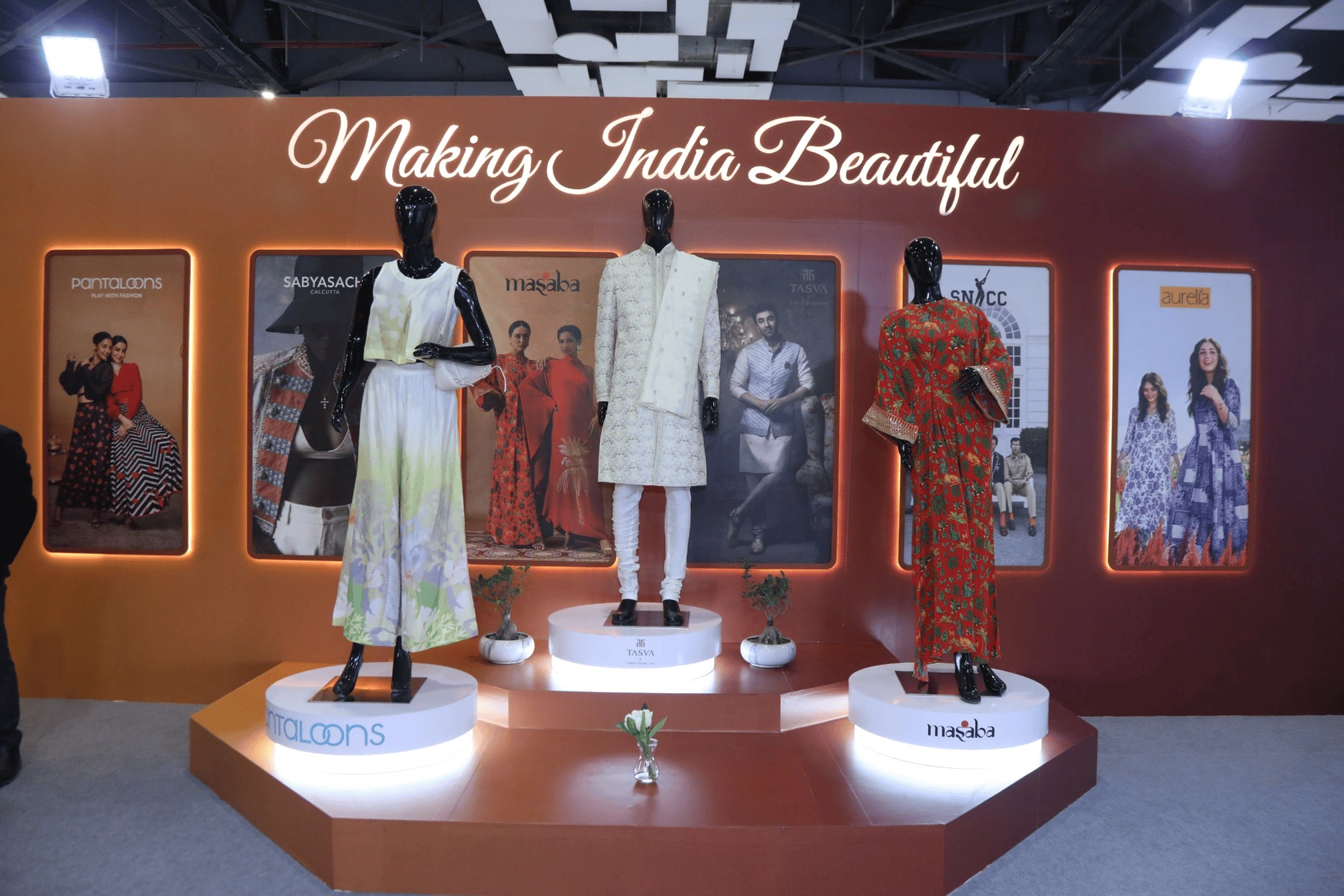
India’s contribution to this was showcased at Bharat Tex 2026, where the Eco-Stitch Sustainability and Circularity Hub showcased the country’s fibre-to-garment ecosystem. H&M’s materials team also outlined research examining wheat straw as an alternative raw material for textile fibre development. Raw material innovation has become a boardroom topic on the sourcing side of the industry.
The coalition’s first act is a research project, using behavioural scientists to study the gap between what shoppers say they want and what they actually buy. Resale growth and deadstock runway numbers already point to where that gap is narrowing fastest across categories. Paris now has a standing body built to track it across all eight founding cities, a structure that did not exist before July 9.