Why Watch Weight Matters for Daily Wear | Luxyora
A luxury watch can be many things – an heirloom, a mood, a tiny sculpture that happens to tell time. But on an ordinary Tuesday, when you’re typing, commuting, carrying coffee, and living at full speed, one detail decides whether your watch feels like a delight or a distraction: weight.
Watch weight is the quiet factor people often ignore until they can’t ignore it anymore. It influences comfort, fit, wrist fatigue, how your watch sits on the skin, how it behaves on a bracelet, and even how “luxurious” it feels emotionally. Because yes – sometimes weight feels like substance. Other times, it feels like work.
Let’s unpack why weight matters, what affects it, and how to choose the right feel for your everyday life.
Weight is comfort - before it’s anything else
Daily wear means hours: at a keyboard, behind a steering wheel, in meetings, on walks, on flights. A watch that feels fine for 10 minutes can start to feel heavy by hour six.
Heavier watches can cause:
- Wrist fatigue, especially if you’re sensitive to pressure or spend long stretches with your wrist resting on a desk
- Hot spots, where the caseback or clasp presses into the skin
- Constant sliding, if the bracelet/strap fit isn’t dialled in (a heavier head exaggerates this)
On the other hand, a lighter watch can feel like it disappears, which is precisely the point if you want effortless elegance with no sensory drama.
The “luxury weight” illusion: when heavy feels expensive
There’s a reason many people equate heft with quality. A solid steel bracelet, a thick case, that satisfying “presence” on the wrist can feel reassuring, like closing the door of a well-made car.
But luxury isn’t measured in grams. It’s measured in how well something is designed. A thoughtfully engineered watch can feel premium at a lighter weight through:
- balanced proportions
- comfortable curvature
- bracelet articulation
- a clasp that sits flat
- a fit that stays stable all day
The goal is never “heavier is better.” It’s the right weight, right balance.
Weight distribution matters more than the number
Two watches can weigh the same and wear completely differently. The difference is in distribution.
Here’s what affects it most:
1) Top-heavy vs balanced
A large case on a light strap can feel top-heavy, causing the watch head to rotate on your wrist. Meanwhile, a weightier bracelet can counterbalance the case and stabilise it.
2) Case thickness
Thicker watches sit higher, which increases the “lever” effect and makes them more likely to catch cuffs, knock desks, and feel bulky.
3) Bracelet and clasp design
A bracelet that articulates smoothly spreads weight. A stiff bracelet concentrates pressure. And a bulky clasp can become the uncomfortable “anchor” point that you always notice.
Material is the biggest weight decision you’re actually making
If you want to predict how a watch will feel, start with the materials.
Stainless steel
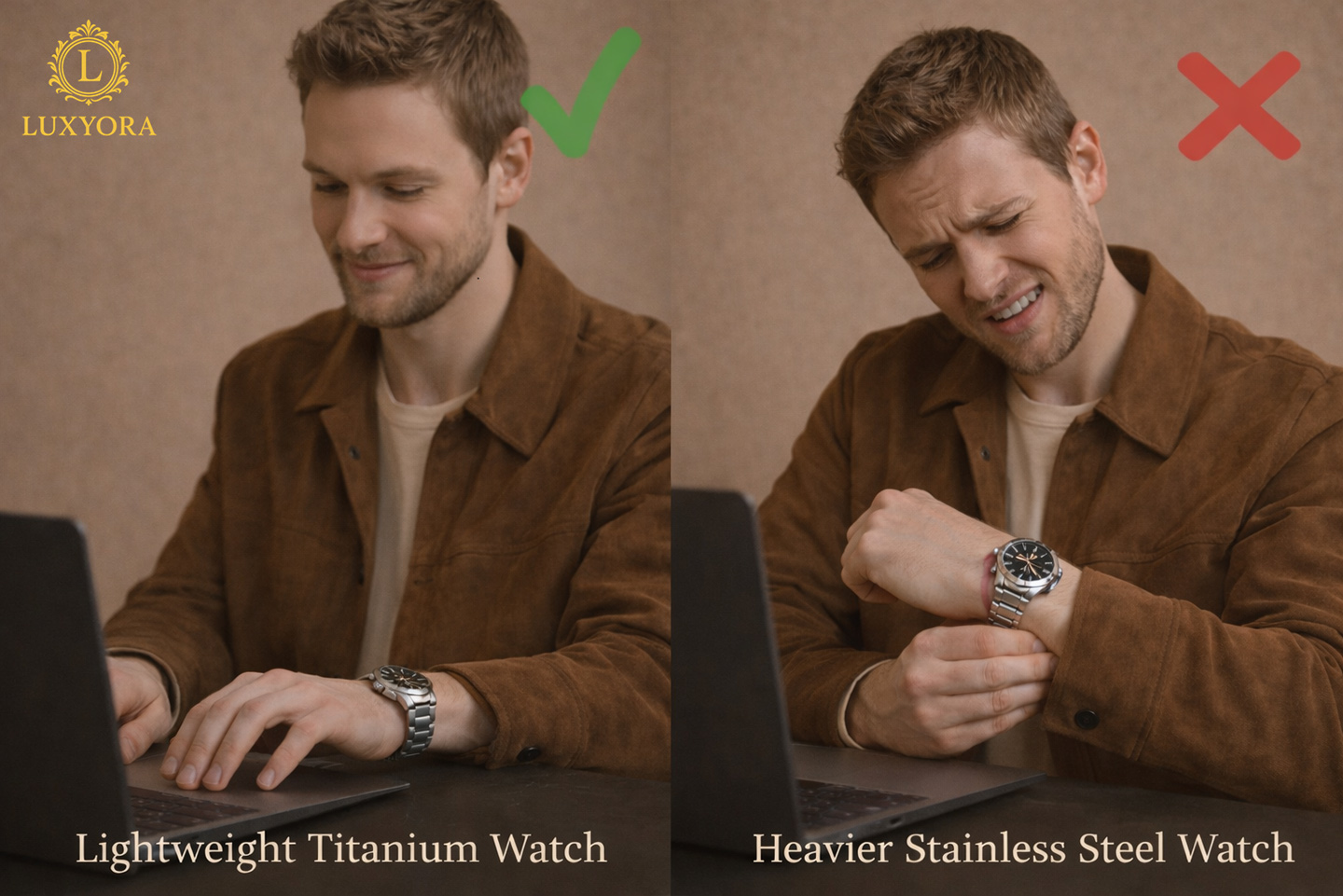
Classic, durable, and often satisfyingly substantial. Steel watches can feel reassuring, but on long days, they can also feel present.
Titanium
The quiet hero for daily wear. Titanium is notably lighter than steel (often cited as around 40% lighter, depending on alloy and construction). The result is a watch that feels sporty, modern, and easy, especially for travel, long workdays, or anyone who dislikes wrist weight.
Gold and precious metals
Beautiful, warm, and typically heavier. If you love the jewellery feel of a watch and want it to read as luxurious instantly, the weight of precious metal can feel decadent. Just be honest about whether you want decadence or effortlessness at 4 p.m.
Strap materials
- Leather can reduce overall weight and soften the feel, but may shift more if not perfectly fitted.
- Rubber is lightweight and stable. It is great for active days.
- Bracelets usually add weight, but they can also improve stability and comfort if designed well.
Micro-adjustments: the comfort feature that makes weight feel lighter
Even the “perfect” weight can feel wrong if the fit isn’t right. Wrists expand and contract throughout the day with heat, hydration, and activity. That means a bracelet that fits in the morning can feel tight by afternoon, or loose by evening.
This is where micro-adjustment (or quick-adjust) clasps matter. They allow small, tool-free changes in bracelet length so your watch stays comfortable without shifting, pinching, or sliding. For daily wear, this is one of those details that quietly upgrades your entire experience, especially with heavier watches.
Your lifestyle decides your ideal weight
There isn’t one correct answer, only a correct match.
If you work at a desk
Lighter watches or well-balanced mid-weight pieces tend to feel best over long hours of wrist-on-surface contact. Slim cases and comfortable clasps matter.
If you travel often
Titanium and lighter builds can be a dream: less fatigue, less “I need to take this off” mid-flight energy, and easier all-day wear.
If you love the jewellery, feel
A heavier watch, especially with a bracelet, can feel luxurious and grounding. Just prioritise comfort features: good bracelet articulation, smooth edges, and a clasp that sits flat.
If you’re active
Weight that shifts is more annoying than the weight itself. A stable strap (rubber, well-fitted bracelet) and a balanced case are key.
A practical way to shop for weight without guesswork
Not all brands publish exact grams, but you can still shop smart:
- Check material first (steel vs titanium makes a noticeable difference)
- Check size and thickness (bigger and taller generally means heavier and more “present”)
- Prefer bracelets with adjustability if you plan to wear them daily
- Try it on and do real-life motions: typing posture, arms crossed, jacket cuffs, lifting your wrist
- Notice what you feel after five minutes, because your wrist is honest
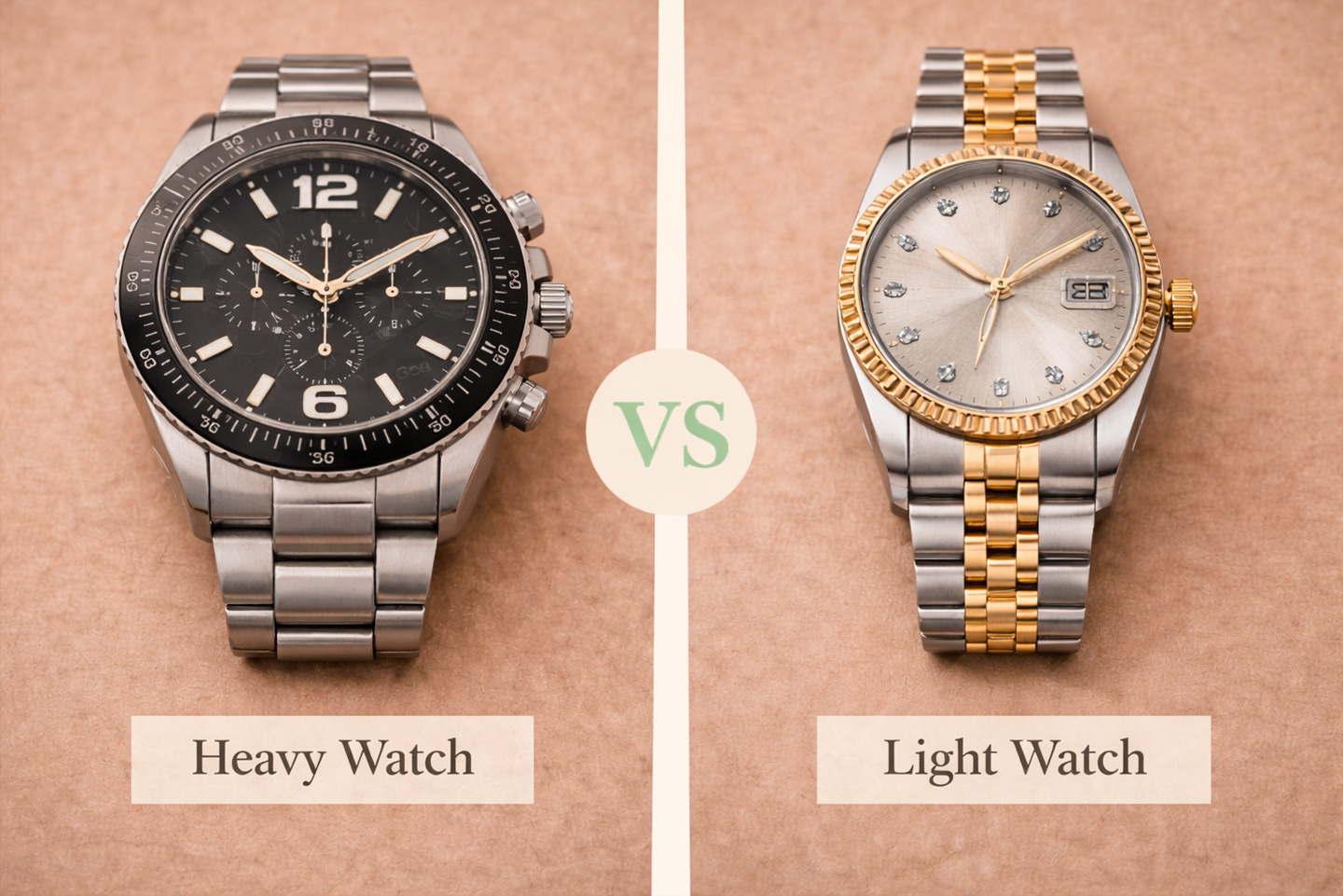
A helpful benchmark often cited by watch retailers is that many “average” watches fall somewhere in the 80-100g range. Still, daily comfort depends far more on balance, fit, and materials than on a single number.
Luxyora Philosophy: Luxury is the feeling you forget you’re wearing something, until you catch it in the light and remember you chose it. The right watch weight is the one that supports your day, not one that steals your attention.
References:
- AblogtoWatch. (2022, August 22). Grinding gears: Why some watches are uncomfortable & possible solutions to the problem. AblogtoWatch.
- Barrington Watch Winders. (n.d.). What is micro-adjustment? Retrieved January 1, 2026.
- Davosa. (2021, December 6). Titanium vs. stainless steel watch – Pros and cons. Davosa USA.
- Quill & Pad. (2023, July 7). Titanium vs. stainless steel watches: Beyond the silvery surface. Quill & Pad.
- Shinola. (2021). Your guide to watch weight. Shinola.
- Zhu, H., Zhou, M., & Wu, B. (2024). Comfort of smartwatch wearing: A comparative study of different hand types. Wearable Technologies, (article page).