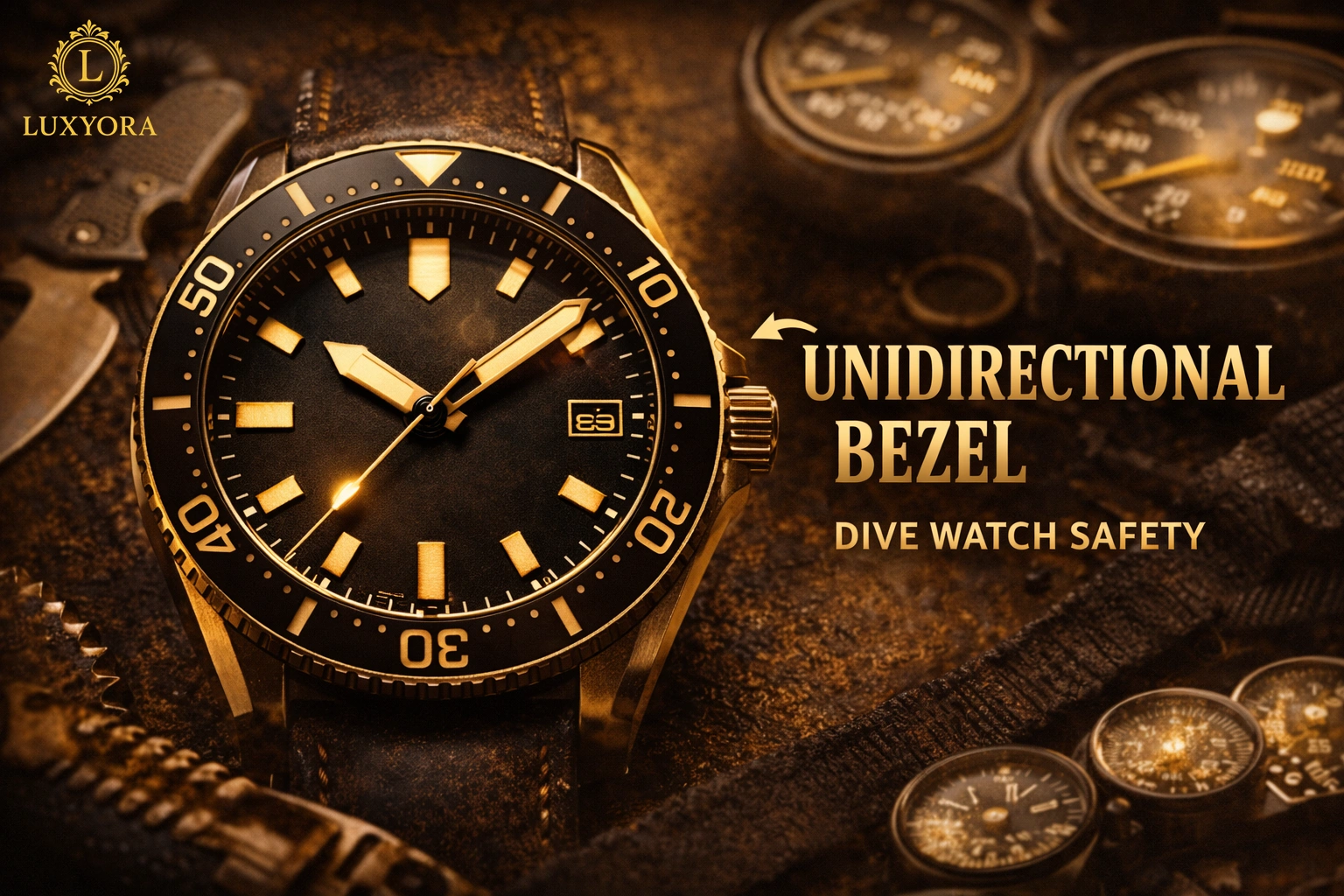
Unidirectional Bezel : What is Unidirectional Bezel
A unidirectional bezel is a rotating watch bezel designed to turn only in one direction, almost always counterclockwise, and is most strongly associated with diver’s watches and elapsed-time measurement. In the watch industry, it is considered a safety component: if the bezel is accidentally bumped and shifts during a dive, it can only shift in a way that makes the dive seem longer, not shorter, encouraging a diver to surface sooner, rather than falsely believing they have more time remaining.
This “failsafe” logic is why unidirectional bezels are commonly referenced alongside ISO 6425, the international standard that defines requirements and test methods for divers’ watches.
What is a unidirectional bezel, in industry terms?
A unidirectional bezel is an elapsed-time controller built into the watch’s bezel system. It typically includes:
- a 60-minute scale (0/60 at the top, then 5–55 around the ring),
- a prominent luminous “pip” or triangle at the zero marker for visibility in low light,
- a ratcheting click mechanism (often 60 or 120 clicks per full rotation) to improve precision and resist accidental movement,
- and a rotation direction that prevents “gaining time” accidentally.
Many educational and brand guides summarize the purpose the same way: align the bezel’s zero marker to the minute hand at the start of an activity (commonly a dive), then read elapsed minutes directly from the bezel.
Why do dive watches use unidirectional rotation
The safety principle: “Fail-safe” timing
In underwater diving, time is not just convenient; it ties into air consumption planning, decompression models, and conservative decision-making. A bezel that can rotate both ways could be knocked in a direction that makes elapsed time appear smaller, giving a diver a dangerously optimistic impression of how long they’ve been submerged.
A unidirectional bezel prevents that specific error: if the bezel shifts, it can only indicate that more time has elapsed. That pushes a diver toward more caution, not less.
Standardization: ISO 6425 and “inadvertent handling.”
ISO 6425:2018 requires a diving time indicator and states that it must be protected against inadvertent handling, allowing reading of dive time with minute-level resolution over at least 60 minutes.
Many watch-industry explainers interpret the unidirectional bezel as the typical implementation of this requirement.
How to use a unidirectional bezel (step-by-step)
Timing elapsed minutes underwater (classic use case)
- Before descent, rotate the bezel so the luminous zero marker aligns with the minute hand.
- As time passes, look at where the minute hand points on the bezel scale.
- The number on the bezel at the minute hand indicates the elapsed time in minutes since you set it.
This method is described consistently across watch brand instructions and educational guides.
Example:
If you set the bezel at the start of the dive and later the minute hand points to “25” on the bezel scale, 25 minutes have elapsed.
Timing everyday activities (non-diving)
Unidirectional bezels are also used for:
- cooking/resting timers,
- parking meter checks,
- workout intervals,
- meeting blocks,
- and general “how long has it been?” tracking without pulling out a phone.
While the diver’s bezel is optimized for underwater legibility and safety, the underlying function is simply a robust analog elapsed-time timer.
Unidirectional vs. bidirectional bezel: what’s the difference?
Unidirectional bezel (counterclockwise-only)
Best for: diving and any safety-sensitive elapsed timing
Strength: cannot accidentally reduce indicated elapsed time (failsafe)
Bidirectional bezel (both directions)
Best for: quick adjustments, travel timing, aviation/world-time calculations on other bezel types (not the classic diver’s bezel)
Tradeoff: can be bumped in either direction, so it’s less preferred for professional diving.
Some dive-adjacent watches use internal rotating bezels (set by a crown) to reduce accidental knocks and corrosion exposure, but the same “elapsed time control” concept applies.
Design and materials: what makes a good unidirectional bezel?
1) Grip and ergonomics
Diving gloves, wet fingers, and cold conditions mean the bezel needs:
- deep knurling or scalloped edges,
- clear click feedback,
- and minimal slip.
2) Legibility and lume
Most diver bezels emphasize:
- high-contrast numerals/markers,
- a bright luminous pip/triangle at zero,
- and clear 5-minute indications.
These design expectations also appear in discussions of diver-watch standards and requirements.
3) Bezel inserts and durability (steel, aluminum, ceramic)
Modern dive watches frequently use:
- aluminum inserts (light, classic look, can fade charmingly),
- ceramic inserts (high scratch resistance and stable color),
- engraved steel with filled markings (rugged tool aesthetic).
For example, watch coverage commonly references ceramic inserts (including proprietary ceramics) as a durability and corrosion-resistance upgrade in professional dive watch lines.
Where you’ll see unidirectional bezels in the market
Professional and recreational dive watches
Unidirectional bezels remain a defining feature in:
- ISO-inspired diver designs,
- mainstream tool watches,
- luxury dive icons,
- and “desk diver” lifestyle models.
Recent buyer guides continue to treat the unidirectional bezel as a core part of the “dive watch checklist.”
Beyond external bezels: internal rotating bezels
Some watches place the timing scale inside the case and control it via a crown. This can reduce accidental movement and protect the mechanism, often discussed in functional bezel overviews.
Common misconceptions (and quick clarifications)
- “A unidirectional bezel is only decorative.”
Many people wear dive watches casually, but the bezel is still a functional elapsed-time tool. - “It measures how much air you have left.”
It doesn’t measure air directly; it helps track elapsed time, which you combine with pressure gauge readings and dive planning. - “All dive watches meet ISO 6425.”
Not necessarily many watches look like divers without claiming ISO certification. ISO 6425 defines requirements and tests; brands may or may not certify.
Conclusion
A unidirectional bezel is one of the watch industry’s most practical “tool-watch” features: a counterclockwise-only elapsed-time controller designed to reduce the risk of accidental movement, especially in diving contexts. It has endured from mid-century dive-watch innovation into modern standards-driven design, and it remains a key term for anyone learning dive-watch functionality, ISO 6425 requirements, and the engineering logic behind “safety-first” mechanical interfaces.
References
Brunner, G. L. (2019). The Watch Book: Compendium. teNeues. (Amazon India)
Brunner, G. L. (2023). The Watch Book: Compendium – Revised Edition. teNeues. (Google Books)
Circula Watches. (2024). ISO 6425 and DIN 8306: What must a diver’s watch be able to do? (CiRCULA)
Fratello Watches. (2022, May 30). The dry facts about the ISO 6425 divers’ watch standard. (fratellowatches.com)
Grand Seiko. (n.d.). Unidirectional rotating bezel (instruction guide). (Grand Seiko)
International Organization for Standardization. (2018). ISO 6425:2018(en), Horology — Divers’ watches. (ISO)
Longines. (n.d.). What defines a dive watch? (longines.com)
Paul Altieri / Bob’s Watches. (2019). How does a dive watch bezel work? (Bobswatches.com)
The 1916 Company. (2021, February 23). What is a dive watch? (ISO 6425 definition & meaning). (The 1916 Company)Timex. (2025, April 11). How to use a diver’s watch bezel. (Timex US)
TurtleDove / Teddy Baldassarre. (2026). The 62 best dive watches (2026). (Teddy Baldassarre)
Braun, P., & Radkai, M. (Eds.). (2019). Wristwatch Annual 2019: The catalog of producers, prices, models, and specifications. Abbeville Press. (Abbeville)
Braun, P., & Radkai, M. (Eds.). (2024). Wristwatch Annual 2024: The catalog of producers, prices, models, and specifications. Abbeville Press. (Google Books)