Tachymeter Bezel : What is Tachymeter Bezel
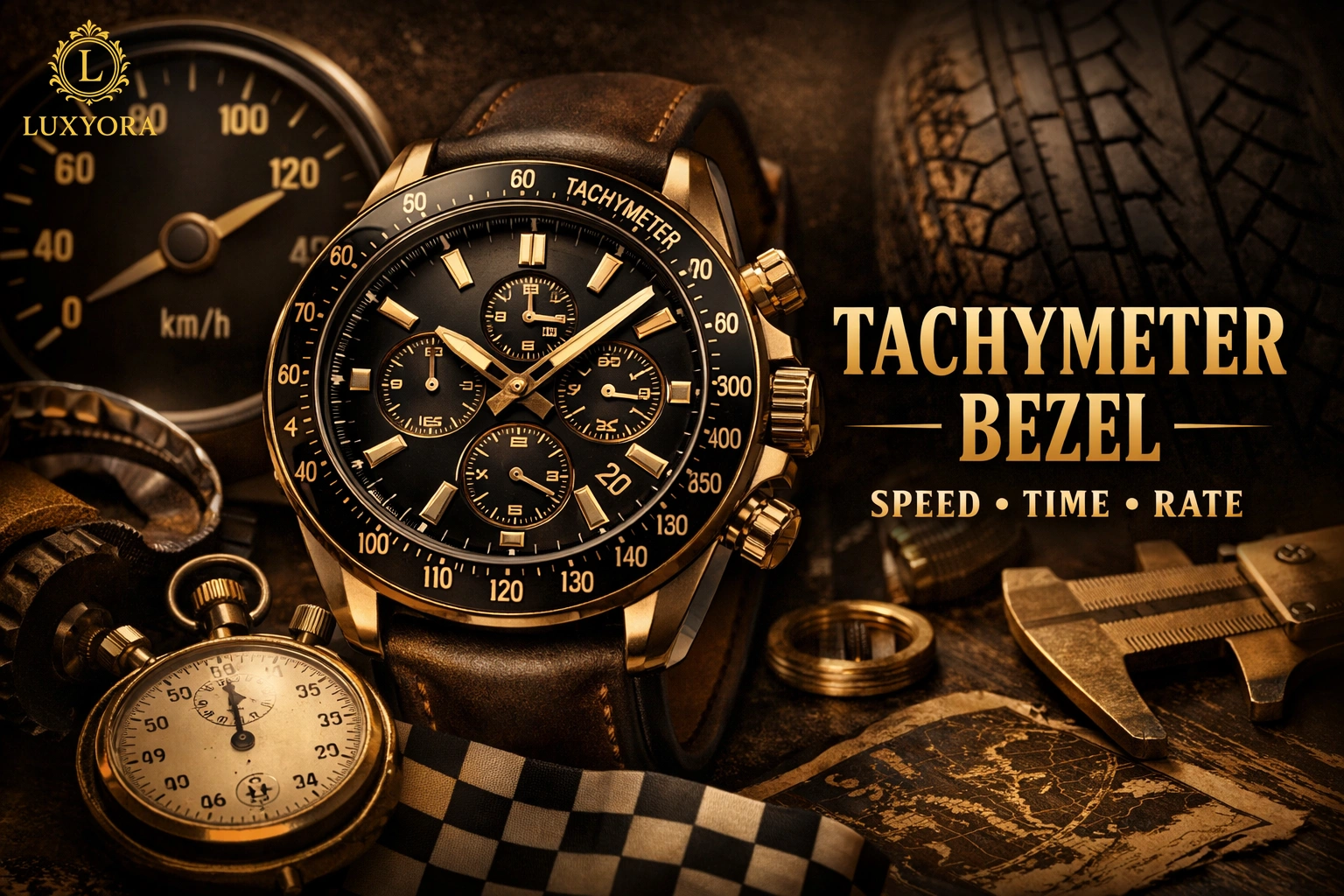
A tachymeter bezel (often spelled tachymetre in some markets) is a speed- and rate-calculation scale printed or engraved around a watch’s dial, most commonly on a fixed bezel, and designed to be used with a chronograph (stopwatch function).
In simple terms, it converts elapsed time to units per hour, allowing the wearer to quickly estimate average speed over a known distance (e.g., 1 km or 1 mile) or measure a production/event rate (units completed per hour).
What exactly is a tachymeter bezel?
A tachymeter bezel is a ring marked with numbers, typically ranging from 400 to 60, that serves as a logarithmic scale. When paired with the chronograph’s seconds hand, it enables “speed = distance ÷ time”- style calculations without doing the math in your head.
Key industry terms you’ll see:
- Tachymeter scale/tachymeter bezel: The printed/engraved scale.
- Chronograph: The stopwatch mechanism that measures elapsed seconds/minutes.
- Units per hour: The tachymeter’s output (km/h, mph, items/hour), depending on what “one unit” means in your measurement.
Why are tachymeters strongly associated with chronograph watches
A tachymeter requires a precise elapsed-time reference, typically the central chronograph seconds hand, to indicate the correct value on the bezel. That’s why tachymeters are most commonly found on racing chronographs and sport chronographs, where timing and speed estimation are part of the watch’s identity and use-case.
Some brands may print a tachymeter scale for aesthetic appeal even when it’s not functionally paired with a true chronograph (a “decorative tachymeter”), but the classic industry meaning assumes chronograph capability.
How a tachymeter bezel works (step-by-step)
1) Measuring average speed over a known distance
The classic use: measure how fast something travels over one known unit of distance (1 kilometer or 1 mile).
Steps
- Start the chronograph at the first distance marker.
- Stop it exactly at the next marker (after 1 km or 1 mile).
- Read the number where the chronograph’s seconds hand points on the tachymeter scale.
- That number is the average speed in units per hour (km/h if you used 1 km; mph if you used 1 mile).
Example: If it takes 45 seconds to travel 1 km, the hand points near 80 → 80 km/h.
2) Measuring hourly production or event rate
A tachymeter can also measure how many times an event occurs per hour, which is useful for manufacturing, sports drills, or repetitive tasks.
Steps
- Start the chronograph at the beginning of one completed unit (e.g., one finished part).
- Stop it when the unit is complete.
- Read the scale: the indicated number approximates units per hour.
The “one-minute rule” and limitations (important!)
Most tachymeter scales are designed to read accurately when the measured event takes 60 seconds or less. That’s because tachymeter readings are based on converting seconds to an hourly rate; once you go beyond a minute, many scales run out of markings or become harder to read.
Practical workarounds:
- Measure over a shorter distance (e.g., 0.5 km) and adjust mentally.
- Or measure multiple units (e.g., 2 km), then divide the reading accordingly.
Tachymeter bezel design: materials, printing, and readability
Fixed bezel vs. dial printing
A tachymeter scale can be printed:
- On the bezel (very common; highly visible, “tool watch” look), or
- On the dial flange/rehaut, or
- On the dial itself (less common, but historically seen).
Common materials and finishing
In modern watchmaking, tachymeter bezels can be:
- Stainless steel (engraved and filled with paint/lacquer),
- Ceramic (high scratch resistance and strong contrast; common on modern racing watches),
- Aluminum inserts (lighter, more vintage-leaning aesthetic),
- Sapphire overlays (less common; premium look).
Collectors and buyers often judge a tachymeter bezel by contrast, font clarity, and alignment precision because usability depends on instant legibility.
Where the tachymeter bezel shows up in the watch industry
1) Motorsports and racing heritage
The tachymeter bezel is an icon of the racing chronograph category, as much a design signature as a functional tool. Many luxury and enthusiast watches emphasize this heritage because it conveys a culture of speed, performance, and timekeeping.
2) Luxury retail and collector markets
In the pre-owned and collector ecosystem, tachymeter-equipped chronographs are often grouped as “sports chronographs” and described as having a tachymeter scale for speed calculation. Major marketplaces frequently note the tachymeter as a defining feature of chronograph listings.
3) 2025–2026 design trend notes
Recent watch coverage still highlights tachymeter scales as a functional-bezel category and as a styling motif in contemporary chronograph releases, sometimes placing the tachymeter just inside the bezel for a layered track effect.
How to teach someone to use a tachymeter bezel (quick, practical tips)
- Use a known distance: highway kilometer markers, a measured track lap segment, or a GPS-measured straight.
- Start/stop precisely: small timing errors can swing the reading.
- Remember units: the bezel doesn’t “know” miles vs. kilometers, the unit comes from what you measured.
- Pick high-contrast scales if you actually plan to use them in motion (driving/racing environments demand instant readability).
Summary: why this term matters
A tachymeter bezel is more than a ring of numbers; it’s a core horology and chronograph industry term that combines:
- a historical tool-watch function (speed/rate estimation),
- a recognizable motorsport design language, and
- modern manufacturing choices (ceramic, engraving methods, contrast engineering) that affect both usability and market appeal.
References
Bob’s Watches. (2026). What is a tachymeter bezel and how does it work? (Bobswatches.com)
Braun, P., & Radkai, M. (Eds.). (2024). Wristwatch Annual 2024: The catalog of producers, prices, models, and specifications (25th ed.). Abbeville Press. (Google Books)
Brunner, G. L. (2019). The Watch Book: Compendium. teNeues. (Amazon India)
Brunner, G. L. (2023). The Watch Book: Compendium – Revised Edition. teNeues. (Google Books)
Citizen Watch Co. (n.d.). How to use the tachymeter. Citizen Watch Global. (CITIZEN WATCH Global Network)
Kapoor Watch Company. (2024). Tachymeter tactics: Reading and maximizing your watch for every occasion. (kapoorwatch.com)
Lechevalier, B. (Ed.). (2023). The Millennium Watch Book: Chronographs (English ed.). GMT Publishing. (Monochrome Watches)
Seiko Watch Corporation. (n.d.). How to use the tachymeter (Instruction guide for 8R46/8R48). (Seiko Watch Corporation)
Slaven, E. (2025, December 13). The ABCs of time: Your guide to functional watch bezels. Monochrome Watches. (Monochrome Watches)
TrueFacet. (2018, February 15). Understanding the tachymeter bezel. (Truefacet)
TrueFacet. (2026). Chronograph vs chronometer 2026: Meaning, differences… (Truefacet)
T3. (2026). This new Czapek & Cie watch proves that green dials are making a comeback in 2026. (T3)