Mozambique Fashion Week
Mozambique Fashion Week, commonly known as MFW, is Mozambique’s principal annual platform for fashion presentation, talent development and creative-industry exchange. Founded in 2005 and organised by DDB Moçambique, the event brings together designers, models, artisans, artists, entrepreneurs and cultural voices while promoting fashion as an expression of contemporary Mozambican identity. More than a sequence of runway shows, MFW has developed into a meeting point for design, cultural storytelling, entrepreneurship, social engagement and regional collaboration.
From Tofo Beach to a National Fashion Institution
The story began in November 2005 on Tofo Beach in the coastal province of Inhambane. It was an unconventional setting for the launch of a national fashion week, but one that immediately connected the project to Mozambique’s landscape, cultural character and sense of place. From this relatively intimate beginning, MFW gradually expanded its reach and moved much of its programme to Maputo, where it could connect designers with a larger audience, commercial partners and national stakeholders.
International participation followed quickly. The official MFW archive records the involvement of creators from Nigeria, Eswatini and South Africa in 2006. In 2007, the event dedicated its opening day exclusively to Mozambican creators, reinforcing a principle that has remained central to its identity: international exchange should complement, rather than overshadow, national talent. Subsequent seasons welcomed designers from countries including Angola, Kenya, Portugal, Italy and other parts of Southern Africa.
MFW also became known for presenting fashion beyond the expected white runway. Memorable editions were staged at Maputo’s Central Railway Station, Mavalane Airport and the Maputo Port warehouse. By using transport, industrial and civic spaces, the organisers turned familiar parts of the city into settings for fashion and performance. The railway station hosted the 2009 edition, while the port returned as a major venue in 2023 under the theme Kings and Queens or O Trono é Teu.
These locations were not simply dramatic backdrops. They gave MFW a recognisably Mozambican visual language. Rather than reproducing the conventions of Paris, Milan or London, the event made Maputo’s architecture, movement and urban atmosphere part of the fashion experience.
Fashion as an Expression of Moçambicanidade
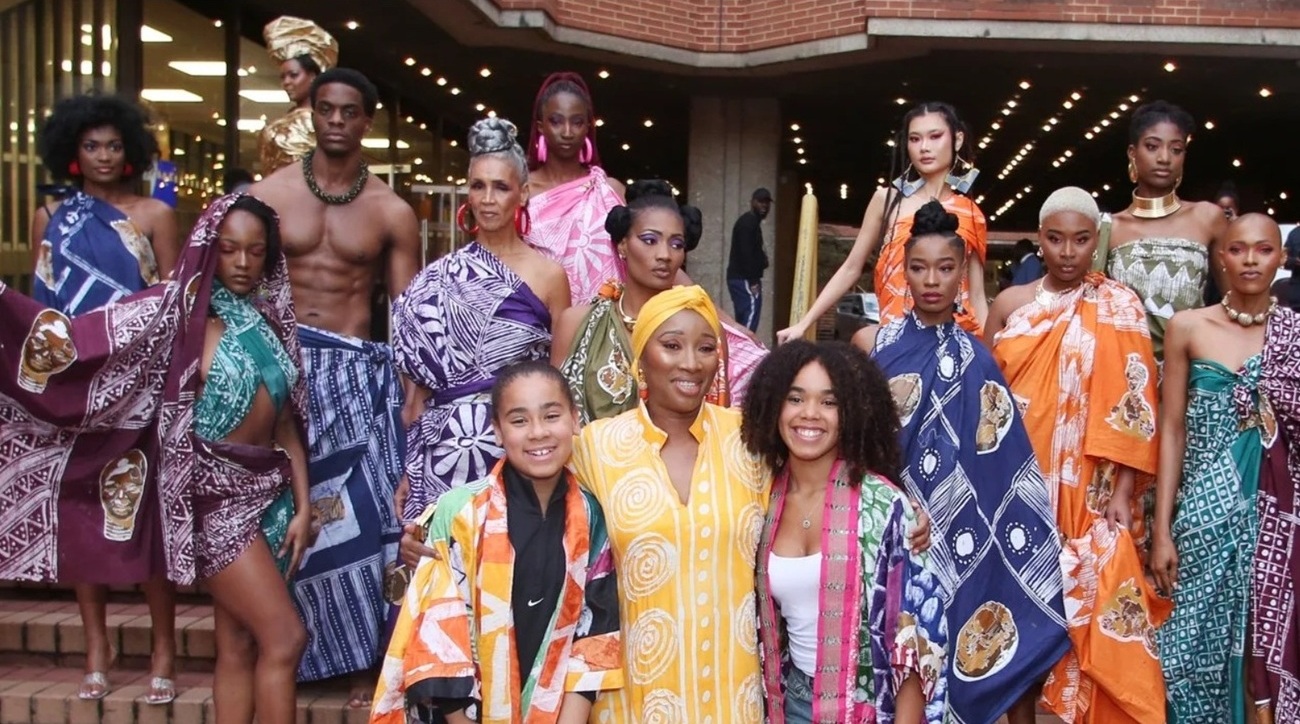
One of MFW’s defining achievements has been its encouragement of moçambicanidade, a sense of Mozambican identity expressed through colour, material, craftsmanship, silhouette and contemporary life. That identity is not presented as a fixed design formula. It appears through many approaches, from couture and occasion dressing to streetwear, crochet, accessories, tailoring and experimental fashion.
The capulana has a particularly visible place within this creative vocabulary. Some designers preserve its familiar visual energy, while others cut, layer or reposition the cloth within modern garments. MFW’s published designer profiles describe Chibaia, for example, as an afro-casual and streetwear label that uses capulana to express cultural identity. Omar Adelino is similarly recognised for bringing tradition and modernity together through an expressive use of the textile.
At the same time, Mozambican fashion cannot be reduced to print alone. The platform has supported minimalist brands, couture specialists, urban labels, crochet designers, tailors and multidisciplinary artists. MINA is presented through minimalism, cultural inheritance and limited production, while Taússy is associated with sophisticated couture and sculpted feminine silhouettes. Other participants have explored recycled materials, futurism, heritage craft and ethical production.
This breadth matters. It allows Mozambican designers to work with cultural references without being confined by them. The resulting fashion can be both local and international, ceremonial and practical, rooted and experimental.
Building a Pathway for New Talent
From its earliest seasons, MFW has placed considerable emphasis on discovering and promoting emerging creatives. Its programmes have offered young designers an opportunity to present collections in a professionally produced environment, learn how a runway operates and encounter photographers, stylists, models, media professionals and established designers.
The event’s designer archive illustrates the size and variety of this network. It includes established figures, independent ateliers and newer participants from Maputo, Inhambane, Nampula, Gaza and beyond. Designers are presented not only as makers of clothing but as entrepreneurs building identifiable labels and contributing to a wider creative economy.
Education has also appeared within the event’s partnerships. Standard Bank Mozambique, formerly a major MFW sponsor, supported the MFW School Contest. The Portuguese School of Mozambique received recognition following student Yunara Zaqueu’s victory in the 2012 competition. Her award included financial support and a trip to South Africa for a fashion workshop, while the school received a substantial collection of books connected to a national reading initiative.
By the twentieth-anniversary edition, the development pathway had become more clearly segmented. Established designers and international brands appeared on the main stage, while emerging creators were given a dedicated MFW Young Designers space. This structure allowed new talent to retain its own identity rather than being treated simply as an introductory part of the principal programme.
MFW has consequently operated as both a showcase and a point of entry. For a young creator, the value of participation may extend beyond a single collection. Runway photographs, media exposure, professional contacts and experience presenting work to a live audience can all contribute to the gradual development of a label.
Designers Shaping Contemporary Mozambican Fashion
A number of designers associated with Mozambique Fashion Week have helped broaden awareness of the country’s fashion culture.
Taibo Bacar is among Mozambique’s most internationally recognised fashion labels. Founded by designer Taibo Bacar with business partner Tatiana Ismael, the house has become known for refined womenswear, expressive materials and a polished approach to African luxury. Its visibility beyond Mozambique has demonstrated how a nationally rooted label can speak to regional and international audiences.
Chibaia represents a different but equally important direction. Based in Maputo, the label places Mozambican identity within contemporary streetwear and afro-casual clothing. Its use of capulana, relaxed silhouettes, and urban styling shows how cultural materials can be adapted for a younger, more informal fashion environment.
MINA approaches identity through restraint and limited production. Its aesthetic is described by MFW as minimalism, careful details and an exploration of Mozambican cultural duality. Taússy, meanwhile, works in a more formal couture language, with an emphasis on feminine shape, construction and occasion dressing.
Omar Adelino has combined design practice with mentorship and production, while brands such as Cuccla and Mabenna have represented Mozambique in regional exchanges. The coexistence of these different voices is one of MFW’s strengths. It prevents the event from presenting a single, simplified image of Mozambican fashion and instead reveals a creative culture with multiple generations, markets and aesthetic positions.
A Platform for Conversation and Social Purpose
MFW has repeatedly used fashion to open conversations beyond clothing. Its official history records themed presentations addressing breast-cancer awareness, domestic violence and gender-based violence. Over time, the event has also created space for discussions about inclusion, cultural participation and the social role of creative work.
The Sunset Talks, introduced during the 2018 edition at South Beach, offered a particularly clear example. Open to the public, the programme brought together professionals and interested community members for discussions on art, poetry, photography, music, entrepreneurship, social responsibility, fashion business, and cosmetics.
Sessions explored how artistic practice could contribute to national development, how young fashion businesses could establish brands and create value, and how fashion could communicate public-awareness messages. A social-responsibility session addressed breast-cancer information and the work of Associação Casa Rosa, while a fashion-business discussion considered company formation, intellectual property, brand identity and internationalisation.
The entrepreneurship strand also produced a practical outcome. Barclays Bank Mozambique presented the 2018 Best Fashion Entrepreneurship Project award to Woogui, a project founded by Wacy Zacarias that developed bag material from recycled plastic waste. The award recognised both its business potential and its environmental purpose.
Initiatives of this kind demonstrate how MFW has enlarged the conventional meaning of a fashion week. Runways remain important, but they sit alongside education, public discussion, enterprise development and cultural advocacy.
Connecting Mozambique with the Regional Fashion Economy
International participation has been part of MFW since its second edition. In more recent years, the event has strengthened its regional role through direct exchanges with neighbouring fashion organisations.
A significant step came in 2023, when Mozambique Fashion Week entered its first formal collaboration with South African Fashion Week. Mozambican labels Chibaia, Mabenna and Cuccla presented their work at the South African platform, accompanied by models Rachel Mbiza, Chantel Tomo, Rússel António and Ivanildo Lourenço.
The collaboration was positioned as an opportunity to share knowledge, build business networks and advance responsible fashion development across both countries. Vasco Rocha described the exchange as a means of encouraging entrepreneurship, innovation, and employment among young people in the regional creative industries.
This type of partnership is particularly valuable because African fashion markets are interconnected. Designers benefit when they can meet buyers, media, manufacturers and consumers beyond their domestic markets while retaining a strong national identity. For MFW, regional exchange also helps place Maputo within a wider circuit that includes Johannesburg, Cape Town, Harare, Luanda and other African creative centres.
Twenty Years: “The Story of a Revolution”
Mozambique Fashion Week celebrated its twentieth anniversary in 2025 with its most institutionally ambitious programme to date. Held at the Centro Cultural Moçambique-China in Maputo, the anniversary was organised around the theme A História de uma Revolução–The Story of a Revolution.
The wider programme ran from 1-6 December. The Mozambique Fashion Forum took place on 1 and 2 December, followed by the principal runway programme from 3–6 December. The celebrations also incorporated the first Mozambique Fashion Awards, created to recognise the designers, models, institutions and creative professionals who had contributed to the event’s development.
Approximately 50 brands participated in the runway programme. Established designers and international guests appeared on the principal stage, while emerging creators were presented through MFW Young Designers. The Ceres sustainability challenge recognised Mozambican designer Nuno Jota Jota, reflecting the growing importance of environmentally considered design within the event’s future vision.
The collections demonstrated the programme’s continental reach. Alongside Mozambican names such as Taússy, Rita Creations and Chibaia, the event featured participants from South Africa, Zimbabwe, Lesotho, Italy and other markets. GQ South Africa’s coverage highlighted the diversity of approaches, from sculptural couture and crochet to denim, tailoring and culturally grounded streetwear.
From Cotton Field to Runway
Perhaps the most important development of the twentieth-anniversary edition was the introduction of the Mozambique Fashion Forum. Organised by Imagine DDB in collaboration with the Cotton and Oilseeds Institute of Mozambique, known by its Portuguese abbreviation IAOM, the two-day forum considered fashion as part of a complete economic and cultural value chain.
Discussions addressed sustainability, technology, industrialisation and participation in international value chains. Contributors included representatives associated with UNESCO, UNIDO, CNA Federmoda, Mozambican public institutions and cotton-sector organisations. The objective was to strengthen relationships between agriculture, textile production, design, education and the market.
This “field-to-fashion” perspective marks an important stage in MFW’s evolution. It recognises that a successful fashion economy requires more than talented designers. It also depends on material production, technical skills, manufacturing, business education, financing, retail access, communication and international distribution.
For Mozambique, where cotton has long formed part of the agricultural economy, connecting locally produced fibre with design and value-added manufacturing presents a meaningful creative opportunity. The forum therefore situated fashion within a broader conversation about employment, youth entrepreneurship, cultural identity, and national production.
The Continuing Significance of Mozambique Fashion Week
After two decades, Mozambique Fashion Week’s importance lies in the relationships it has built around fashion. It has connected new designers with established names, local creativity with international exchange, cultural materials with contemporary design and runway presentation with education and enterprise.
Its history also shows that a fashion platform can grow without abandoning its original character. From the sands of Tofo to Maputo’s railway station, airport, port and cultural institutions, MFW has repeatedly allowed its surroundings to shape the experience of fashion.
The next chapter is likely to be defined by deeper professionalisation: stronger training pathways, closer links between cotton and textile production, greater support for responsible manufacturing, improved commercial access and continued African collaboration. The Mozambique Fashion Forum indicates that this work has already begun.
Mozambique Fashion Week is therefore best understood not simply as an annual date on the social calendar, but as an evolving cultural and economic platform. Its runways reveal clothing, but its wider legacy lies in the confidence, visibility and creative infrastructure it has helped build around Mozambican fashion.
References
Diário Económico. (2025, November 28). Primeiro Fashion Fórum debate como criar uma verdadeira cadeia de valor da moda.
GQ South Africa. (2026, January 12). Mozambique Fashion Week showcases African design and sustainability in Maputo.
Mozambique Fashion Week. (2025a). História: Reviva duas décadas de moda moçambicana.
Mozambique Fashion Week. (2025b). MFW 2025: A história de uma revolução.
Mozambique Fashion Week. (2025c). Mozambique Fashion Forum: Inovação, sustentabilidade e cadeias de valor.
Mozambique Fashion Week. (n.d.-a). Temporadas: Duas décadas de história e inovação na moda.
Mozambique Fashion Week. (n.d.-b). Designers: 20 anos do Mozambique Fashion Week.
Profile Mozambique. (2025). Mozambique Fashion Week celebra 20 anos.
South African Fashion Week. (2023, March 30). South African Fashion Week Spring Summer 2023 and the shaping of the new fashion future.
Standard Bank Mozambique. (2013, September 23). Winner of MFW School-2012 receives bibliographic collection.
Sultuane, S. (2018). Sunset Talks do MFW 2018.