Microencapsulation : What is Microencapsulation
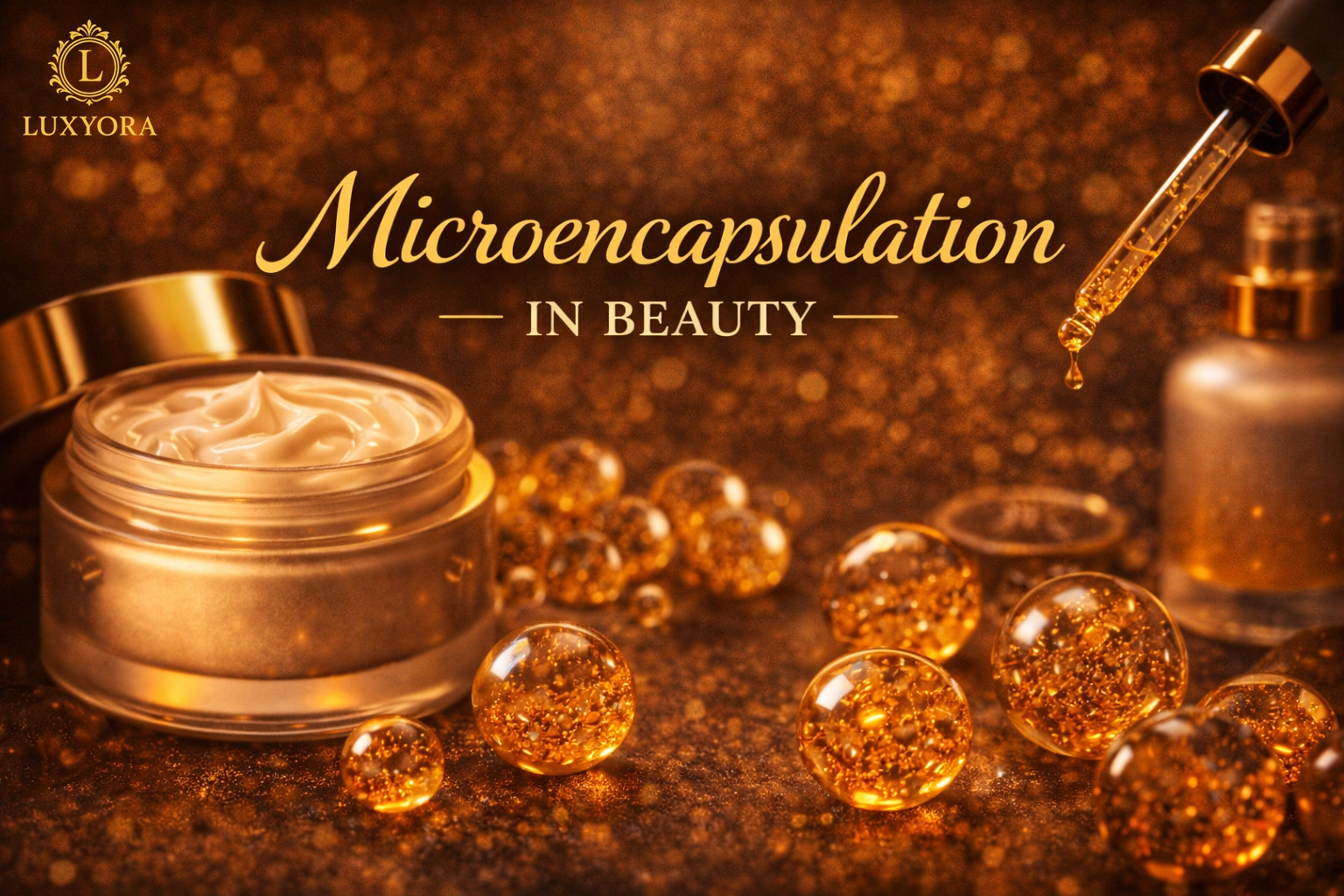
Microencapsulation is one of the most important “behind-the-scenes” technologies in modern beauty and personal care. In simple terms, microencapsulation means trapping an active ingredient (the “core”) inside a protective coating (the “shell”) to form tiny particles often in the micron range that can be mixed into creams, serums, deodorants, shampoos, makeup, and even textiles. The goal is not just to “package” an ingredient, but to control when, where, and how it is released, while improving stability and consumer experience.
In today’s beauty industry, microencapsulation supports many high-value claims consumers care about: long-lasting fragrance, freshness over time, reduced irritation, better stability of fragile actives, targeted delivery, and premium sensorial performance.
It also sits at the center of recent sustainability and regulatory discussions, particularly regarding microplastics and microcapsule shell materials in the EU.
1) What Microencapsulation Means in Beauty (Industry Definition)
In cosmetic science, microencapsulation refers to the encapsulation of droplets or particles of an ingredient with a coating or byembedding them in a matrix to form microcapsules. This protective barrier can help isolate the ingredient from oxygen, light, moisture, pH shifts, or incompatible ingredients until conditions are right for release.
The basic structure
- Core (payload): fragrance, vitamin, sunscreen filter, essential oil, antioxidant, pigment, deodorant active, etc.
- Shell (wall material): polymers, biopolymers, waxes, silica, or other matrices designed for stability and release behavior.
2) Why Microencapsulation Is Used in Cosmetics
Beauty formulations often combine ingredients that are chemically fragile or reactive. Microencapsulation addresses several recurring formulation problems:
A. Stability and shelf-life improvement
Many popular activities degrade when exposed to oxygen, UV light, heat, or water. Encapsulation can reduce oxidation and protect performance over time.
B. Controlled release and longer-lasting effects
Microcapsules can be engineered to release slowly (controlled diffusion) or to “burst” under certain triggers, helping brands deliver longer-lasting fragrance or time-release actives.
C. Reduced irritation and improved tolerability
Encapsulation can reduce “active shock” by reducing direct contact between strong actives and the skin, supporting claims such as gentler retinoid delivery or reduced sting.
D. Better sensorial experience
Encapsulation can mask unpleasant odors/tastes, reduce greasiness, and prevent discoloration, especially for sulfur notes, certain botanicals, or high-load actives.
3) What Ingredients Are Commonly Microencapsulated in Beauty?
Microencapsulation is used across skincare, haircare, deodorants, and fragrance-adjacent categories. High-impact examples include:
Fragrance and aroma systems
Microencapsulation is heavily used to protect volatile fragrance molecules and enable long-lasting scent release, sometimes triggered by friction (touch), heat, or humidity. Advanced research also explores stimuli-responsive microcapsules that switch “on/off” release based on environmental changes.
Essential oils and botanical actives
Essential oils are volatile and reactive; microencapsulation helps preserve their aroma integrity, reduce evaporation, and enable controlled release in topical products.
Sensitive skincare actives
While delivery systems vary (micro to nano), encapsulation strategies are widely used to improve the performance of actives that struggle with stability or penetration, an area that intersects with broader cosmetic delivery science.
Sunscreens and UV filters
Encapsulation approaches can improve dispersion, reduce irritation potential, and support more elegant textures, as discussed under “advanced formulation” and delivery systems in cosmetic formulation texts.
4) How Microcapsules Release Their Payload (Release Mechanisms)
A major advantage of microencapsulation is the ability to design release behavior:
- Mechanical release (rubbing/friction): common in fragrance microcapsules for “burst” scent on touch.
- Diffusion-controlled release: slow movement of the active through the shell for extended performance.
- Temperature- or humidity-triggered release: useful for fragrance and sensorial effects.
- pH- or enzyme-responsive systems: explored in broader delivery science and could support targeted release concepts.
5) Technologies and Materials Used in Cosmetic Microencapsulation
In beauty, encapsulation is not a single method; it’s a toolbox. Common approaches include:
- Coacervation (complex coacervation): forms a coating via phase separation of polymers; long used for fragrance and oil payloads
- Spray drying: a cost-effective method often used for powders and some actives.
- Polymerization/interfacial methods: can create robust shells with tunable permeability.
- Inorganic/silica microencapsulation: uses silica matrices to embed ingredients; recent dermatology literature discusses silica-based microencapsulation used in topical therapies and notes regulatory recognition of amorphous silica as an excipient in some contexts.
6) Safety, Sustainability, and Regulation: Microcapsules Under the Microscope
Microencapsulation’s biggest modern challenge is not performance, it’s environmental impact.
EU restrictions on intentionally added microplastics
The EU has moved to restrict synthetic polymer microparticles (“microplastics”) intentionally added to products, under Regulation (EU) 2023/2055, with phased compliance timelines. ECHA explains the rationale for this restriction and the goal of reducing microplastic release into the environment.
In the beauty sector, this matters because some traditional microcapsule shells can fall into the “microplastics” conversation depending on composition and biodegradability. Industry commentary in early 2026 emphasizes the complexity of timelines and the expectation that global beauty brands will need reformulation strategies.
The direction of innovation: “biodegradable-by-design” shells
A scientific discussion of microcapsule design notes pressure to move away from persistent, cross-linked shells toward more sustainable microcapsule architectures. Related research highlights the broader “microplastic label” issue surrounding some microencapsulation systems and the push toward biodegradable shell capsules.
7) What Microencapsulation Signals as an “Industry Term.”
When you see microencapsulation in a beauty context, it often signals:
- advanced delivery technology
- controlled release / time-release
- improved stability and shelf life
- sensory enhancement (especially fragrance longevity)
- premium formulation engineering
- active protection and compatibility management
and increasingly, sustainable-material innovation under new regulations
References
BeautyMatter. (2026, January 11). EU microplastics regulation: The global beauty impact. (Online) (beautymatter.com)
Dreher, F., Jungman, E., Sakamoto, K., & Maibach, H. (Eds.). (2022). Handbook of Cosmetic Science and Technology (5th ed.). CRC Press. (Offline reference) (Taylor & Francis)
European Commission. (2025). Commission Regulation (EU) 2023/2055 – Restriction of microplastics intentionally added to products. (Online) (single-market-economy.ec.europa.eu)
European Chemicals Agency. (2019). Microplastics (restriction proposal and background). (Online) (echa.europa.eu)
Fraunhofer Microencapsulation Platform. (2018). Microencapsulation for personal care applications (Newsletter III/2018). (Online PDF) (platform-microencapsulation.fraunhofer.de)
Green, L. J., et al. (2023). Silica-based microencapsulation used in topical dermatologic therapies. Archives of Dermatological Research. (Online) (Springer)
Kim, B., et al. (2020). Transdermal delivery systems in cosmetics. Experimental & Molecular Medicine, 52, 1–10. (Online) (Springer)
Kłosowska, A., et al. (2023). Microencapsulation as a route for obtaining encapsulated fragrances and aromas. Cosmetics, 10(1), 26. (Online) (MDPI)
Lobel, B. T., et al. (2024). Current challenges in microcapsule designs and sustainable alternatives. ACS Applied Materials & Interfaces. (Online) (ACS Publications)
Russell, S., et al. (2023). Encapsulation of fragrances in micro- and nano-systems: Materials and techniques. Macromolecular Rapid Communications. (Online) (Wiley Online Library)
Sousa, V. I., Parente, A., & Marques, C. (2022). Microencapsulation of essential oils: A review. Molecules. (Online, PMC) (PMC)
Benson, H. A. E., Roberts, M. S., Leite-Silva, V. R., & Walters, K. A. (Eds.). (2019). Cosmetic Formulation: Principles and Practice. CRC Press. (Offline reference) (Routledge)
Woźniak-Budych, M., et al. (2024). Microplastic label in the microencapsulation field. Journal of Hazardous Materials. (Online) (ScienceDirect)
Xiao, Z., et al. (2022). Stimulus-responsive microcapsules and their aromatic applications: A review. Journal of Controlled Release. (Online) (ScienceDirect)