Brushed Metal Hardware : What is Brushed Metal Hardware
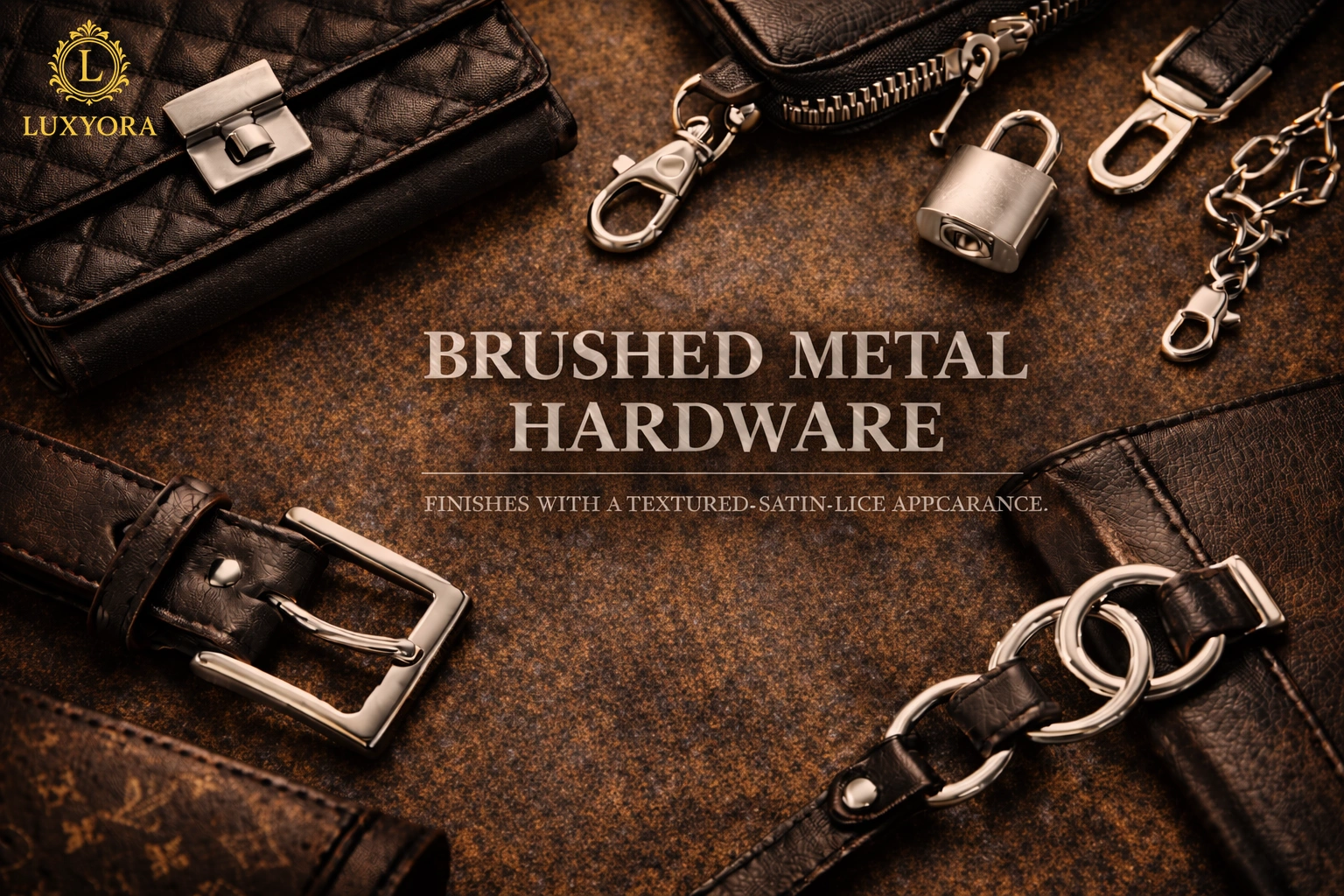
In the fashion and accessories industry, brushed metal hardware refers to metal components, such as buckles, clasps, zippers, padlocks, chains, D-rings, rivets, eyelets, snaps, logo plaques, and bag feet, that have a soft, satin-like surface texture created by controlled abrasion. Instead of a mirror-like shine, brushed hardware shows a fine directional grain (tiny linear “micro-scratches”) that diffuses light. This makes brushed finishes popular for “quiet luxury” styling because they look refined, modern, and less flashy than high-polish metal.
Brushed hardware isn’t merely an aesthetic choice; it’s a performance choice. The brushed finish helps mask fingerprints, smudges, and minor scratches, which is why brands often use it on high-touch areas like bag closures and belt buckles.
Manufacturing explanations of brushed finishing emphasize the use of controlled abrasion to create uniform satin surfaces that conceal handling marks and imperfections.
What “Brushed” Means (and What It Doesn’t)
Brushed = a texture
“Brushed” describes the surface texture, not the base metal itself. A brushed finish may be applied to:
- stainless steel
- brass
- zinc alloys
- other accessory-grade metals
Brushed ≠ plated (but it can be)
A brushed texture can be applied to bare metal or to a coated/plated surface. In fashion hardware, it’s common to see:
- brushed palladium/silver-tone
- brushed gold
- brushed gunmetal
- brushed brass / antique brass
For example, luxury resale and collector guides describe Brushed Gold hardware as gold plating given a contemporary satin finish by brushing micro-fine lines in one direction.
Why Brushed Hardware Is Popular in Fashion Accessories
1) Understated luxury and modern styling
Brushed finishes reduce glare and feel more architectural, pairing well with minimalist bags, structured silhouettes, and tonal outfits.
2) Practical wear benefits
Multiple manufacturing and finishing guides note that brushed finishes can be more forgiving in daily use because they show fewer fingerprints and hide minor scratches better than high-polish surfaces.
3) Better “aging” on high-touch parts
Because fashion hardware is constantly handled (opening/closing zippers, turning locks, sliding buckles), a brushed surface often looks “good longer,” even when it accumulates micro-wear.
Where You’ll See Brushed Metal Hardware Most Often
Handbags & small leather goods
- turn-locks, push-locks, zipper pulls, padlocks, chain straps, logo plates
Belts
- buckles, keepers, prongs, rivets
Footwear
- buckles, eyelets, decorative bars/bits
Outerwear
Fashion accessory design references treat hardware as a key component of product development and brand identity. Function and finish are part of the product’s “signature,” not an afterthought.
How Brushed Metal Hardware Is Made
1) Mechanical brushing (the classic method)
Brushing is typically performed with abrasive belts, wheels, or pads that produce a controlled, unidirectional grain pattern. The grain direction should be consistent across components for a premium look.
A helpful technical benchmark: stainless steel brushed finishes are often specified by the brushing belt/grade or by surface roughness (Ra). One stainless finish explainer notes typical average roughness values for brushed finishes of 0.2–1.0 μm, depending on the finish class.
2) Brushed + plating (color finish layered over texture)
A common luxury approach is to brush the base surface and then apply a decorative finish:
- electroplating for gold-tone or palladium-like appearances
- multi-layer systems for adhesion, corrosion resistance, and final color tone
In fashion manufacturing, finishing process choices matter because electroplating and alternatives like PVD have different durability and environmental trade-offs. A fashion-focused study compares electroplating and PVD scenarios and discusses decision-making for finishing in the fashion industry.
3) Brushed + PVD (texture stays, color changes)
An important concept in decorative coatings: PVD changes the color, not the texture. If the substrate is brushed before PVD, it remains brushed after coating, which is one reason brushed PVD surfaces can be more forgiving of fingerprints and handling marks than mirror-polished PVD surfaces.
A broader review of decorative PVD notes its expansion into decorative applications and growing interest as industries look to reduce reliance on more hazardous electrochemical processes.
Brushed vs. Satin vs. Matte vs. Polished: Industry Vocabulary
These terms are sometimes used loosely, so it’s useful to know the common logic:
- Polished: high reflectivity, mirror-like; scratches and fingerprints show easily.
- Brushed: directional grain lines; satin-like reflectivity; hides small marks well.
- Satin: often used similarly to brushed, sometimes slightly smoother/less visibly lined, depending on manufacturer terminology.
- Matte: very low reflectivity; may be blasted, etched, coated, or chemically treated.
(Brands may use “satin” and “brushed” interchangeably in marketing; specs should ideally clarify process and texture.)
How to Evaluate Brushed Hardware Quality Like a Pro
Use this checklist when buying, sourcing, or reviewing accessories:
1) Grain consistency
- Is the brushing direction consistent across matching parts (buckles, zipper pulls, rings)?
- Is the grain even, or does it look patchy/cloudy?
2) Edge finishing
- Premium brushing includes clean edges without burrs or sharp points.
- Poor finishing often shows “breaks” in the grain at corners.
3) Feel and function
- Brushed hardware should feel solid, not flimsy.
- Zippers should glide; locks should align; clips should close smoothly.
4) Coating integrity (if plated/PVD)
Look for early warning signs:
- discoloration at corners
- rub-through at high-contact points
- uneven tone or speckling
5) Fit with the material palette
Brushed finishes pair particularly well with:
- pebbled leather (texture-on-texture sophistication)
- matte leathers and suedes
- neutral and earth-toned palettes
Durability, Care, and Common Wear Issues
Even brushed finishes are not “damage-proof.” Over time, you may see:
- burnishing (areas become smoother and shinier where frequently rubbed)
- directional scuffing (marks that run against the grain)
- edge wear (coatings thin faster on corners)
Best care habits
- Wipe hardware with a soft microfiber cloth after use (removes oils/moisture).
- Keep away from harsh chemicals (perfume, sanitizer, cleaners).
- Store accessories to reduce metal-to-metal rubbing (chains vs. plaques, locks vs. zipper pulls).
Sustainability: Why “Brushed” Is Part of a Bigger Finishing Conversation
Brushed texture is mechanical, but it often forms part of a broader finishing system that includes plating/coating. That matters because metal finishing can involve complex chemical inputs and waste treatment. The fashion-industry finishing comparison (electroplating vs PVD) highlights environmental considerations and scenario-based decision support.
Meanwhile, the decorative PVD review highlights industry momentum toward coatings that reduce reliance on certain hazardous electrochemical processes, though real-world adoption depends on product requirements and manufacturing constraints.
Conclusion
Brushed metal hardware is an industry term that combines design language and real-world performance. It delivers a refined, contemporary look while helping hide fingerprints and everyday micro-scratches, making it a smart choice for high-touch accessories. The most important takeaway is that “brushed” isn’t just a label: quality depends on grain uniformity, base metal preparation, coating stack (if any), and component engineering. When executed well, brushed hardware becomes a subtle hallmark of premium craftsmanship.
References
- Gilroy, D.-J. (2023). Fashion bags and accessories: Creative design and production. Laurence King Publishing. (Laurence King Publishing UK)
- Saunders, A. (2023). Design, manufacture and sell your bag collection. Bloomsbury Visual Arts. (Laurence King Publishing UK)
- NIIR Board. (2021). Electroplating, anodizing & metal treatment handbook (Rev. ed.). NIIR Project Consultancy Services. (Niir Project Consultancy Services)
- Bandinelli, R., Fani, V., & Bindi, B. (2021). Electroplating and PVD finishing technologies in the fashion industry: Perspectives and scenarios. Sustainability, 13(8), 4453. (Laurence King Publishing UK)
- Fractory. (2019, September 13). Stainless steel finishes explained (EN & ASTM). (Fractory)
- Neway Precision. (n.d.). Brushed finishes: Aesthetic and functional applications. (Neway | Custom Parts Manufacturer)
- Sotheby’s. (2024, August 12). 4 designer handbag trends for your most stylish summer yet (includes “brushed gold hardware” examples). (Sothebys.com)
- The Stainless World. (2025, December 23). What is a PVD finish on stainless steel? (The Stainless Word)
- Vorobyova, M., et al. (2023). PVD for decorative applications: A review. Materials (Open-access via PubMed Central). (PMC)
-
-