No products in the cart.

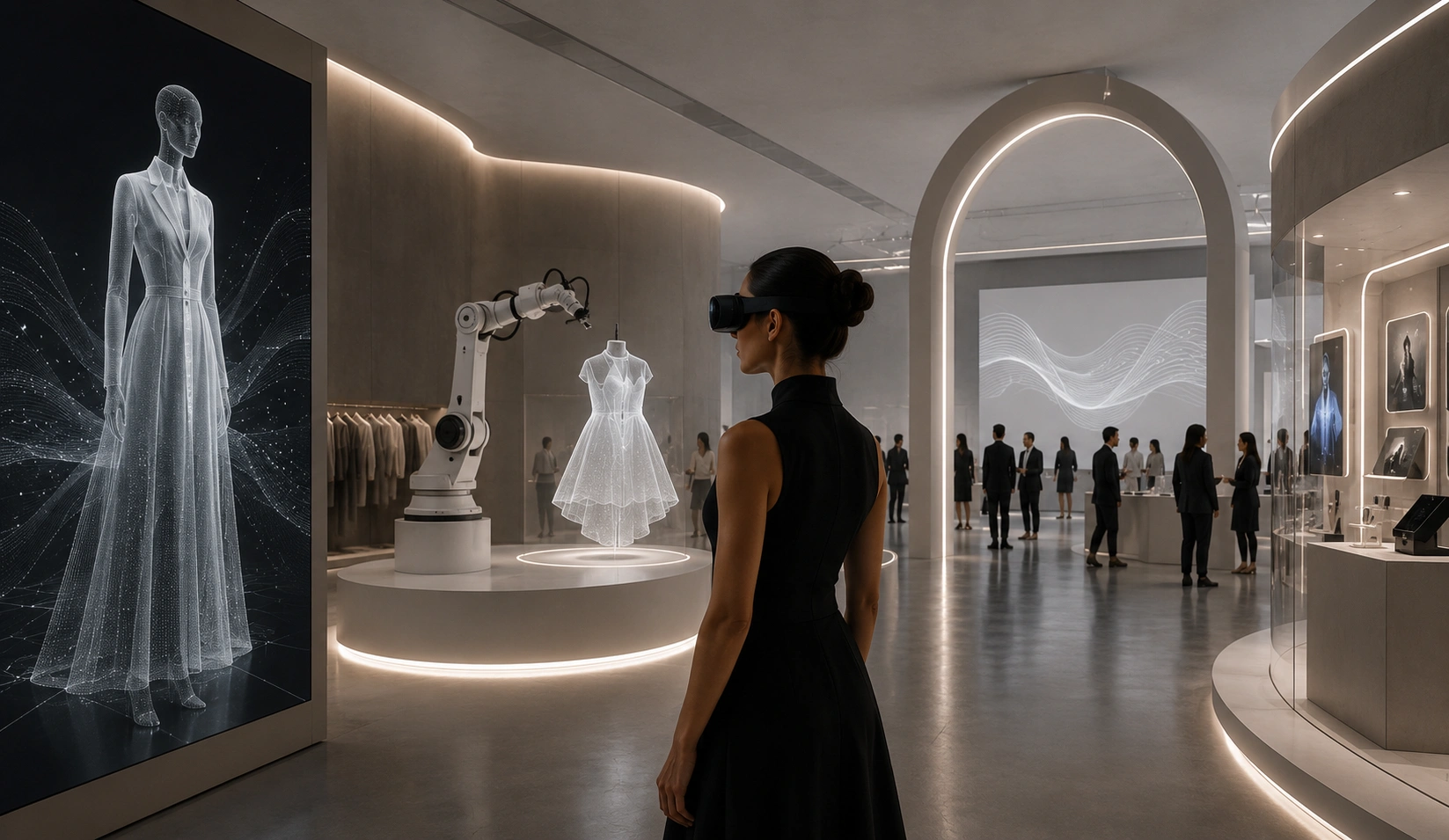
Fashion AI Expo is a Paris-based international industry platform that brings fashion brands, luxury professionals, designers, technology companies, AI startups, investors, media, and creative specialists together to explore how artificial intelligence is changing the way fashion is designed, presented, marketed, sold, and experienced. Launched in 2026, the platform combines physical events with a developing year-round digital ecosystem, placing practical technology demonstrations alongside runway presentations, industry conversations and cross-sector collaborations. Rather than treating artificial intelligence as a subject separate from fashion, Fashion AI Expo has built its program around situations in which designers, established houses, and technology developers can encounter one another directly.
That approach has quickly given the project a distinctive place within the fashion-tech conversation. Its first three physical activations took place in France within less than three months: an inaugural Paris Fashion Week edition in March, a Cannes edition in May and the Sustainability AI Summit at Château de Bertichères later that month. Its next Paris edition is scheduled for 2-5 October 2026 during the Spring/Summer 2027 womenswear season. The Fédération de la Haute Couture et de la Mode has confirmed that the wider Paris Fashion Week season will run from 28 September to 6 October 2026.
Fashion AI Expo was founded by Olga Gasnier, a Paris-based fashion photographer whose professional background places her unusually close to both image-making and luxury brand communication.
Gasnier founded Aglography, her Paris photography and video production studio, in 2020. The studio specialises in editorials, campaigns, events and e-commerce imagery, combining photography with artistic direction and brand strategy. Aglography lists collaborations involving names including Louis Vuitton, Berluti, Chopard, Pierre Cardin, Helena Rubinstein and Getty Images, while Gasnier’s published fashion work has appeared across titles including L’Officiel, Harper’s Bazaar, Marie Claire and Grazia.
That visual background helps explain the positioning of Fashion AI Expo. Its treatment of AI has not centred solely on automation. Across its programming, the emphasis has repeatedly returned to what technology can add to creative work: faster experimentation, new forms of storytelling, virtual presentation, better retail experiences and digital extensions of physical fashion.
This philosophy was visible from the first edition, where established craftsmanship appeared alongside companies working on video intelligence, wholesale technology, augmented reality, virtual try-on, and generative design.
Fashion AI Expo officially debuted on 6 March 2026 during Paris Fashion Week.
According to the organiser’s post-event record, the first edition welcomed more than 200 participants from over ten countries, alongside 14 exhibitors and six partners. Independent coverage from FAB UK Magazine also recorded guests arriving from cities including Paris, Zurich, Dubai, Barcelona, Berlin, New York and Vienna.
Maison Pierre Cardin was Guest of Honour. The participation carried particular relevance because Pierre Cardin’s design history has long been associated with futurism, experimentation and space-age forms. Rodrigo Basilicati-Cardin, President of the House of Pierre Cardin, addressed the audience on the relationship between innovation and creative vision.
His remarks offered an important framework for the evening: AI could assist designers by accelerating development and allowing ideas to be simulated before physical production, potentially saving materials, time and unnecessary prototyping. The message was not about handing authorship to software, but about using new tools to extend a designer’s ability to explore.
The first edition therefore worked on two levels. There was fashion to see, but there were also technologies that could be tested and discussed as working business tools.
Among the technology companies presenting in Paris was AIVE, represented by co-founder and CEO Olivier Reynaud. Founded in 2019 by Reynaud and Rudy Lellouche, AIVE has developed technology for analysing and transforming video content into multiple formats and versions. Its current platform positions AI as a way of handling repetitive video-production work while maintaining brand controls. AIVE reports that its technology can produce substantially more variations from existing video assets while automating a large share of repetitive production tasks.
Kingpin, represented by co-founder and CEO Harsh Sajnani, approached AI from another part of fashion’s commercial infrastructure: wholesale. The company develops technology for retailer discovery, outreach, catalogue management and order processing. Kingpin currently describes itself as an AI-powered global sales agency and states that its network includes more than 3,500 retailers, with more than $700 million in gross merchandise value facilitated since 2021. These are company-reported figures, but they illustrate why wholesale technology formed part of the Fashion AI Expo conversation: artificial intelligence is increasingly being applied not only to designing clothes but to the machinery that helps brands reach stores and markets.
The third prominent technology presentation came from DRESSX, represented by Alla Zeitoun, Vice President of Business Development. Founded in 2020 by Daria Shapovalova and Natalia Modenova, DRESSX began in digital fashion and has since developed a broader suite of AI services for fashion commerce. Its current virtual try-on products can be integrated through APIs, white-label systems and platforms including Shopify, allowing shoppers to visualise garments digitally and enabling brands to connect virtual experiences directly to e-commerce.
At Fashion AI Expo, Zeitoun demonstrated the technology using looks that had appeared physically at the event, producing digital photo and video interpretations of the same fashion. It was a practical example of the recurring idea behind the platform: a runway need not end when a model leaves the room.
The inaugural event was not structured simply as one group of technology companies speaking to another. Fashion brands themselves became part of the experiments.
Thalie Paris, founded by Nathalie Dionne, presented its “What Thalie Bag Are You?” concept, using AI-driven visuals and personality-led storytelling around its accessories.
Dia De Rose explored generative AI and virtual try-on around its cocktail and eveningwear, while Austrian jewellery company Oliver Weber presented an AI Collection combining AI-assisted design with established jewellery-making techniques. Independent coverage of the event reported that the collection was created with Swarovski crystals.
Other demonstrations pushed further into collaboration. Attach, working with Banuba, explored virtual makeup try-on and personalised recommendations. LOOK AI demonstrated its real-time creative workflow with artist Olga Vaulina, translating her iPad sketches into increasingly developed visual interpretations while she continued drawing. LOOK AI subsequently described the demonstration as a way of shortening the distance between an initial fashion idea and its visualisation.
The evening closed with a digital runway created by Terri Trovato, founder of The Darcy Agency. Trovato used generative tools to reinterpret Pierre Cardin imagery in a digital runway format, with the resulting work presented to Rodrigo Basilicati-Cardin. The juxtaposition neatly captured what Fashion AI Expo was attempting to establish from the outset: heritage fashion and computational creativity occupying the same conversation rather than opposing sides of it.
The platform returned in May with a second edition in Cannes, recorded by the organiser as taking place from 18 to 22 May 2026 during the Cannes Film Festival period.
Instead of repeating the Paris format, Cannes concentrated more strongly on immersive commerce, digital fashion presentation, AI-generated editorial content and the relationship between fashion, media and cinema.
The programme opened at Thalie Paris on Boulevard de la Croisette. Technology company OpenMall, represented by CEO Gennaro Cali and Maurizio Marseguerra, demonstrated immersive virtual showroom technology. The idea was straightforward but commercially relevant: physical fashion pieces could also exist inside navigable digital spaces, extending a showroom beyond its geographic location.
Generative-AI company Astria, represented in Cannes by CFO Daniel Rein, worked with Fashion AI Expo on another model of digital presentation. AI artist and creative director Sivan Aharon, with styling by Alexandra Pavlova, created an AI-generated fashion editorial incorporating pieces from participating brands into cinematic environments inspired by Cannes and the French Riviera. Brands represented included Oliver Weber, Aysina, Thalie Paris, BY GAIL, Elena Perseil, 21SIX, Eddie Corps, Semenenko, EPPS, Serena B, Kenzel and FAIR BLVD, among others.
Fashion Week Online also documented the OpenMall and Astria projects, including the use of immersive virtual showroom experiences and digitally constructed editorial environments.
The Cannes programme extended beyond technology demonstrations. Fashion AI Expo participated in a gala and roundtable with Listen to Her Parole, founded by Alice Chen and Naomi Massengo, bringing leadership, women’s representation, media and technology into the programme. The edition also connected its technology partners with BJS House Productions and United Fashion Designers, founded by Elmira Polyayeva, widening the conversation from technology demonstration to fashion business development.
Only days later, Fashion AI Expo staged its third 2026 activation.
The Sustainability AI Summit took place on 30 May 2026 at Château de Bertichères in Chaumont-en-Vexin, in partnership with Royal Jump. Royal Jump’s own programme confirms Fashion AI Expo’s presence at the château and describes the collaboration as combining artificial intelligence, fashion, luxury and an AI-enhanced runway experience.
Here, the discussion shifted towards responsible innovation.
Speakers included Varvara Karimova, founder of Up & Coming PR, discussing communication around sustainability; Anna Balashova, founder of Balushka and AARU, addressing ethics and craftsmanship; and Viktoriya Zorina, founder and creative director of ZORÏA, examining the role of 3D technology in product development and production.
The physical programme was equally important. United Fashion Designers, curated by Elmira Polyayeva, presented a runway featuring brands including EPPS Official, Burda Brand, VALA Fashion, Yuliia Kurlishchuk and Lastivka France. The presentation was opened by French model April Benayoum, Miss Provence 2020 and Miss World France 2021.
Elsewhere at the château, Balushka, Haute Epicure, AARU and ATTACH participated in the accompanying brand showcase, while Terri Trovato and The Darcy Agency created a digital runway experience. Independent coverage in FAB UK Magazine also documented the summit, designers and participating brands.
Fashion AI Expo is now developing beyond a sequence of standalone events.
Its official model describes two connected parts: physical events and a digital ecosystem. The online community is curated around fashion brands, AI companies, investors, founders, creatives and industry professionals, with access to updates, tools, event information and potential introductions. Its current participation material describes an audience/community of more than 1,000 members.
The platform has also introduced the Fashion AI Expo Digest, publishing commentary and analysis around developments such as virtual try-on, AI-assisted production, fashion media and luxury creativity. The publication describes its readership as spanning fashion capitals, technology hubs and investment circles across more than 30 countries.
This broader structure matters. Fashion’s adoption of AI is unlikely to be defined by one spectacular generated image or a single virtual runway. The more significant changes are happening across many smaller steps: design visualisation, content adaptation, wholesale prospecting, virtual fitting, product recommendations, digital showrooms, 3D development and brand communication. Fashion AI Expo increasingly reflects that wider picture.
The next Fashion AI Expo is scheduled for 2-5 October 2026 in Paris, placing it within the official Paris Fashion Week Spring/Summer 2027 womenswear calendar.
The currently announced structure divides the programme across four days:
Participation formats currently being offered cover technology companies, fashion brands, designers, experts and creators, with options ranging from exhibition stands and technology demonstrations to runway showcases, talks and custom collaborations.
The timing is significant. The Fédération de la Haute Couture et de la Mode has confirmed that the Spring/Summer 2027 womenswear season runs from 28 September to 6 October 2026, meaning Fashion AI Expo’s full programme sits directly inside one of the periods when international buyers, media, brands and fashion professionals are already concentrated in Paris.
Fashion AI Expo is still a young platform, but its first year already reveals what it is trying to become.
Its most interesting characteristic is not simply that AI companies exhibit beside fashion brands. It is the attempt to make the relationship tangible. A dress can move from runway to virtual try-on. A hand-drawn concept can become a digital visualisation while an artist is still developing it. An accessories company can experiment with augmented reality. A physical showroom can acquire a virtual counterpart. A heritage fashion house can sit beside a generative creator without surrendering the principles that make its design language recognisable.
That is a more useful discussion than asking whether artificial intelligence will somehow “replace fashion.”
Fashion is built from judgement, culture, memory, material knowledge, emotion and identity. Software operates differently. The opportunity being explored at Fashion AI Expo is what happens when the speed and analytical capabilities of new technology are placed around, not instead of, those human qualities.
From its first evening with Pierre Cardin in Paris to immersive projects in Cannes and conversations around responsible production at Château de Bertichères, Fashion AI Expo has begun constructing a meeting place for people working on both sides of that equation.
As the platform moves towards its October 2026 edition, its relevance will rest on the same principle that shaped its debut: fashion technology becomes most meaningful when it leaves the abstract discussion and enters the real creative and commercial processes of the industry.
Aglography. (2026). About Aglography and Olga Gasnier. Aglography
AIVE. (2026). Creative intelligence platform for video performance. AIVE
DRESSX. (2026). AI Suite: Tailored AI solutions built for fashion commerce. DRESSX AI Suite
FAB UK Magazine. (2026, March 10). Fashion AI Expo debuts in Paris, bridging fashion and artificial intelligence. FAB UK Magazine – Paris Edition coverage
FAB UK Magazine. (2026, June 16). Fashion AI Expo explores sustainability, craftsmanship and innovation at Royal Jump. FAB UK Magazine – Sustainability AI Summit coverage
Fashion AI Expo. (2026). Fashion AI Expo — Paris Fashion Week. Fashion AI Expo official website
Fashion AI Expo. (2026). Paris Fashion Week edition — March 2026. Fashion AI Expo – March 2026 edition
Fashion AI Expo. (2026). Cannes edition — May 2026. Fashion AI Expo – Cannes 2026 edition
Fashion AI Expo. (2026). Sustainability AI Summit — May 2026. Fashion AI Expo – Sustainability AI Summit
Fashion Week Online. (2026, May 20). Fashion AI Expo announces its special Cannes edition during the 2026 Film Festival. Fashion Week Online – Cannes coverage
Fédération de la Haute Couture et de la Mode. (2026). Womenswear Spring/Summer 2027: Paris Fashion Week 2026. FHCM – Spring/Summer 2027 calendar
Forbes. (2026, March 7). Venture capital is discovering fashion tech. Forbes – Fashion technology coverage
Kingpin. (2026). The leading AI-powered global sales agency for consumer brands. Kingpin
LOOK AI. (2026, March 23). LOOK AI captivates Paris Fashion Week with real-time AI design integration. LOOK AI – Fashion AI Expo demonstration
Royal Jump. (2026). Animations: Fashion AI Expo at Château de Bertichères. Royal Jump

Stay inspired with exclusive brand features, luxury insights, and the latest in fine fashion and beauty — directly in your inbox.