A Guide to Shoe Materials : Leather, Suede, and More | Luxyora
Shoes are basically the most honest thing you own: they tell the truth about where you’ve been, what you actually do for fun, and whether you’re the kind of person who carries a “just in case” blister plaster. But if you want your footwear wardrobe to look elevated and last think “quiet luxury,” not “why is this peeling?” it helps to know what your shoes are made of.
Because here’s the little secret: material is the mood. It determines how a shoe ages, how it reacts to rain, how it creases, how it cleans, and whether it’s a “wear every day” hero or a “special occasions only” diva.
Let’s decode the shoe-material universe beautifully, practically, and with zero intimidation.
Leather: the classic that can look better with time
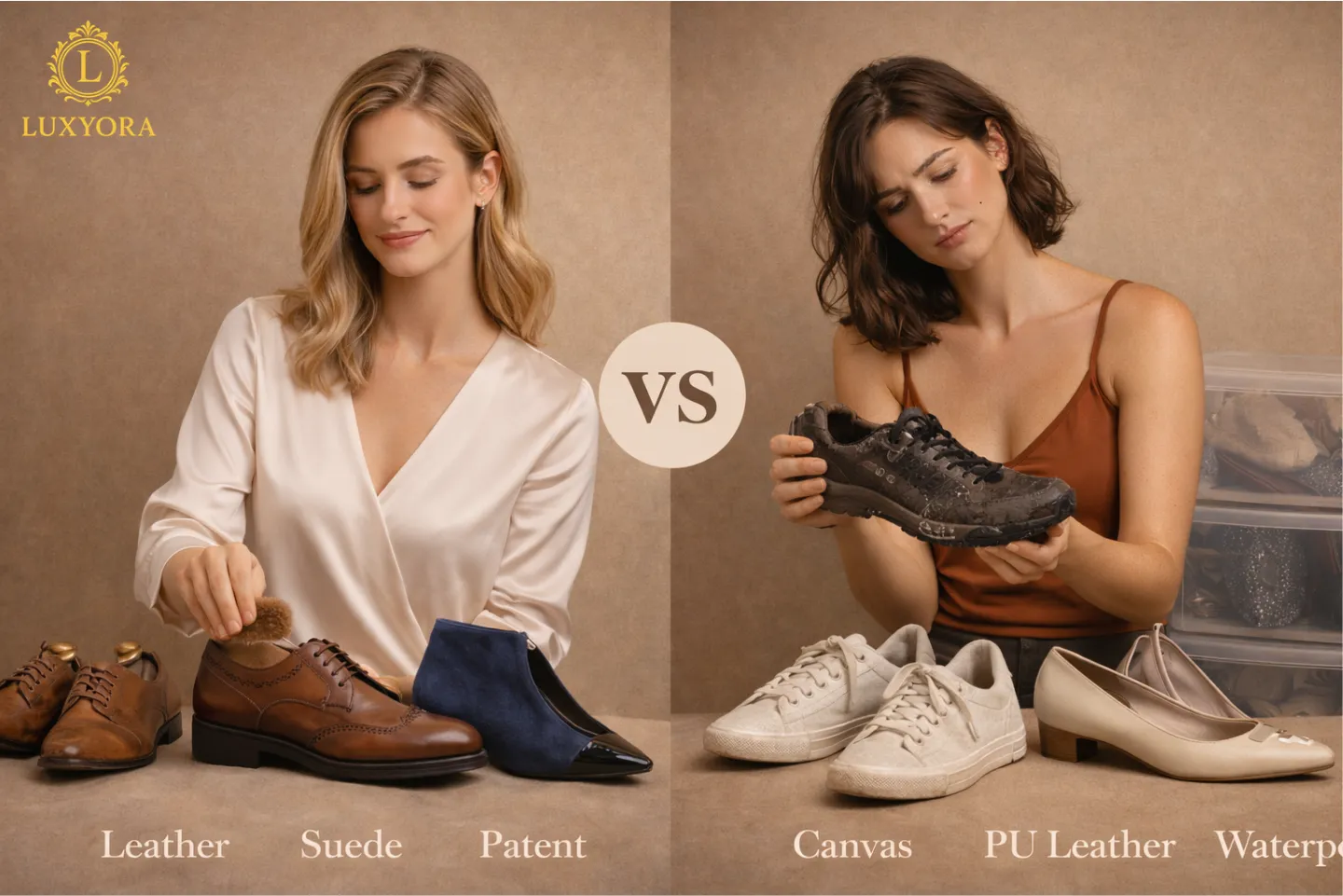
Leather is the wardrobe equivalent of a great trench: timeless, adaptable, and (when it’s good) it develops a gorgeous patina. But “leather” isn’t one single thing; there are grades and finishes that change the entire experience.
Full-grain & top-grain leather
Full-grain leather is the outer layer of the hide, with the natural surface left intact, making it typically strong and able to age gracefully. “Top-grain” refers to the upper part of the hide and can include full-grain and corrected-grain leathers.
Corrected grain & nubuck
Corrected grain leather has been buffed/sanded to remove imperfections, and nubuck is often cited as an example of this style of finish. It can feel velvety and luxe like suede’s more structured cousin.
Leather care vibe check:
- Leather loves conditioning (not too often, just enough to stay supple).
- It hates heat and harsh drying.
- It tolerates light rain better when treated, but it’s not invincible.
The best looking leather rarely looks untouched it looks maintained. If you’ve ever wondered why some shoes seem to get better over time, the answer may be simpler than you think. Read more about Shoe care 101: polishing and conditioning leather.
Suede: soft, romantic, and slightly high-maintenance
Suede is leather just from a different part of the hide, with that signature brushed nap. It’s the material of Parisian weekends and “I didn’t try” elegance. But it’s also more vulnerable to water and stains, so it asks for a little devotion.
Suede vs. nubuck (the quick distinction)
Nubuck is generally made from the grain side, giving it a tighter, finer nap. Suede is made from the underside, often softer and sometimes less durable, depending on thickness and quality.
Suede care rules you’ll actually follow:
- Brush regularly (gentle, always).
- Protect with a suede spray before the first wear.
- Avoid soaking blot, don’t rub, if you get caught in the weather.
Some materials reward careful wear, and suede is one of them. Keeping that soft, refined finish intact is less about perfection and more about understanding the rituals behind it. Explore How to clean suede shoes.
Patent leather: glossy, dramatic, and surprisingly technical
Patent leather is leather with a high-gloss coating, think mirror-like shine and formal energy. Modern patent finishes are typically achieved with synthetic coatings (often polyurethane-acrylic blends) that create a sleek, lacquered look.
What to know before you commit:
- Patent is easier to wipe clean than suede.
- It can show scuffs and can be prone to color transfer if stored against darker items so give it space. (This “store carefully” point is widely noted in patent care guidance.)
Canvas & knit: airy, casual, and summer-coded
Canvas sneakers and woven/knit uppers are light, breathable, and effortlessly cool. They’re also honest about dirt. Canvas can often be spot-cleaned, while knits vary wildly; some handle gentle washing, others prefer a careful wipe-down.
Style tip: If leather is “investment,” canvas is “capsule wardrobe,” easy, versatile, and happiest in bright weather.
Synthetic leathers: PU, microfiber, and the sustainability conversation
If you see “vegan leather,” it often means a plastic-based material such as polyurethane (PU). PU can be made to look sleek and feel soft, but it won’t age like natural leather, and it can crack or peel depending on quality, thickness, and how it’s bonded. (PU leather is broadly defined as an artificial leather using polyurethane.)
Microfiber (often “microfiber leather”)
Microfiber-based uppers are commonly marketed for their durability and ease of maintenance, and they can feel smooth and uniform. Just remember: microfiber “leather” isn’t leather, it’s a synthetic textile structure, often paired with coatings, and quality can range dramatically by manufacturer.
Sustainability note (the honest one):
Footwear sustainability is complex because shoes combine materials such as glue, foam, rubber, and fabric, making recycling difficult. Brands are exploring bio-based and recycled options, but creating durable soles without petroleum remains challenging.
There’s also tension around “vegan leathers,” which are often plastic-based and non-biodegradable, so the most sustainable choice is often the pair you’ll wear for years.
Soles and midsoles: where comfort (and aging) really happens
The upper gets all the compliments, but the sole does the real work.
Rubber outsoles (traction + durability)
Rubber is beloved for grip and resilience, especially in rain and everyday street wear. Natural and synthetic rubbers have different strengths; synthetic rubbers are often engineered for higher abrasion resistance and durability.
PU soles: soft, comfy… and prone to hydrolysis
Polyurethane (PU) soles can feel wonderfully cushioned, but they have a notorious weakness: hydrolysis, a moisture-driven chemical breakdown that can cause soles to crumble over time, even in storage.
Translation: if you have older fashion sneakers or work shoes you rarely wear, give them occasional use and store them in a cool, dry place.
EVA midsoles: the everyday cushion
EVA (ethylene-vinyl acetate) is common in sneakers and running shoes because it’s lightweight and shock-absorbing.
TPU & PEBA “performance foams” (the bounce era)
TPU- and PEBA-based foams are used in more performance-oriented footwear for their resilience and energy-return feel. Research continues to compare how different foams behave over time and under load.
Shoe materials may get the attention, but comfort, movement, and wearability often tell a different story. The detail most people overlook is hidden underneath because the way a shoe feels after hours of wear often starts with what’s underfoot. Discover How different soles change the experience of walking.
Waterproof membranes: the clean-girl version of “practical”
If you’ve ever stepped into a puddle and spent the rest of the day emotionally recovering, you already understand the appeal of waterproof-breathable membranes. Brands like GORE-TEX describe their membranes as durable barriers against water while helping manage moisture.
The key styling truth: Waterproof shoes are a lifestyle shoe. They’re perfect for commuting, travel, and rainy climates, but they can feel warmer than non-membrane shoes, so they’re not everyone’s everyday pick.
How to choose the right material (without overthinking it)
Ask yourself three questions:
- Where will I wear these most? (City pavement? Office? Rain? Events?)
- How much maintenance am I realistically doing? (Be honest. Love that for you.)
- Do I want “patina” or “pristine”?
- Patina: leather, high-quality suede/nubuck
- Pristine: coated leathers, synthetics, tightly woven fabrics
Luxyora Philosophy: Luxury is knowing what something is made of and caring for it accordingly. The most sustainable shoe is the one you’ll wear beautifully, for a long time.
References:
Carl Friedrik. (2021). Patent leather: What it is and how it’s made. (Carl Friedrik)
Kuraray. (2024, September 4). PU soles have conquered the shoe industry (hydrolysis overview). (Kuraray Elastomers)
Popov Leather. (2023, September 1). Leather quality chart: Decoding leather grades. (Popov Leather®)
Rodrigo-Carranza, V., et al. (2024). Influence of different midsole foam in advanced footwear (Sports Medicine study). (Wiley Online Library)
Safety Jogger. (n.d.). Hydrolysis: The crumbling of shoe soles explained. (Safety Jogger)
Sievi. (n.d.). Polyurethane soles: Properties, uses and challenges (hydrolysis explanation). (Sievi)
Supwell. (2023, May 30). Demystifying running shoe foams: PEBA, TPU and EVA. (Supwell)
The Tannery Row. (2021, January 28). Understanding leather grains: Top grain, full grain, corrected grain. (The Tannery Row | Leather Distributor)
Vogue. (2019). Can leather go green? (Vogue)
Vogue. (2023). Sustainability in footwear, a longstanding hurdle, makes new strides. (Vogue)
Wang, J. (2025). What is PU leather? (Definition and overview). (BTOD)
Wikipedia. (n.d.). Patent leather (care and definition overview). (Wikipedia)
Microfiber-based uppers are commonly marketed for durability and easy maintenance, and they can feel smooth and uniform. Just remember: microfiber “leather” isn’t leather—it’s a synthetic textile structure, often paired with coatings, and quality can range dramatically by manufacturer. (Winiw International Co., Ltd)