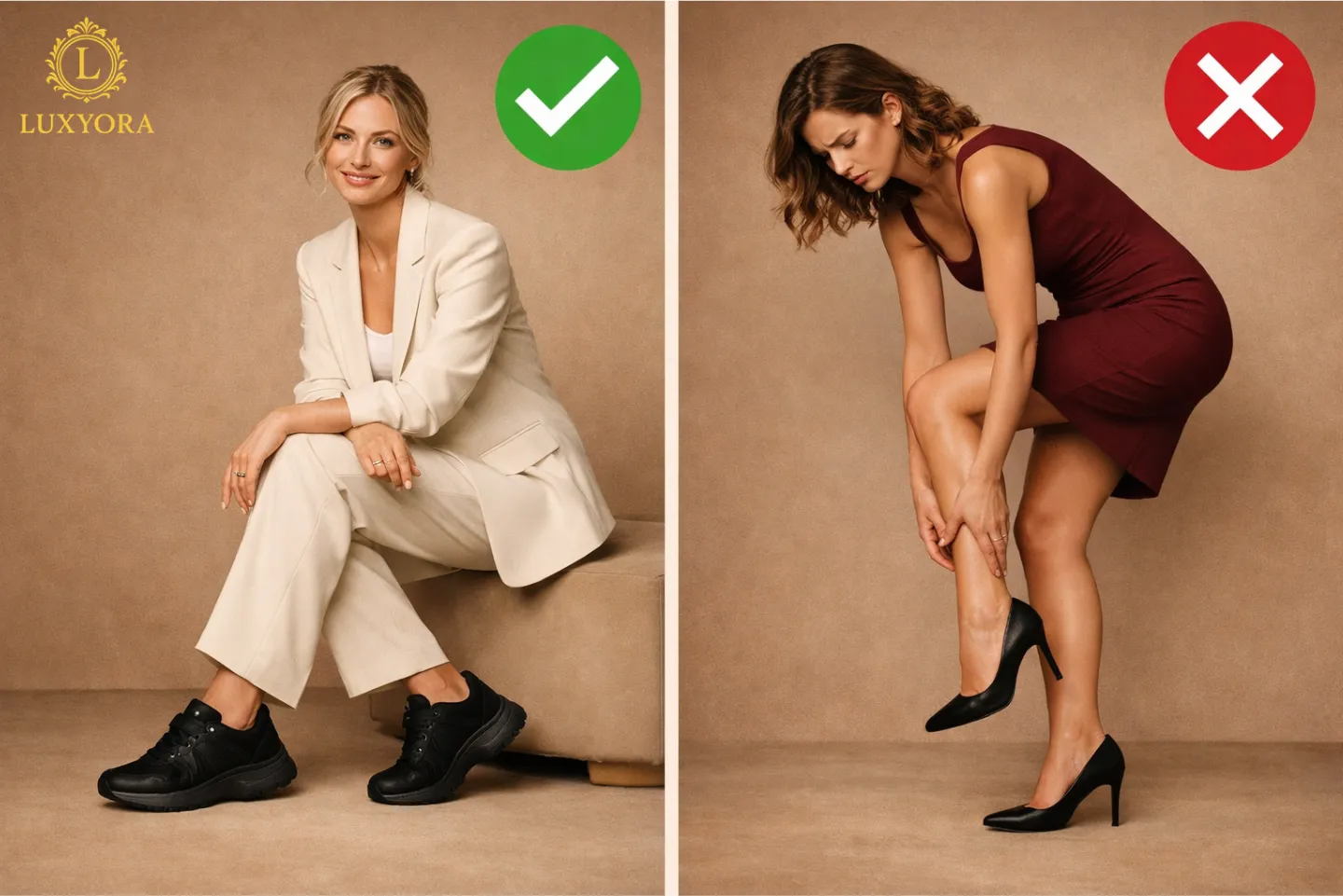
Best Shoes for Standing All Day at Work | Luxyora
There’s a particular kind of tired that lives in the soles of your feet. It shows up halfway through a long shift, quietly at first, then loudly, like your arches are filing a formal complaint. If you stand for work (retail, hospitality, healthcare, events, beauty, factory floors), your shoes aren’t “just shoes.” They’re your daily infrastructure.
And while the internet loves a dramatic “one perfect sneaker” moment, the real secret is more vogue than viral: fit, materials, support, and styling that make you feel like yourself without punishing your body.
First: what standing all day actually demands from a shoe
Prolonged standing is associated with fatigue and lower-limb discomfort, and ergonomics guidance often recommends combining supportive footwear (or inserts) with other supports like anti-fatigue mats and opportunities to sit/shift posture.
Research specifically looking at standing workers suggests cushioned materials can help reduce discomfort and fatigue, with some evidence favoring insoles as an intervention as well.
Translation: your best “standing shoe” is usually a well-fit, supportive shoe with smart cushioning and often a great insole strategy.
The non-negotiables: what to look for (even before you pick a style)
1) A stable base (because wobble = fatigue)
A shoe can be plush and still be wrong if it’s unstable. Look for:
- A wider platform under the heel and midfoot
- A firm heel counter (the back of the shoe shouldn’t collapse easily)
- Minimal twisting through the middle (some flex is fine; floppy is not)
This stability helps your foot stop “gripping” all day, keeping you secure.
2) Cushioning that absorbs impact, but doesn’t swallow your posture
Cushioning matters: evidence supports the use of cushioned materials to reduce discomfort during prolonged standing. But the trick is balance: too-soft foam can feel amazing at 9 a.m. and exhausting by 3 p.m. because your foot has to work overtime to stay aligned. Think comfort with structure.
3) Arch support that matches your foot, not a generic ideal
Some people love high arch support; others feel like they’re standing on a golf ball. If you’re unsure, start with moderate support and adjust via insoles. APMA’s public guidance emphasizes selecting appropriate footbeds and support aligned with foot needs, and the APMA Seal program is a useful shorthand for products reviewed to promote good foot health.
4) Toe room (the chicest thing you can do is let your toes exist)
A narrow toe box forces toes to compress and claw, tiny dramas that turn into big fatigue. Your toes should be able to spread naturally, especially when your feet swell later in the day.
5) The right outsole for your workplace (style is nothing without traction)
If you work on slick floors (kitchens, hospitals, salons), prioritize certified slip resistance. The most supportive shoe in the world is not worth it if you’re bracing yourself every step.
The style edit: the best types of shoes for standing jobs
The “supportive sneaker” (the modern workhorse)
This is the go-to for a reason: sneakers can combine cushioning + stability + breathability. For standing-heavy days, look for:
- A supportive midsole (not ultra-squishy)
- A secure heel and midfoot
- Removable insoles (so you can upgrade)
The search for shoes that survive long workdays no longer ends in the comfort aisle. Today’s most coveted pairs are blending runway influence with wear-all-day ease, see how in Comfort Meets Couture: The New Era of Designer Sneakers.
The “pro clog” or supportive mule (surprisingly iconic)
This is the go-to for a reason: sneakers can combine cushioning + stability + breathability. For standing-heavy days, look for:
- A supportive midsole (not ultra-squishy)
- A secure heel and midfoot
- Removable insoles (so you can upgrade)
The “all-day loafer” (polished, but secretly practical)
If your dress code leans smart, hunt for loafers with:
- A cushioned, removable footbed
- A slightly thicker outsole (thin leather soles are gorgeous, but brutal for standing)
- Enough toe room, yes, even in a loafer
The “work boot lite” (for warehouses, events, and hard surfaces)
If you’re on concrete, a boot-style shoe with a shock-absorbing midsole and a stable shank can feel like you’ve upgraded your entire skeleton. Prioritize weight: heavy boots can tire you out fast.
The real luxury: insoles, rotation, and the “whole setup”
Shoes are step one. Your system is step two.
Upgrade with insoles (especially if your workplace floor is unforgiving)
Insoles can add targeted cushioning and support; research on standing interventions suggests they can be beneficial, and there’s evidence supporting cushioned strategies for discomfort reduction.
If you’re dealing with heel pain or suspected plantar fasciitis, clinical references often mention shock-absorbing footwear and orthoses as part of conservative care.
Rotate shoes like you rotate skincare
Wearing the same pair daily compresses cushioning and repeats the same pressure patterns. Rotating pairs can help vary loading and improve recovery. Emerging clinical research has even explored “shoe rotation” strategies for heel pain management.
If you can influence your environment: anti-fatigue mats matter
Standing on softer surfaces can reduce the negative effects of prolonged standing, and controlled studies have found benefits from anti-fatigue mats in fatigue-related outcomes.
If your workplace allows it, pairing great shoes + a mat is an elite combo.
Fit checks: how to know you’ve nailed it
Try shoes at the end of the day (your feet swell, reality is not a morning fantasy). Then do this quick “standing-shift test”:
- Heel: doesn’t slip when you walk
- Midfoot: feels held, not squeezed
- Toes: can wiggle; no pinching
- After 10 minutes standing: you feel stable, not like you’re balancing
And if your feet hurt in new places after switching shoes, don’t “push through.” Pain is data.
The shoes that keep you comfortable through long workdays may have less to do with cushioning and more to do with a detail hiding in plain sight. See why finding your perfect pair starts with How to Choose the Right Shoes for Your Foot Type.
A final note, from one glamorous realist to another
The best standing shoe doesn’t have to look orthopedic or feel like surrender. You can absolutely have shoes that are supportive and stylish because elegance isn’t about suffering. It’s about moving through your day like you’re supported.
Luxyora Philosophy: Comfort is not a compromise; it’s a standard. Choose what supports your body today, and your future self will walk like she owns the room.
References:
- Centers for Disease Control and Prevention, National Institute for Occupational Safety and Health. (2019). Using Total Worker Health® concepts to reduce fatigue-related risks (Publication No. 2019-102). U.S. Department of Health and Human Services. (CDC)
- Buchanan, B. K., & Kushner, D. (2024). Plantar fasciitis. In StatPearls. StatPearls Publishing. National Center for Biotechnology Information. (NCBI)
- Lu, Z., Chen, H., & Zhang, Y. (2021). Gait characteristics and fatigue profiles when standing on an anti-fatigue mat for long periods. Biology, 10(11), 1083. (MDPI)
- Speed, G., Harris, K., & Keegel, T. (2018). The effect of cushioning materials on musculoskeletal discomfort and fatigue during prolonged standing at work: A systematic review. Applied Ergonomics, 70, 300–314. (PubMed)
- Tedeschi, R., et al. (2024). Footwear and foot health: Unveiling the role of proper shoe fit in preventing podiatric disorders and enhancing well-being. Applied Sciences, 14(21), 9938. (MDPI)
- American Podiatric Medical Association. (n.d.). Seal of Acceptance/Approval database (Seal DB). (Content accessed 2026). (APMA MAIN)
- Koo, S. W., et al. (2024). Effectiveness of shoe rotation in managing plantar fasciitis pain. Journal of Clinical Medicine, 13(16), 4624. (MDPI)
No amount of resoling or repair can restore alignment, balance, or form. When the shoe no longer supports your foot properly, it’s more than cosmetic—it’s biomechanical inefficiency.