How to Choose Clothes That Actually Suit Your Body Type | Luxyora
Let’s retire the myth that “flattering” is code for “hiding.” The real goal is alignment: clothes that echo your proportions, move with your lifestyle, and make you feel like you walked out of your own editorial. Body-type dressing isn’t about squeezing yourself into a category. It’s about learning a few styling levers (line, structure, length, and balance) and pulling them with intention.
Fashion researchers have been saying it plainly: fit isn’t just about size; bodies with the same labelled size can experience very different fit issues because shape affects how a garment hangs and where it strains or puddles. In other words: if you’ve ever blamed your body for a stubborn waistband or a gaping shirt, it’s not you. It’s the pattern.
Step 1: Ditch the “one perfect body” idea and keep the useful parts of body typing
Body typing can be helpful only if you use it like a map, not a verdict. The classic shapes (hourglass, rectangle, pear/triangle, inverted triangle, apple/round) are essentially shorthand for the proportions of how shoulders, bust, waist, and hips relate.
But modern style culture is (finally) shifting toward the idea that everybody is “a good body,” and that self-presentation should feel joyful, not punitive. So treat body type as a starting point for experimentation, not a rulebook that bans you from trends.
Quick, low-drama way to find your “working proportions”:
- Stand in front of a mirror (or take a straight-on photo).
- Notice what reads widest visually. Is it your shoulders, bust, hips, or midsection?
- Notice your vertical line: long torso, long legs, or balanced.
That’s enough to start making smarter choices.
Step 2: Make “fit” your non-negotiable (and learn what fit actually means)
Fit has both a feel and a look. Apparel pros often evaluate it with objective criteria like ease (room to move), balance (hang), and line (how seams fall). You don’t need the jargon, you just need the checklist:
- Shoulders first: If the shoulder seam is off, everything else will look off.
- Waistband truth: If it digs in when you breathe, size up and tailor down elsewhere.
- Seat and thighs: If fabric pulls into diagonal lines, you need more ease (or a different cut).
- Bust gaping: Try a different brand, a stretch weave, or tailoring. Don’t “just tape it” and suffer.
The Luxyora-level secret: buy for the part of you that needs the most room, then tailor the rest. Tailoring isn’t “extra.” It’s how clothes become yours.
Understanding how fit shapes proportions may change the way you dress altogether. Learn more in How Proper Fit Changes the Way Clothes Look.
Step 3: Choose silhouettes that balance, not “correct”
A gorgeous outfit is usually a balancing act: volume meets sleekness, structure meets softness, length meets proportion. A Vogue India feature on dressing across diverse builds boils it down to the essentials: proportion, detail, cut, fit, and confidence. That’s the whole game.
Here’s how to translate that into outfits you can actually wear:
If your shoulders/bust feel dominant (often “inverted triangle”)
- Go for clean, open necklines (V, scoop, square) to elongate the upper body.
- Balance with movement below: wide-leg trousers, A-line skirts, pleated or draped bottoms.
- Keep shoulder details minimal if you don’t want extra emphasis.
If your hips/thighs feel dominant (often “pear/triangle”)
- Use visual pull upward: statement earrings, interesting collars, brighter tops.
- Choose bottoms with structure and skim: straight leg, bootcut, trousers with a defined waistband.
- Look for fabrics that don’t cling. Think denim with stretch recovery or fluid crepe.
If your waist is defined (often “hourglass”)
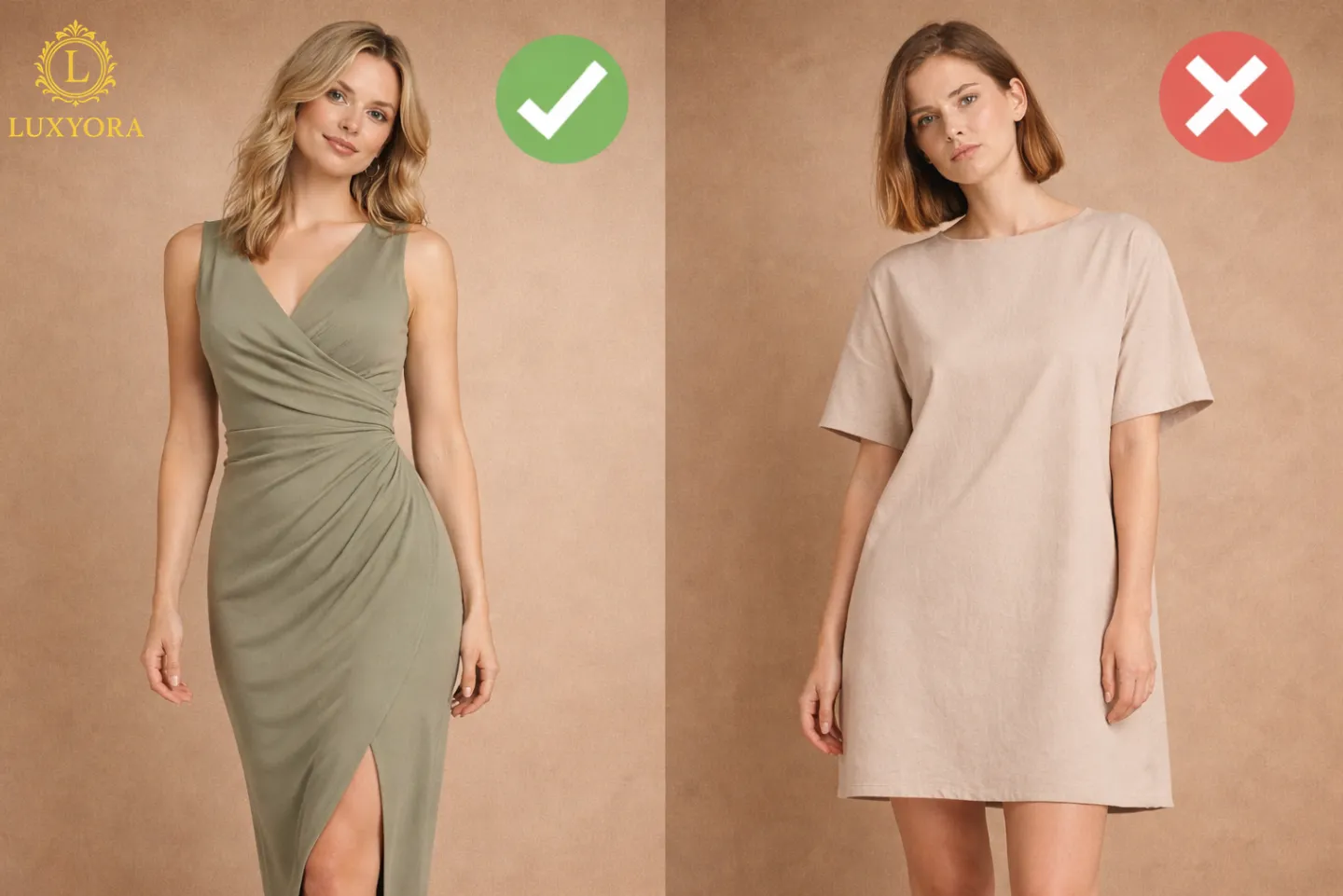
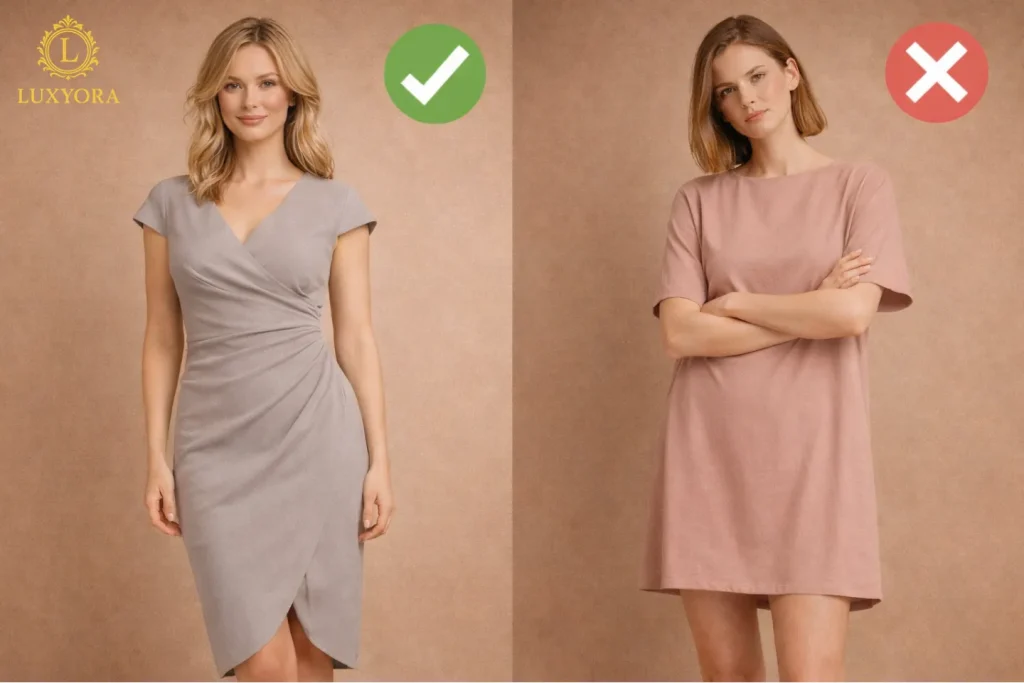
- Your best friends are waist definition and clean lines: wrap tops, belts, shaped blazers.
- Be cautious with overly boxy cuts if you want to keep your natural shape visible.
- Bodycon can work beautifully, but comfort and fabric quality matter.
If your waist feels less defined (often “apple/round” or “rectangle”)
- Aim for intentional shaping, not squeezing: seams, darts, wrap details, gentle cinching.
- Try column dressing (similar tones top-to-bottom) to lengthen the silhouette.
- Add structure with a blazer, longline vest, or crisp shirt, then soften with a drapey pant or skirt.
Step 4: Use the “rule of thirds” like a stylist
Want that “effortless but expensive” proportion that makes mirrors kinder? Try dividing your outfit into thirds rather than halves. High-rise trousers + a tucked knit, or a cropped jacket over a longer dress, creates visually pleasing ratios, especially helpful if you feel “cut in half” by mid-rise bottoms.
Also: if you’re petite, don’t default to “tiny everything.” Often the win is clean hemlines and uninterrupted lines, not miniature details.
Step 5: Fabric is the quiet hero
Silhouette is the plan; fabric is the execution. The same cut in a clingy knit vs. a structured cotton can read like two completely different garments. When in doubt:
- Structure (poplin, denim, twill) gives shape and polish.
- Drape (crepe, silk blends, viscose) skims and moves.
- Stretch with recovery prevents bagging and helps fit across curves.
If you only remember one thing: your “best” fabric is the one that matches your comfort and movement. Because if you’re tugging at your outfit all day, it’s wearing you.
Step 6: Shop brands, not just sizes - because sizing is not standardized
Retail sizing is famously inconsistent, and that inconsistency contributes to poor fit experiences. The most stylish move you can make is treating each brand like its own country with its own sizing language. Try on multiple cuts, save what works, and repeat.
And yes, more fashion voices are pushing for broader sizing access and less segregation of bodies in shopping spaces. That matters because “suiting your body type” also means you deserve options that meet you where you are.
Step 7: Wear the outfit with a body-positive lens
Style isn’t therapy, but it does shape how we inhabit ourselves. Research suggests that body-positive imagery can increase body satisfaction compared with idealized imagery
Translation: follow people whose style inspires you and whose bodies feel real, diverse, and joyful. Your algorithm is part of your wardrobe.
And if you need a mantra: your clothes are there to serve your life, not postpone it until you’re “worthy.”
The right outfit doesn’t just change appearances, it quietly changes posture, presence, and the way you move through the world. Discover more in How Apparel Shapes the Way You Carry Yourself
Luxyora Philosophy:Dress for resonance, not rules: when your clothes honor your proportions and your comfort, confidence stops being a performance and becomes your default.
References:
- Chrimes, C., Boardman, R., McCormick, H., & Vignali, G. (2023). Investigating the impact of body shape on garment fit. Journal of Fashion Marketing and Management. https://doi.org/10.1108/JFMM-03-2022-0049
- Fasoli, F., & Constantinou, D. (2024). Does body positivity work for men as it does for women? The impact of idealized body and body positive imagery on body satisfaction, drive for thinness, and drive for muscularity. Acta Psychologica, 243, 104126. https://doi.org/10.1016/j.actpsy.2024.104126
- Hidayati, S. C., Hsu, C.-C., Chang, Y.-T., Hua, K.-L., Fu, J., & Cheng, W.-H. (2018). What dress fits me best? Fashion recommendation on the clothing style for personal body shape. In Proceedings of the 2018 ACM Multimedia Conference (MM ’18). ACM. https://doi.org/10.1145/3240508.3240546
- Singer, M. (2022, February 23). What’s changing – and what isn’t – about fashion’s relationship to the body? Vogue India. Reference : https://www.vogue.in/fashion/content/whats-changing-and-what-isnt-about-fashions-relationship-to-the-body
- Elizabeth, M. (2021).In Katie Sturino’s First Book, Body Acceptance Is for Everyone. https://www.vogue.com/article/katie-sturino-book-body-talk
- van Deemter, C. (2018, July 24). How these four women learned to dress for their diverse shapes. Vogue India. https://www.vogue.in/content/how-these-four-women-learned-to-dress-for-their-diverse-shapes
- Waldman, A. (as told to Okwodu, J.). (2022, February 2). Universal Standard is the most size-inclusive brand in fashion—now they want the rest of the industry to follow suit. Vogue. https://www.vogue.com/article/universal-standard-alexandra-waldman-size-inclusivity-in-2022