Is Mass Production Killing Handbag Craftsmanship? | Luxyora
Walk into any shopping district, and you’ll see it: handbags everywhere, endlessly refreshed, perfectly photographed, and produced at a speed that would make even the most dedicated trend forecaster dizzy. A new drop, a new “it” shape, a new shade with a name that sounds like dessert. And yet, behind the glossy carousel of launches, a quieter question is tugging at the stitching: is mass production slowly suffocating true handbag craftsmanship or simply reshaping it into something else?
The answer isn’t a clean yes or no. It’s more like a well-worn leather handle: layered, textured, and shaped by pressure over time.
What “craftsmanship” really means in a handbag
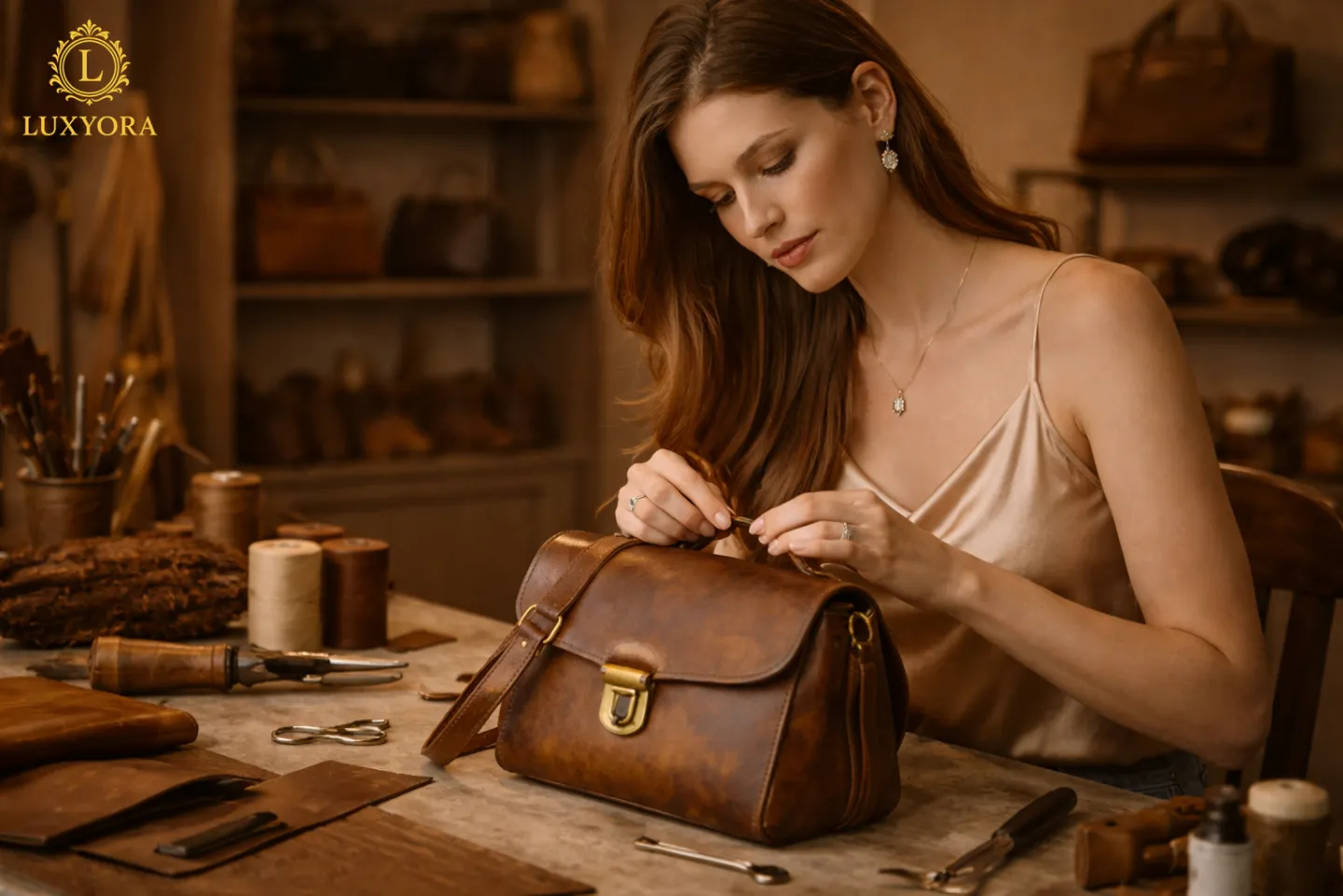
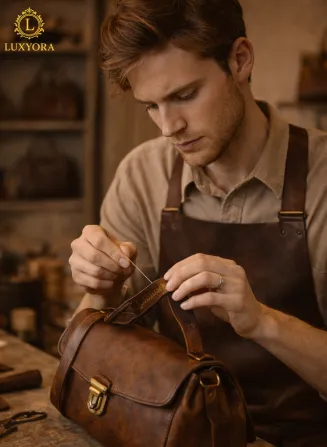
Craftsmanship isn’t just a romantic idea, though it certainly looks good in a heritage campaign. At its core, it’s the combination of material knowledge, manual skill, precision, and time, the kind of time that can’t be compressed without consequences. Traditional craft definitions emphasise an artisan’s direct manual contribution as the most important part of the finished object, even when tools or machines are involved.
In handbag terms, craftsmanship shows up in details you can feel: a clean edge finish that doesn’t crack after a season, a handle anchored to take years of movement, stitching that holds its tension, and corners that wear gracefully instead of unravelling. It’s also in the invisible: thoughtful pattern cutting, reinforcing stress points, selecting leather that will age well, and understanding how each hide behaves.
The mass production effect: speed changes the standard
Mass production is designed for consistency, scale, and cost efficiency. It’s not inherently “bad”; it’s given more people access to functional bags and can deliver impressive uniformity. The issue is what happens when volume becomes the primary goal, and craftsmanship becomes the marketing garnish.
When timelines shrink, there’s less room for slower processes that improve longevity, careful leather selection, controlled conditioning, multi-step edge finishing, thorough quality control, and the kind of training that turns a worker into an artisan. In high-speed manufacturing, tasks are often split into narrow steps to achieve faster output and easier standardisation. That system can be efficient, but it can also dilute the holistic “maker’s eye” that catches small issues before they become big ones.
And then there’s material strategy. To keep up with aggressive price points and trend churn, brands may favour heavily coated leathers and high-surface finishes that photograph beautifully and resist scratches in the short term, but don’t always develop character in the long term. Some finishes are designed to stay visually stable rather than evolve into a patina. That’s a valid design choice, but it quietly changes the emotional relationship: the bag is less likely to “become yours” over time.
But here’s the twist: mass production doesn’t just erase craft, it can push it into luxury’s spotlight
In the luxury world, craftsmanship has become a competitive weapon rather than a quaint tradition. When mass-market production floods the landscape with lookalikes, the genuinely well-made bag stands out precisely because it refuses to be rushed. Many heritage houses and newer ateliers have doubled down on artisan training, small-batch production, and workshop-based models where one craftsperson completes large portions of a bag (or even an entire bag).
This isn’t just storytelling. Some luxury workshops use long apprenticeships and structured training programs to build skills over time, precisely because scaling quality is harder than scaling volume. Craft becomes the “moat”: the thing that can’t be replicated overnight, no matter how advanced the supply chain is.
The real threat isn’t machines, it’s the loss of skills
The most fragile ingredient in craftsmanship is not leather or thread. It’s people.
Across Europe, craft sectors have flagged challenges around skills pipelines, training pathways, and attracting the next generation into hands-on trades. Craft work demands patience, precision, and long learning curves and in a culture addicted to instant results, that’s a hard sell unless the profession is respected, visible, and financially viable.
When fewer young workers enter the field, brands face a bottleneck: you can build more workshops, but you can’t shortcut mastery. The risk is that craftsmanship becomes concentrated and protected inside a few high-end houses, while the broader ecosystem of independent makers and small ateliers struggles to survive.
Sustainability and transparency are forcing a craft rethink
There’s another pressure mass production can’t ignore anymore: sustainability expectations. Leather supply chains, chemical management, worker welfare, and traceability are increasingly scrutinised, with industry standards evolving to address environmental and social performance. These frameworks don’t automatically equate to craftsmanship, but they raise the bar for responsible production.
This matters because “cheap and fast” becomes harder to justify when customers care about lifecycle, repairability, and long-term value. The conversation is shifting from “How many bags can we sell?” to “How long will this bag last, and what does it cost the world to make it?”
Luxury, interestingly, sometimes aligns with “slow fashion” principles, not because it’s morally perfect, but because durability and repair culture fit the logic of craftsmanship. A bag designed to be repaired is one built with construction integrity. A bag built to last naturally elevates skilled labour.
Where craftsmanship is heading: hybrid is the new normal
So, is mass production killing handbag craftsmanship?
It’s definitely changing it. The future looks less like a pure battle between factory and atelier, and more like a spectrum:
- Industrial craftsmanship: smart tooling, consistent processes, better quality control, still scaled, but improved.
- Artisan luxury: slower, skill-heavy production where time is part of the value.
- New craft: emerging materials, upgraded finishing technologies, and modern training that blends tradition with innovation.
The most exciting brands will be the ones that stop pretending craftsmanship is only about nostalgia. Real craftsmanship is a living practice. It can include innovation. It can be modern. But it cannot be faked because the bag will reveal the truth at the corners, the stitches, the edges, and the fifth year.
In the end, mass production doesn’t “kill” craftsmanship in one dramatic moment. It erodes it when consumers are trained to expect endless novelty at disposable speed. And it strengthens it when buyers demand fewer pieces made better, worn longer, repaired proudly, and passed on with stories stitched into the lining.
Luxyora Philosophy: True luxury isn’t how quickly something is made, it’s how beautifully it lives over time. Choose craftsmanship that respects the hands behind it and the years ahead.
References:
- Abdelmeguid, A., Afy-Shararah, M., Salonitis, K., & Athanassopoulou, N. (2024). Insights into sustainability and circular economy trends in luxury fashion: Drivers shaping the landscape in the UK. Cleaner Engineering and Technology, 18, 100681.
- Crafting Europe. (2022). The craftsmanship sector in Europe (European craft sector report). Crafting Europe.
- Leather Working Group. (2021). LWG standard P7: Leather manufacturer audit standard (Version 7). Leather Working Group.
- Leather Working Group. (2021). LWG leather manufacturer audit protocol (Issue 7.0). Leather Working Group.
- Rehn-Groenendijk, J., Lehmann, L., & Schenten, J. (2022). Handbook of leather design for sustainable development. Hochschule Darmstadt.
- UNESCO Intangible Cultural Heritage. (n.d.). Traditional craftsmanship (ICH domain description). UNESCO. (Content current through 2024)
- van der Laan, E., & Velthuis, O. (2020). Cultural meaning and market value in luxury: The role of craft and authenticity. Journal of Cultural Economy, 13(5), 1–16.