Why Fragrance Feels More Personal Than Any Other Accessory | Luxyora
There are accessories you choose in the mirror and accessories you choose in the air.
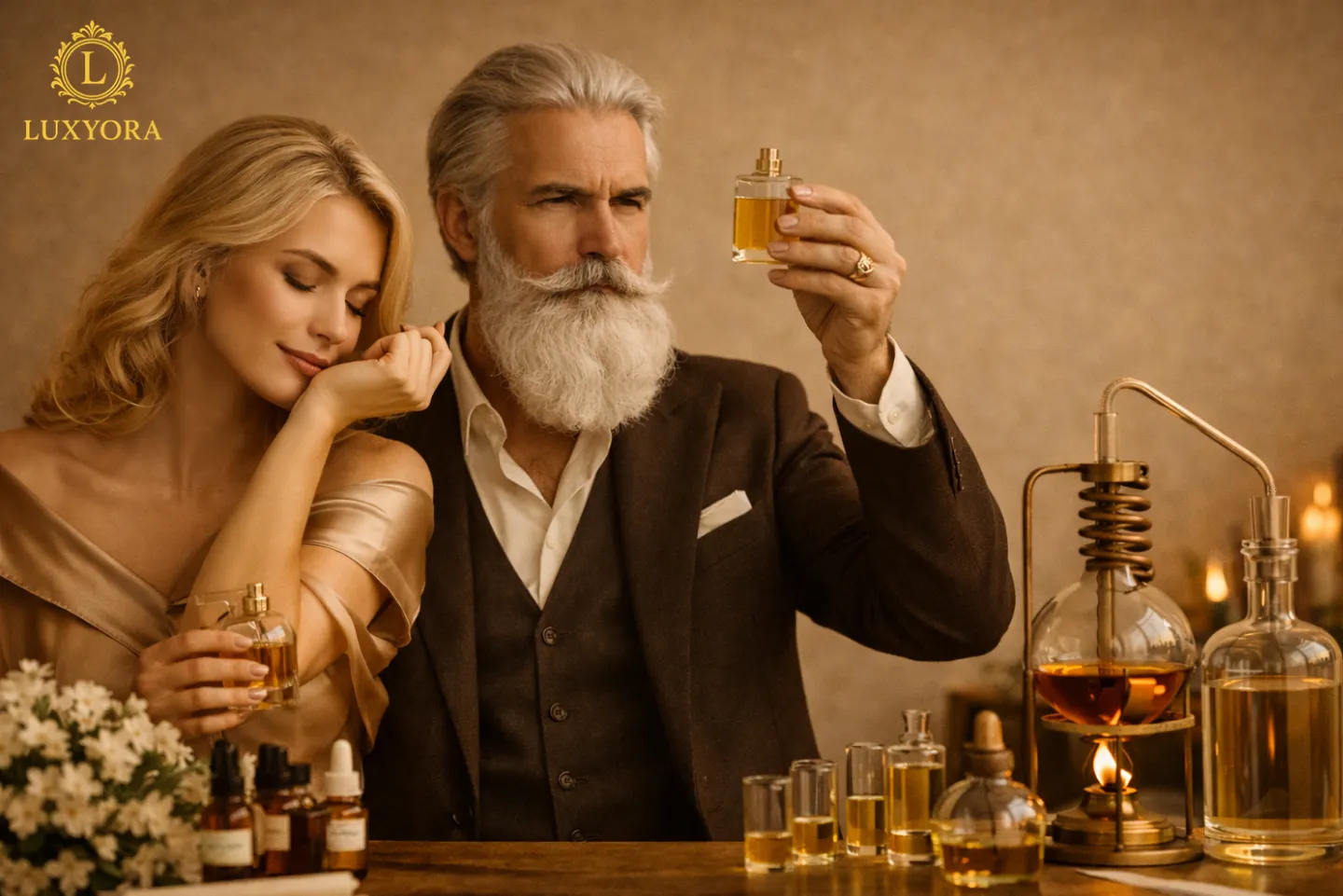
A bag can be iconic, a watch can be heirloom-worthy, and a pair of sunglasses can give instant mystique. But fragrance? Fragrance doesn’t just finish your look. It introduces you often before you’ve said a word, and sometimes long after you’ve left the room. It’s the only “accessory” that merges with skin, mood, memory, and chemistry to become something quietly, unmistakably yours.
It’s the one luxury you wear with your nervous system
Fragrance is intimate because smell is intimate. Unlike the other senses, which take the scenic route through the brain, scent has a famously direct line to regions linked to emotion and memory. That’s why one accidental inhale can time-travel you: a childhood dressing table, a specific train station, a particular person’s shoulder in a dimly lit party. Not a vague recollection, something vivid and physical, like your body remembered before your mind did.
That’s also why fragrance feels emotionally “louder” than, say, lipstick. A scent can soften you, sharpen you, steady you, seduce you, comfort you. It’s not just aesthetic; it’s affective. And because mood is personal, the fragrance you reach for on a random Tuesday can be as revealing as the one you choose for a candlelit night out.
It’s the accessory that becomes a private language
Clothes are readable. Logos are legible. Jewellery can signal status, taste, or sentiment in a way that’s immediate and public. Fragrance is different: it’s coded. It has to be experienced up close, and it can’t be fully “understood” at a glance.
That quietness is part of the power. Scent is a kind of personal dialect: maybe you speak in smoky woods and black tea, maybe in chilled iris and clean linen, maybe in vanilla that reads less cupcake and more cashmere wrap. And because fragrance unfolds in time, a bright first impression, a warm heart, a lingering base, it mirrors the way people reveal themselves slowly, in layers.
It’s literally individualized by your skin
Here’s where things get deliciously unfair: the same perfume can smell different on different people. Not just slightly different, sometimes dramatically. Your skin’s warmth, oil levels, and natural scent profile can shift how notes bloom and how long they linger. Even the microscopic ecosystem living on your skin plays a role in how molecules evolve after application.
That’s why fragrance feels personal in a way accessories can’t compete with. A ring is a ring. A scarf is a scarf. But perfume is a collaboration between the bottle and the body. You’re not just wearing it, you’re co-creating it.
It sits closer to identity than fashion ever could
Fashion is expressive, but it’s also socially shaped by trends, seasons, dress codes, and the subtle pressure to be perceived. Fragrance can be expressive too, but it has more freedom. You can wear a silk blouse for your meeting. You wear a scent because you want to feel like yourself in that meeting or like a more daring version of yourself.
In recent years, fragrance has become less about having one signature scent forever and more about building a “wardrobe” of moods: something bright and polished for daytime, something skin-close for intimacy, something bold when you want to make a statement. This shift makes fragrance feel even more personal because it tracks the truth of modern identity: we’re not one-note people.
It leaves a trace without asking permission
A handbag doesn’t linger after you’ve left. Fragrance does. It drifts into elevators, clings to collars, stays on skin like a soft afterthought. This is why scent is often tied to presence: it can make you memorable in a way that feels effortless and almost mythic.
And unlike visual accessories, fragrance can’t be “checked” by a stranger across the room. It’s discovered, not displayed. The people who notice it are close enough to matter: friends, lovers, colleagues, leaning in for a greeting. That proximity turns perfume into something almost relational: the accessory that participates in human closeness.
It turns everyday life into something cinematic
Luxury isn’t always about extravagance. Sometimes it’s about attention: the way you slow down, the way you curate a moment, the way you decide that Tuesday deserves beauty too.
Fragrance excels at this. A few sprays can make a routine feel intentional. Morning coffee becomes a ritual, a commute becomes a runway, a late-night shower becomes a reset button. It’s self-styling for the invisible part of you: the mood, the energy, the inner posture.
And perhaps that’s the most personal thing of all. Fragrance doesn’t just decorate your body. It narrates your life.
Luxyora Philosophy: True luxury is what becomes yours uniquely: chosen with intention, worn with feeling, and remembered without effort.
References:
- Croijmans, I., et al. (2021). The role of fragrance and self-esteem in perception of body odors and impressions of others. Frontiers in Psychology.
- Kehl, M. S., et al. (2024). Single-neuron representations of odours in the human brain. Nature.
- Khair, N., Elhajjar, S., & Hamzeh, Z. (2024). Personal branding through perfume in the Middle East: Investigating the role of fragrance in self-presentation, impression management, and cultural identity. Fashion Theory: The Journal of Dress, Body & Culture.
- Kontaris, I., & East, B. S. (2020). Behavioral and neurobiological convergence of odor-evoked emotion and emotion-driven olfactory perception. Frontiers in Behavioral Neuroscience.
- Nez Éditions. (2020). The Big Book of Perfume: For an Olfactory Culture (J. Doré, Ed.). Nez Éditions.
- Dhingra, D. (2023). The Perfume Project: Journeys Through Indian Fragrance. Westland Publications.
- Schlintl, C., et al. (2022). Olfactory imagery as a retrieval method for autobiographical memories: Effects of sensory modality and emotion. Frontiers in Psychology.
- Spence, C. (2021). The scent of attraction and the smell of success. i-Perception.
- Grand View Research. (2024). Luxury perfume market size, share & trends report.
- Mintel. (2025). Make sense of scents: Fragrance trends now and beyond.
- Financial Times. (2024). Perfume offers a new “lipstick effect” in the luxury slowdown.