The Ultimate Guide to Shoe Sizes: UK vs US vs EU | Luxyora
Shopping for shoes should feel like a little dopamine moment: new-season loafers, a heel that makes you stand taller, trail boots that whisper main character energy. And yet, nothing ruins the romance faster than the sizing triangle: UK vs US vs EU, three systems that look like they’re speaking the same language… until you’re holding a size 39 that fits like a 41 and wondering who betrayed you.
Here’s the truth: shoe sizes aren’t universal because they weren’t born universal. They grew up in different countries, with different measuring habits, different “starting points,” and different assumptions about how much extra room a shoe should have. The good news? Once you understand the logic behind each system and learn to prioritise your foot length in millimetres, you can convert sizes with confidence and shop smarter.
Step one: stop guessing, start measuring
Before we talk conversion, let’s talk to you. Because your true “size” isn’t a number, it’s a measurement.
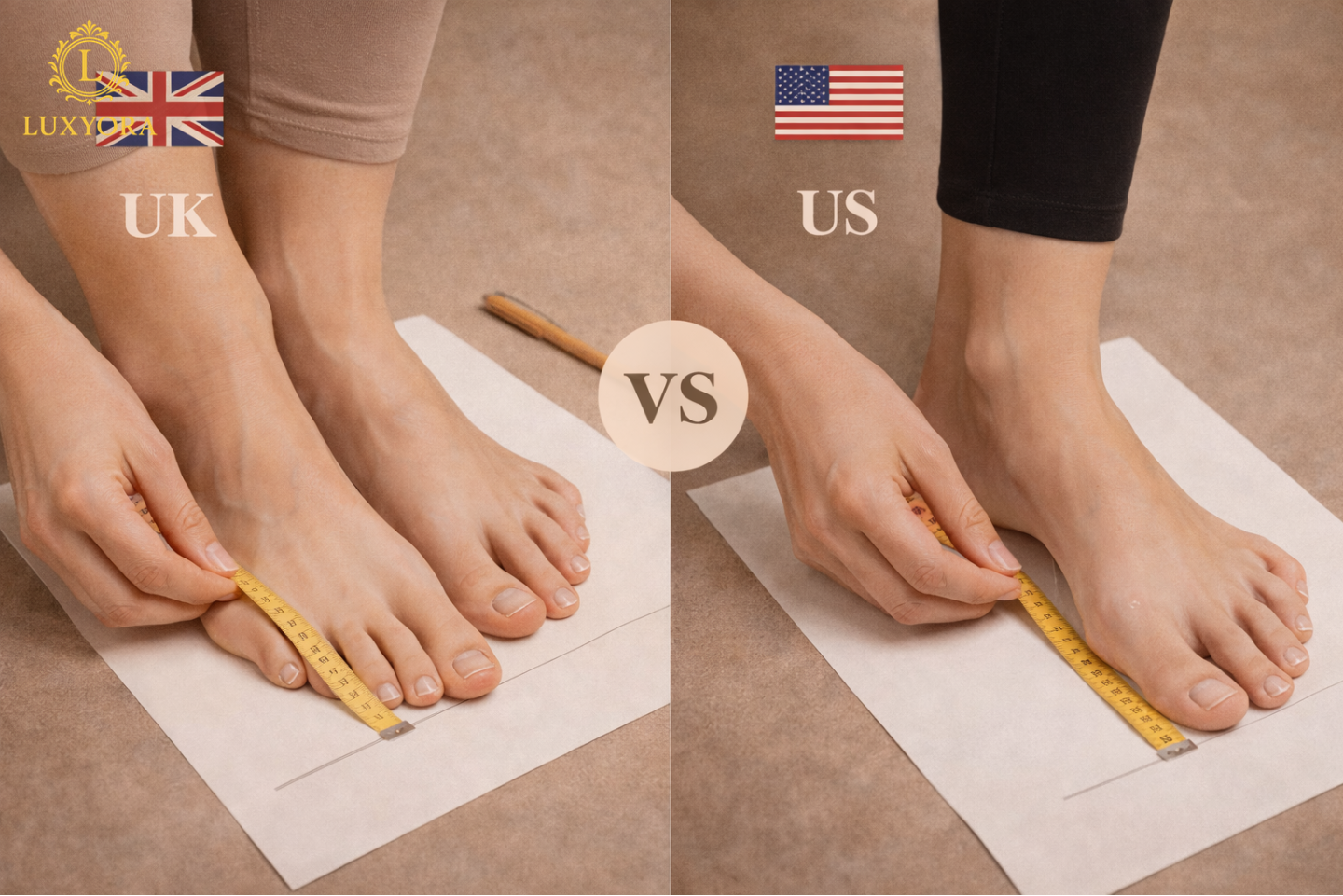
The most consistently recommended at-home method is simple: stand on a sheet of paper, mark the tip of your longest toe and the back of your heel, then measure the distance between them. Nike’s guide specifically recommends measuring in centimetres for precision. Clarks also advises measuring both feet and using the longer one because, yes, most of us are subtly asymmetrical. Sizing advice often includes a simple tip: measure your feet later in the day, when they’re slightly larger, for a more accurate fit.
Your new golden rule: Foot length (mm) → brand size chart → choose the closest fit.
Understanding the three big systems
EU sizing: the “Paris point” story
EU sizes are typically based on a unit called the Paris point, where each size step is 2/3 of a centimetre (about 6.67 mm).
That’s why EU sizes often feel “smooth” and evenly spaced (36, 37, 38, 39…), and why half sizes are less common in many EU lines.
Vibe check: EU sizing is elegant, consistent in steps, but brand-to-brand fit still varies because the last (the foot-shaped mould shoes are built around) varies.
UK sizing: barleycorns and a very British origin story
UK sizing traces back to a historic system in which shoe sizes move in steps related to the barleycorn, a traditional unit equal to 1/3 of an inch. Britannica discusses this origin in the context of English shoe sizing history.
Modern UK sizes still step by this increment, which is why UK sizing has a distinct cadence compared with EU sizing.
Style translation: UK sizes tend to look “smaller” numerically than US for equivalent adult sizes (not always by the same amount across men/women/kids, but as a general shopping reality).
US sizing: similar DNA, different starting point (and gender offsets)
US sizing also descends from English sizing traditions, but the baseline (the “starting point”) differs, and US sizing splits into men’s and women’s scales that aren’t identical. That’s why a US women’s size doesn’t map cleanly onto a US men’s size without an offset.
If you’ve ever thought, “Why is women’s 9 not just men’s 9?” that’s the reason. Sizing guides also highlight that men’s and women’s measurements often differ, which can be a common source of confusion when shopping.
The most accurate bridge between systems: Mondopoint
If UK/US/EU feel like fashion week seating charts (mysterious, political, occasionally petty), Mondopoint is the calm, sensible friend.
Mondopoint is based on measured foot dimensions, typically foot length in millimetres (and sometimes width). ISO’s footwear sizing standard explains Mondopoint as a size designation based on defined foot measurements.
And when it comes to conversions, ISO’s conversion standard makes a key point: conversion tables are based on foot length, described as the “logical starting point” for shoe size marking.
In practice: If a brand lists “CM” or “MM” sizing on the label or box, use it. It’s usually the clearest anchor when you’re jumping between systems.
How to convert UK ↔ US ↔ EU without losing your mind
1) Start with foot length, not your “usual size”
Retail conversion charts are useful, but even Zappos emphasises that conversion is a guide and that size can vary significantly by style, even within the same brand.
So take your measurement (mm/cm), then check the brand’s chart.
2) Expect variation by shoe type
Boots, heels, sneakers, and dress shoes can fit differently because:
- materials stretch differently,
- toe shapes vary,
- and some categories intentionally include more “allowance” for comfort.
So your “EU 39” in a pointed-toe pump might not be your “EU 39” in a chunky sneaker. This is normal. Annoying, but normal.
3) Know the three biggest “conversion traps”
Trap A: Men’s vs women’s US sizing
Always confirm whether the listing is for US Men or US Women.
Trap B: Kids’ sizing
Kids’ scales don’t map cleanly to adult sizes. If you’re buying youth sneakers, check the specific “youth” chart.
Trap C: Width
Length gets all the attention, but width is the quiet dealbreaker. If you’re often “between sizes,” it might be width, not length, causing the drama.
A quick, chic checklist for perfect-fit online shopping
- Measure both feet; use the longer one.
- Measure at the end of the day.
- Prefer mm/cm sizing when available (Mondopoint logic).
- Read product notes: “runs small,” “runs large,” “narrow fit.”
- When in doubt, buy from retailers with easy returns because confidence is great, but trying them on is divine.
Luxyora Philosophy: Style is personal, but comfort is non-negotiable. When you measure first and shop second, you don’t just buy shoes, you buy ease.
References:
- Clarks. (n.d.). Shoe size chart & guide (Fit guide). (Accessed February 9, 2026). (Clarks)
- International Organization for Standardization. (2019). ISO 9407:2019 Footwear sizing—Mondopoint system of sizing and marking. (Iteh Standards)
- International Organization for Standardization. (2023). ISO 19407:2023 Footwear—Sizing—Conversion of sizing systems. (ISO)
- Nike. (2021, November 26). How to measure your foot size. (Nike.com)
- Vogue. (2023). How to measure shoe size in 7 simple steps. (Vogue)
- Zappos. (n.d.). Shoe size conversion. (Accessed February 9, 2026). (Zappos)
No amount of resoling or repair can restore alignment, balance, or form. When the shoe no longer supports your foot properly, it’s more than cosmetic—it’s biomechanical inefficiency.