Skincare Tips for Sensitive Skin | Luxyora
Sensitive skin is the friend who looks effortless at brunch but will absolutely text you later like, “Why did you make me sit near that candle?” One minute you’re glowing, the next you’re stinging after a new serum, a hot shower, a “clean” essential-oil mist, or honestly… just existing.
The good news is that sensitive skin isn’t a life sentence to boring skincare. It’s simply a different operating system, one that thrives on calm, consistency, and fewer surprises. Dermatology resources describe sensitive skin as a state where everyday triggers (products, weather, friction) can cause burning, stinging, itching, or redness, sometimes with very little visible change. Translation: your skin might look fine while it’s internally filing complaints.
Let’s build you a routine that feels luxe and minimal, like a quiet luxury wardrobe for your face.
1) Stop chasing “strong.” Start chasing “stable.”
Suppose your routine feels like a rotating cast of acids, scrubs, peels, and “active stacks.” Sensitive skin will eventually tap out. Recent reviews on sensitive skin point to a mix of barrier disruption, inflammation, and nerve hyper-reactivity as key drivers, meaning irritation doesn’t just feel bad; it can amplify reactivity over time.
The reset (7-14 days):
- Gentle cleanser
- Simple moisturiser
- Sunscreen every day
That’s it. Not forever, just long enough to bring your skin back into a stable, unbothered mood.
2) Choose “fragrance-free,” not “unscented” (they’re not the same)
Here’s the sneaky part: “unscented” products can still contain masking fragrances. Dermatologists specifically recommend choosing products labelled fragrance-free because fragrance ingredients are common irritants for reactive skin. For eczema-prone or highly sensitive skin, the National Eczema Association also advises avoiding fragrance whenever possible.
Also watch for: essential oils, “botanical blends,” and strongly scented natural extracts. Natural doesn’t automatically mean gentle; your skin doesn’t care about marketing poetry.
3) Cleanse like you’re washing silk
Sensitive skin doesn’t want foam parties. It wants a low-key, non-stripping cleanse. DermNet’s guidance for sensitive skin includes using soap-free cleansers, non-irritating moisturisers, and sun protection. Recent cleanser edits highlight dermatologists’ advice to avoid common irritants and prioritise barrier-supportive ingredients like glycerin and ceramides.
Your cleansing rules:
- Use lukewarm water (hot water is drama).
- Cleanse with fingertips, not rough cloths or brushes.
- If you’re very reactive, cleanse once daily at night and rinse in the morning.
4) Moisturize like it’s skincare insurance
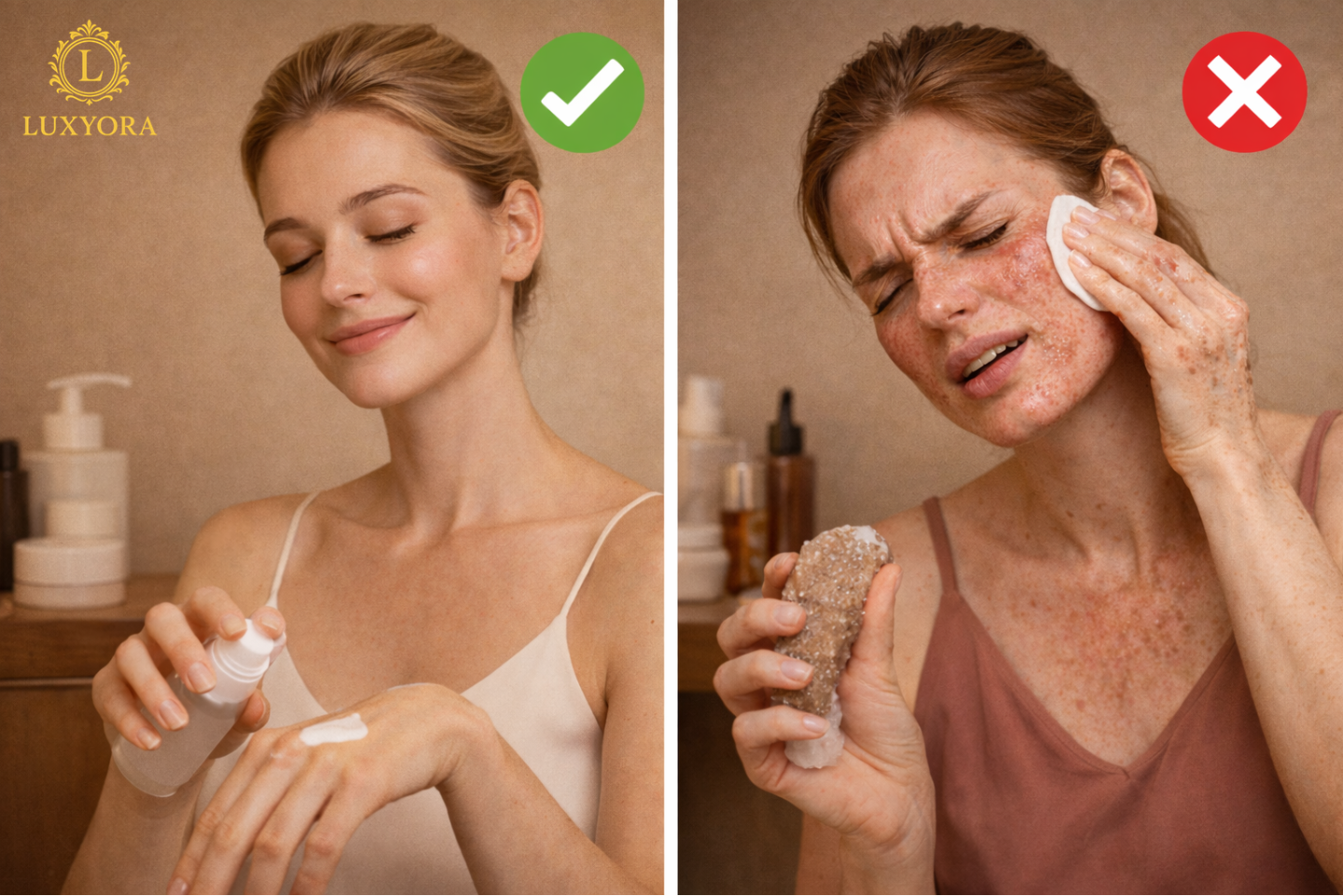
Moisturiser isn’t a “dry skin only” step; it’s barrier support, and barrier support is sensitive skin’s love language. Moisturising guidance from eczema organisations emphasises choosing fragrance-free products and consistently moisturising to protect and soothe reactive skin.
Look for:
- Ceramides + fatty acids (barrier building blocks)
- Glycerin (hydration magnet)
- Colloidal oatmeal (comforting, especially for itchy or eczema-prone skin)
Recent moisturiser roundups echo the same idea: formulas that soothe without heavy fragrance or harsh actives are often best for reactive skin.
5) Sunscreen is non-negotiable (and mineral is often the safest bet)
UV exposure can worsen redness and sensitivity, and it can keep irritation cycling. DermNet includes sun protection as a core part of managing sensitive skin. For many sensitive-skin people, especially those with rosacea or eczema, mineral sunscreens (zinc oxide/titanium dioxide) are often better tolerated than heavily fragranced or alcohol-heavy chemical formulas. The trick is finding one that feels wearable enough to become a daily habit.
Your daily standard: broad-spectrum SPF, applied every morning and reapplied outdoors.
6) Patch test like a beauty editor with boundaries
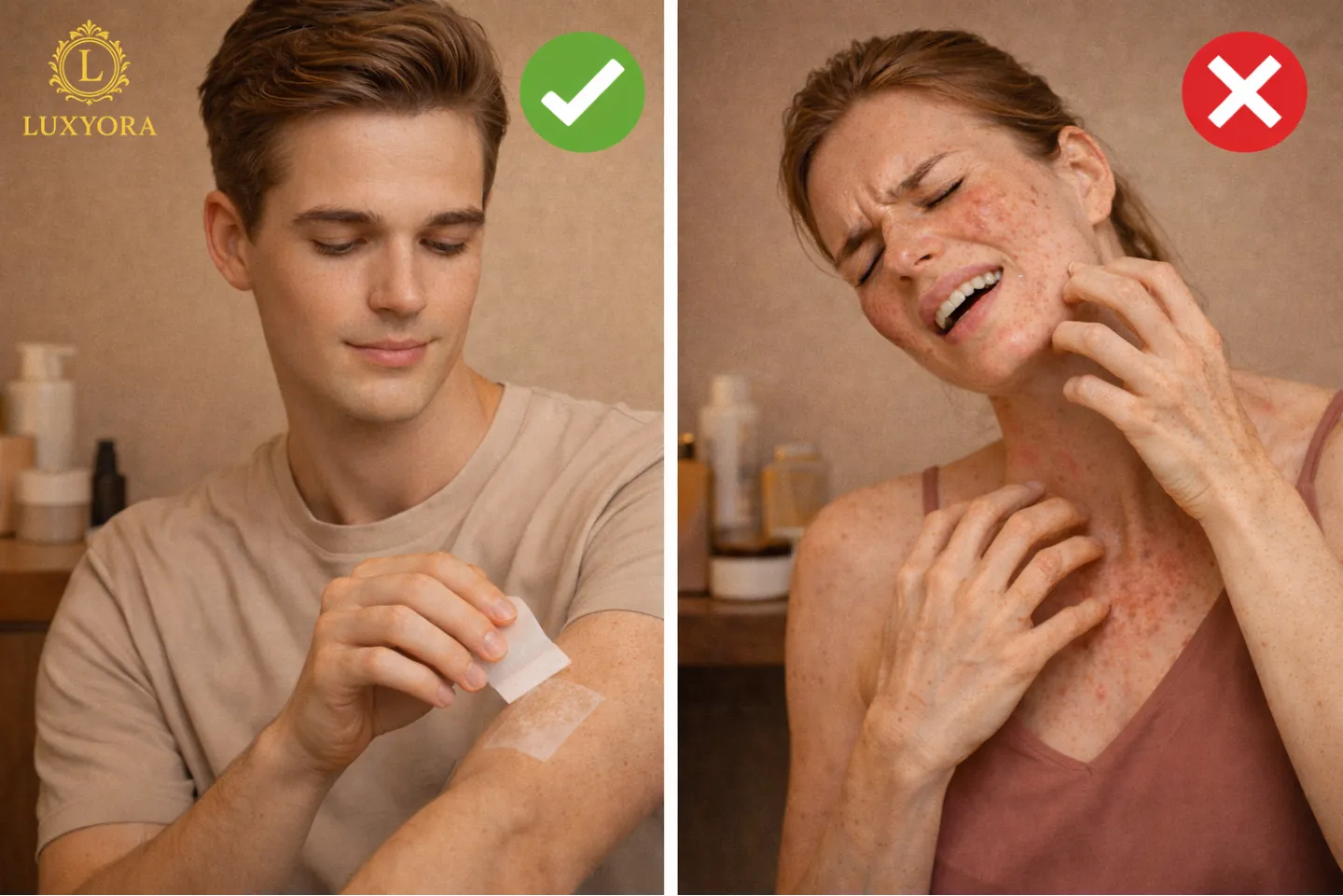
If you have sensitive skin, you need a “soft launch” strategy for new products. The AAD recommends testing a new product by applying it to a small area twice daily for 7-10 days to assess for irritation. It’s not glamorous, but it will save your face.
The chic method:
- Introduce only one new product at a time.
- Avoid testing on days your skin is already flaring.
- If you react, pull back and return to your basics.
Avoid: gritty scrubs, daily acids, and layering exfoliants with retinoids in the same routine, especially at first.
8) Keep “actives” on a leash: one hero at a time
Retinoids, vitamin C, acids, yes, they can be fabulous. But for sensitive skin, how you introduce them matters more than which brand is trending.
A calm way to add actives:
- Start 1-2 nights per week.
- Use a pea-sized amount.
- Buffer with moisturiser if needed.
- Stop at the first sign of persistent stinging, swelling, or rash.
If you suspect you’re reacting to a specific ingredient (or fragrance, preservative, or sunscreen), that may be contact dermatitis, which is worth a visit to a dermatologist. Patch testing is a standard diagnostic tool for identifying allergic triggers.
9) Identify your “trigger trio”
Sensitive skin rarely reacts to everything; it reacts to your pattern. Common categories include:
- Fragrance / essential oils
- Harsh surfactants (very stripping cleansers)
- Overuse of actives (acids + retinoids + exfoliating toners)
Your job isn’t to eliminate every ingredient on earth; it’s to identify the top 2-3 that repeatedly set you off and then curate around them.
10) When to see a dermatologist
If you have frequent burning/stinging, rashes, persistent redness, or recurring flares, you may have an underlying condition such as rosacea, eczema, or allergic contact dermatitis. Sensitive skin can be a symptom, not just a “type”. A dermatologist can help you identify the root cause and design a routine that’s both gentle and effective.
Luxyora Philosophy: Sensitive skin doesn’t need more products; it needs more respect. When you protect your barrier and simplify with intention, your glow becomes the quiet kind that never has to announce itself.
References:
- American Academy of Dermatology Association. (2021, August 10). How to test skin care products. https://www.aad.org/public/everyday-care/skin-care-secrets/prevent-skin-problems/test-skin-care-products
- American Academy of Dermatology Association. (n.d.). Dermatologists’ top tips for relieving dry skin. Retrieved February 1, 2026, from https://www.aad.org/public/everyday-care/skin-care-basics/dry/dermatologists-tips-relieve-dry-skin
- Chen, B., Zhang, Y., & Wang, X. (2024). Mechanisms of sensitive skin and the soothing effects of active substances: A review. Cosmetics, 11(6), 190. https://www.mdpi.com/2079-9284/11/6/190
- DermNet NZ. (2023). Sensitive skin. https://dermnetnz.org/topics/sensitive-skin
- Jiang, C., Liu, Y., & Zhou, Y. (2024). Sensitive skin syndrome: Research progress on prevalence, mechanisms, diagnosis, and daily care. Skin Health and Disease. https://www.sciencedirect.com/science/article/pii/S2950306X2400013X
- National Eczema Association. (2020, October 5). 8 skincare ingredients to avoid if you have eczema. https://nationaleczema.org/blog/8-skincare-ingredients-to-avoid/
- National Eczema Association. (n.d.). Moisturizing for eczema. Retrieved February 1, 2026, from https://nationaleczema.org/treatments/moisturizing/
- National Eczema Society. (n.d.). Contact eczema (dermatitis). Retrieved February 1, 2026, from https://eczema.org/information-and-advice/types-of-eczema/contact-dermatitis/
- Vogue. (2026a). I can attest these gentle cleansers are safe for sensitive skin. Retrieved February 1, 2026, from https://www.vogue.com/article/best-gentle-cleansers
- Vogue. (2026b). The best gentle moisturizers soothe sensitive skin. Retrieved February 1, 2026, from https://www.vogue.com/article/best-gentle-moisturizers