How to Read a Watch Specification Sheet | Luxyora
A watch specification sheet can feel like a glamorous stranger speaking in an abbreviated language. You’re staring at a list of numbers like 40mm, 100m, 4Hz, “sapphire,” “cal.” something, and somehow you’re supposed to know whether the watch will look chic on your wrist, survive your vacation, and still feel like you two years from now.
Here’s the good news: a spec sheet isn’t meant to intimidate. It’s meant to protect you from buying a watch that’s too bulky for your style, too delicate for your life, or simply not worth the price tag. Once you know how to read it, you’ll shop with the kind of calm confidence that looks expensive.
1) Start with the fit trio: case, thickness, lug-to-lug
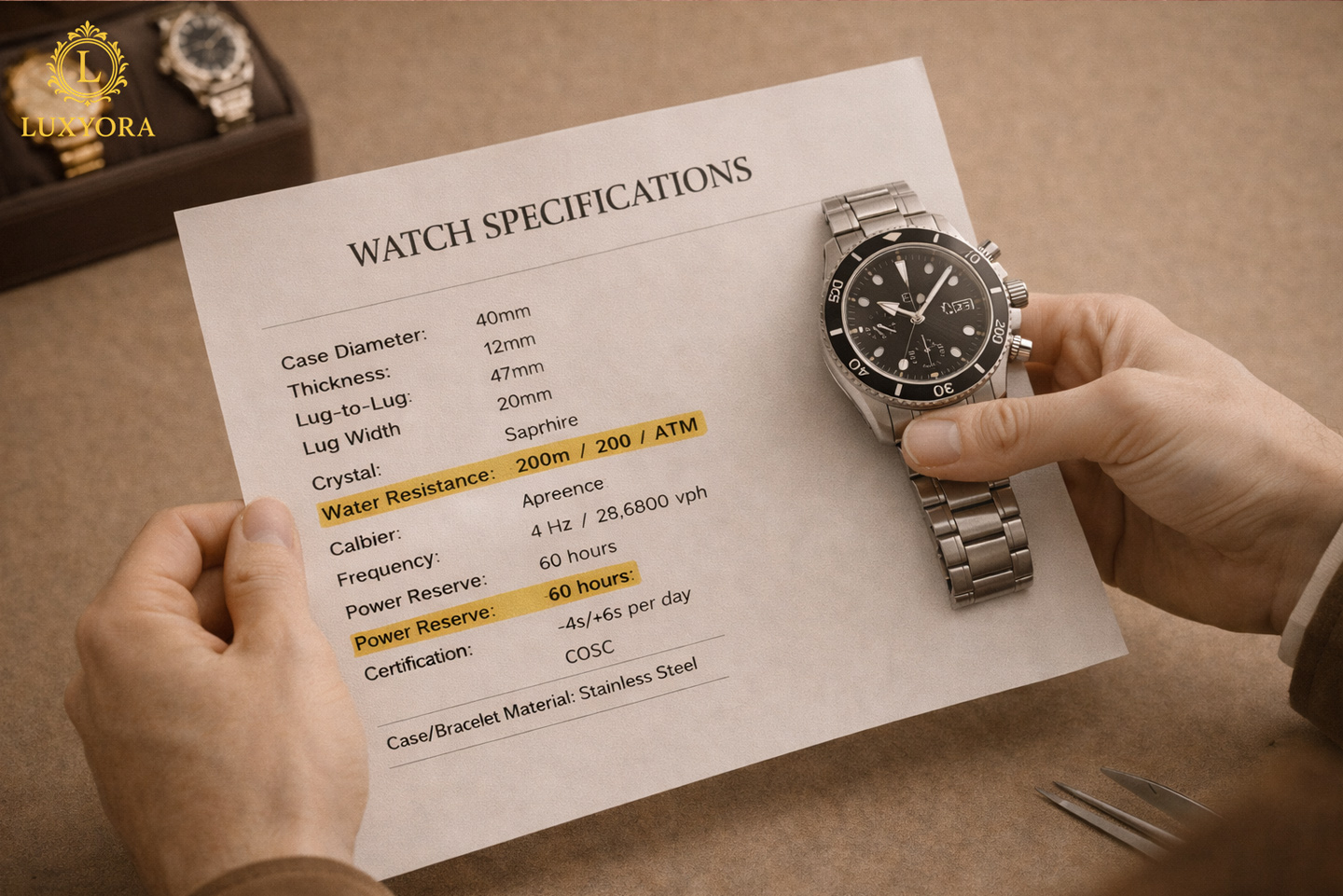
Case diameter (mm) is the headline number, but it’s not the whole story. Two 40mm watches can be worn very differently depending on their shapes and proportions.
- Case diameter: The width of the watch head. Bigger usually reads sportier or more statement; smaller often reads classic and refined.
- Thickness: This is your comfort-and-cuffs measurement. A thicker watch sits taller on the wrist and can feel bolder (or bulky) depending on your preference and wardrobe.
- Lug-to-lug: The distance from the top lug tip to the bottom lug tip. This is often the real decider for wearability, especially on smaller wrists. If lug-to-lug overhangs your wrist, the watch can feel awkward, no matter how pretty it is.
Quick decoding tip: If you want a watch that slips under sleeves and feels sleek, thickness and lug-to-lug matter as much as (or more than) the diameter.
2) Dial and bezel: why the same size can look larger
Spec sheets don’t always list dial diameter, but the visual impression is heavily influenced by bezel design.
- A thin bezel gives a larger dial opening, making the watch look bigger and more modern.
- A thicker bezel visually “shrinks” the dial and can feel sportier or more robust.
If the watch looks unexpectedly big or small in photos, the bezel proportions are often to blame. When possible, compare product images or videos alongside the listed diameter.
3) Lug width: the strap-shopping detail that saves you later
Lug width (mm) is the distance between the lugs where the strap attaches. These are typically 18mm, 20mm, 22mm, etc. It matters because it determines what straps and bracelets will fit. If you like to style your watch like you style jewellery – switching leather, metal, rubber, or suede – this is a must-check number.
4) Crystal: sapphire, mineral, acrylic - what it says about durability
Your crystal is the watch’s “window”, and the spec sheet usually names the material:
- Sapphire crystal: Often the premium standard. It’s known for high scratch resistance (commonly described as around 9 on the Mohs scale).
- Mineral crystal: More budget-friendly and often tougher against certain impacts, but more prone to visible scratches over time.
- Acrylic: Often found on vintage-inspired pieces; it scratches more easily but can sometimes be polished.
If you’re buying a daily-wear watch and don’t want to baby it, crystal choice is not a small detail; it’s a lifestyle decision.
5) Water resistance: decode “m” and “ATM” like a grown-up
Water resistance is one of the most misunderstood lines on a spec sheet. You’ll usually see meters (m) or ATM.
- ATM is pressure, not a promise of real-world diving depth. Roughly, 1 ATM corresponds to pressure at about 10 meters, but real life is messier. Movement, temperature, and splashes can change forces on seals.
- Standards exist: ISO 22810 covers water-resistant watches for everyday use and swimming; dedicated dive watches are typically addressed under a different standard (ISO 6425).
The elegant takeaway: treat water resistance as a capability with conditions, not a dare.
6) Movement details : the “engine specs” section
This is where the sheet shifts from style to substance.
Movement type
- Quartz: Battery-powered, highly accurate, low maintenance.
- Automatic (self-winding): Mechanical, winds with wrist motion; may stop if unworn for long enough.
- Manual-wind mechanical: Mechanical, requires winding; classic, ritualistic, wonderfully old-world.
Caliber / movement reference
A “caliber” name/number identifies the movement. This can hint at reputation, serviceability, and architecture, especially if you’re comparing watches in the same price tier.
Frequency (Hz or vph)
For mechanical watches, you may see Hz or vph (vibrations per hour). Example: 4 Hz = 28,800 vph, a very common modern frequency. Higher frequency can contribute to a smoother second-hand motion and can be associated with certain performance goals, though it’s not a simple “higher is always better” equation.
Power reserve (hours)
This tells you how long a mechanical watch will run when fully wound and then left alone. Many automatics live in a common range (often around the day-and-a-half neighbourhood), while some modern movements are engineered to run longer. Power reserve is especially important if you rotate watches. If you wear something different every day, a longer reserve is pure convenience.
7) Accuracy and certifications: reading beyond marketing sparkle
Some spec sheets list accuracy as a range (for example, seconds gained/lost per day). Others point to certifications.
COSC chronometer certification is commonly associated with a daily rate window often expressed as -4 to +6 seconds per day for mechanical movements under test conditions.
METAS “Master Chronometer” is a different framework that includes additional testing beyond basic timekeeping, and is often cited for strict daily rate targets and strong magnetic resistance benchmarks.
If a spec sheet doesn’t mention accuracy at all, it’s not necessarily a deal-breaker. But, it should nudge you to look for reputable movement information and brand transparency.
8) Materials and finishing: what you’re actually paying for
Luxury isn’t just “steel vs gold.” It’s also how those materials are finished.
Look for details like:
- Case material: stainless steel, titanium, gold, ceramic
- Bracelet material and whether it tapers
- Clasp type: butterfly, foldover, micro-adjust, quick-release
These details affect comfort and longevity. A great clasp and thoughtful bracelet taper can make a watch feel far more expensive than its price suggests.
9) Your quick spec-sheet checklist
Before you buy, scan for these in order :
- Lug-to-lug, thickness, diameter
- Lug width
- Crystal type
- Water resistance + crown type (screw-down or not)
- Movement type + power reserve
- Frequency (for mechanical)
- Any stated accuracy or certification
- Bracelet/clasp details
Because the goal isn’t to “know everything.” The goal is to know enough to choose with intention.
Luxyora Philosophy: A specification sheet is the quiet truth behind the shine. Learn to read it, and you’ll never mistake loud for luxurious again.
References:
- Citizen Watch. (n.d.). What is the difference between mineral crystal vs. sapphire crystal? Citizen Watch Support. Retrieved December 31, 2025.https://support.citizenwatch.com/hc/en-us/articles/16494322181783-What-is-the-difference-between-mineral-crystal-vs-sapphire-crystal
- Hodinkee. (2021, August 9). What does watch frequency mean? Hz, VPH, and why it matters. Retrieved December 31, 2025. https://www.hodinkee.com/articles/watchs-frequency-hz-vph-meaning
- International Organization for Standardization. (2010). ISO 22810:2010(en) Horology—Water-resistant watches. ISO Online Browsing Platform. Retrieved December 31, 2025. https://www.iso.org/obp/ui
- Longines. (n.d.). What is power reserve on a watch? Longines Blog. Retrieved December 31, 2025. https://www.longines.com/en-in/universe/blog/what-is-power-reserve-on-a-watch
- METAS (Swiss Federal Institute of Metrology). (2022). Requirements for certification of movements and watches (METAS N001). Retrieved December 31, 2025. https://www.metas.ch/dam/metas/en/data/dokumentation/rechtliches/zertifizierung-uhren/metas_n001_v_1_2-e.pdf.download.pdf/metas_n001_v_1_2-e.pdf
- Nixon. (2021). What is watch lug width and how to measure it. Retrieved December 31, 2025. https://www.nixon.com/blogs/stories/what-is-watch-lug-width-and-how-to-measure-it?srsltid=AfmBOoqxIC90TQWW9-KDJ3SRv7KIY_OTTEyR9dRfINLvdmDs-JElcFyp&utm
- Nordgreen. (n.d.). What does an “ATM” water rating mean? Retrieved December 31, 2025. https://nordgreen.com/blogs/journal/what-does-a-5-atm-water-rating-on-your-watch-mean?srsltid=AfmBOoraei-d5nshQjZKhlCCGPR9I_NDYfg4dsoBaS17v6MzvEd_xYPd&utm
- Time+Tide Watches. (2025). Everything you need to know about COSC (chronometer certification). Retrieved December 31, 2025. https://timeandtidewatches.com/what-is-cosc-certification/?utm
- The 1916 Company. (2024, September 9). What is METAS certification? What it takes to be a Master Chronometer. Retrieved December 31, 2025. https://www.the1916company.com/blog/metas-certification-what-it-takes-to-be-a-master-chronometer.html?srsltid=AfmBOooQkb18UBNN8oAr7wxabK-zgZ07rcjGbFe4UWqwYHbqf8i8n-WX&utm