How to Pick Clothes That Look Good in Real Life, Not Just Photos | Luxyora
If you’ve ever tried clothes on, snapped a quick mirror pic, and immediately decided it was “a no”… only to wear it later out and get complimented all night, welcome to the very modern problem of camera-led style decisions. The camera is a tool, not a truth serum. It compresses, distorts, exaggerates shine, and panics over certain colours, as if it’s being personally attacked by neon.
Real-life style, the kind that reads expensive, effortless, and you, is built on things photos don’t always capture: movement, comfort, texture, drape, and the quiet confidence of not fussing with your outfit every two minutes.
So let’s build a wardrobe filter that isn’t literal.
1) Remember: cameras don’t see like people do
Your phone camera isn’t your friend; it’s a tiny wide-angle lens with opinions. Close camera distances can create noticeable facial distortion (the “selfie effect”), altering proportions in ways that don’t reflect how you look in person. More recent work in medical and imaging contexts also documents how smartphone photography can distort appearance, especially at short distances and wide fields of view.
Style takeaway: don’t make permanent wardrobe decisions based on one close-up mirror photo. If you’re judging fit and proportion, step back and use a timer shot from farther away or ask a friend to take a photo at a more natural distance.
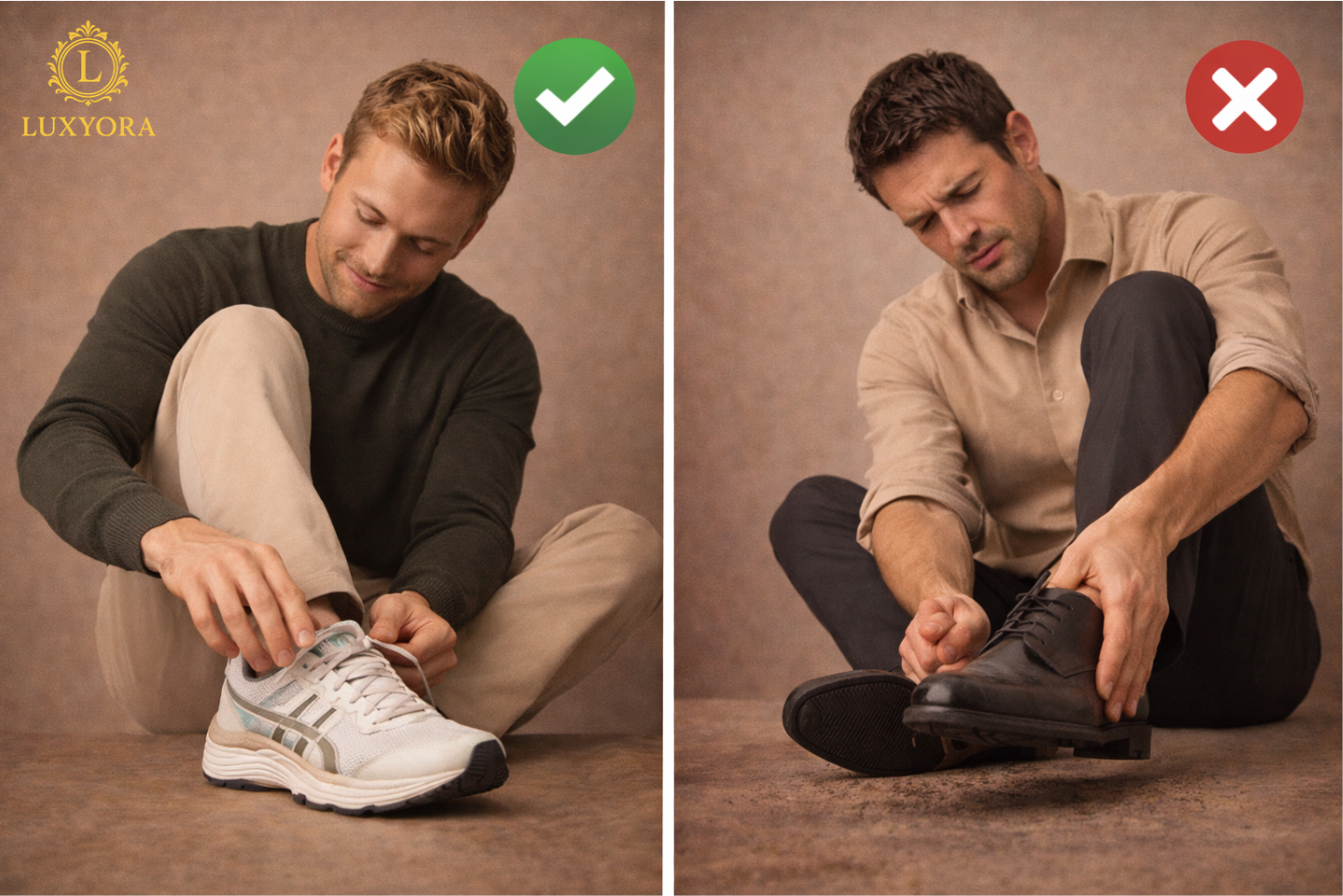
2) The “real life test” is movement, not posing
A photo freezes you in a flattering, edited micro-moment. Real life is walking, sitting, reaching for your bag, hugging people, climbing stairs, and living.
Do a 60-second movement test in the fitting room (or at home):
- Sit down (does the waistband bite? Does the skirt ride up?)
- Lift your arms (does it pull at the bust/shoulders?)
- Walk quickly (does the fabric twist, cling, or restrict?)
- Do a “reach test” (can you comfortably reach for something overhead?)
Fit research repeatedly emphasises that comfort and garment behaviour in motion matter; static appearance alone isn’t the whole story. And when garments feel “off,” they’re also more likely to be abandoned, repaired less, or disposed of sooner. In short, if it only works when you’re standing still, it’s not a real-life hero.
3) Choose fabrics that behave beautifully under multiple lights
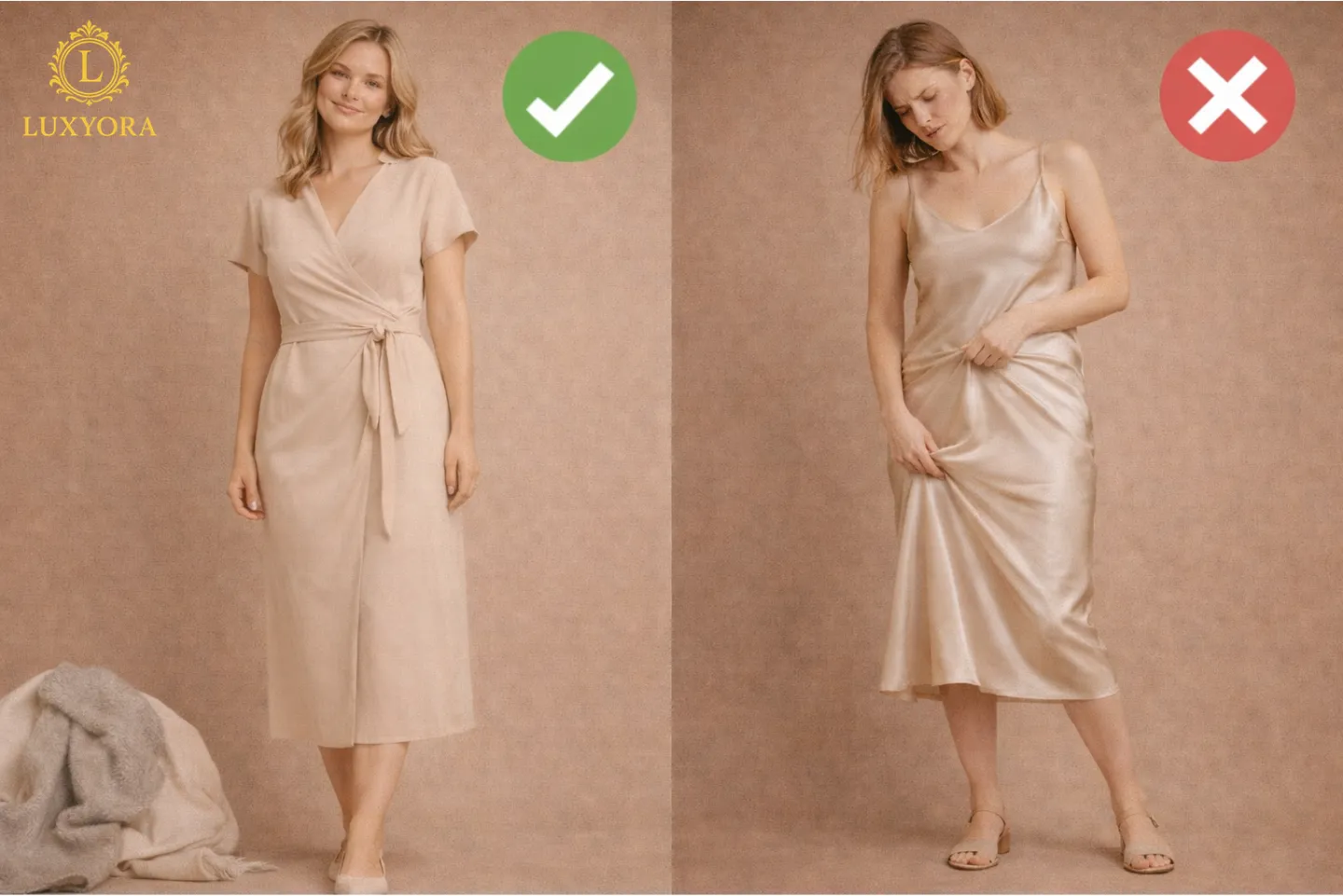
Photos love extremes: glossy becomes blinding, matte can look flat, and some weaves catch light in ways that scream “cheap” on camera even when they’re luxe in person.
Researchers studying fabric perception have shown that sheen and surface reflectance strongly influence how we perceive materials, especially when folds and motion change how highlights appear. And perceptual studies on fabrics (e.g., satin vs. velvet) show that people use specific visual cues (e.g., sharpness, contrast, texture) to judge what a fabric “is”.
Your shopping hack:
- Check fabric in daylight, warm indoor light, and phone flash (yes, really).
- If it’s a shiny fabric (satin, glossy poly blends), do a quick flash test; specular highlights can turn “elegant” into “overexposed” instantly.
- Favour soft sheen over hard shine when you want that quiet-luxury, “expensive in motion” effect.
4) Prioritize structure that holds up when you move
The camera loves a perfectly clipped waist and a statue pose. Real life punishes flimsy structure. Choose garments with:
- clean shoulder seams
- stable waistbands
- enough ease in high-movement zones (bust, hips, thighs)
- linings where needed (dresses/skirts especially)
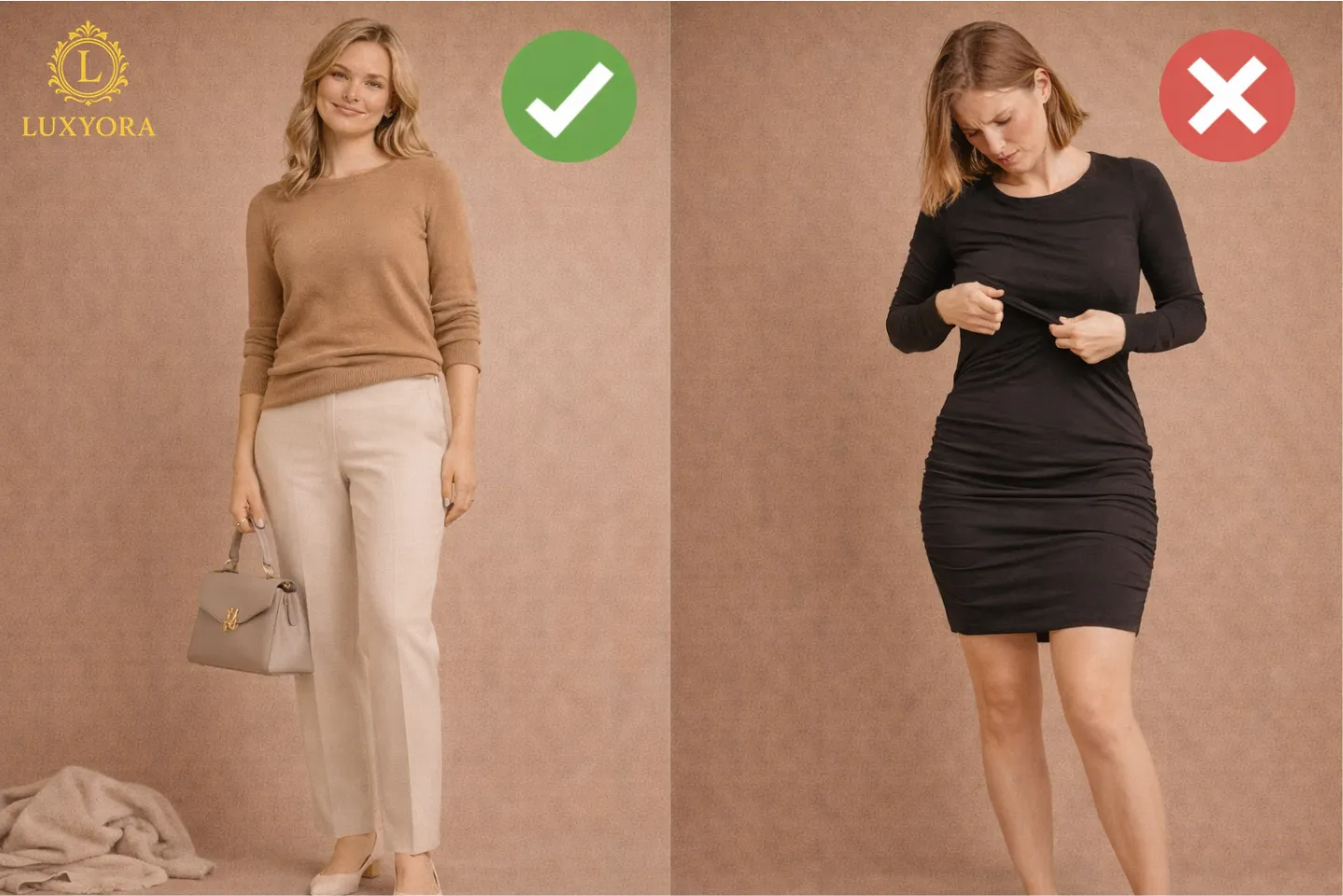
A dress that wrinkles or twists after five minutes of walking is going to look messy in person, even if it photographs like a dream in the fitting room.
5) Don’t let “photo flattering” override “body breathable”
A big reason outfits look better in photos than in real life is simple: discomfort shows. Tugging, adjusting, sucking in, holding your breath, none of that is chic.
If you’re building a wardrobe for real life, buy pieces that let you:
- breathe normally
- eat normally
- move normally
- exist normally
That’s not “settling.” That’s how style looks natural, premium, and effortless.
6) Watch out for the sneaky real-life villains
Here are the common pieces that photograph well but betray you IRL:
A) Sheer surprises
Some fabrics appear opaque indoors but become transparent in daylight. Always check against a window.
B) Wrinkle magnets
If it creases when you blink, it’ll look tired in a hurry. Move around and see how quickly it rumples.
C) Loud textures
Chunky knits, heavy ribbing, and high-pile fabrics can look editorial in photos but feel bulky, hot, or overly casual in real settings.
D) “Sitting problems”
Mini lengths and stiff skirts can look perfect standing up… and chaotic the second you sit.
7) Use “distance and angle” to judge outfits realistically
If you want a photo that matches what people actually see, stop shooting from two feet away with a wide lens. Wide-angle smartphone photography can warp subjects at the edges and exaggerate proportions; multiple research and technical papers focus on correcting or compensating for this distortion.
Practical setup:
- Place your phone farther away (or use a tripod/bookshelf)
- Use the back camera if possible
- Stand in the centre of the frame
- Take a short video while walking video is brutally honest in the best way
8) The real “it factor” is coherence, not perfection
A look reads expensive in real life when the details harmonise: tone, texture, fit, and function align with where you’re going and how you’re moving. The goal isn’t to look like a still image. The goal is to look like you belong in your life beautifully.
Because the most compelling style isn’t “camera-ready.” It’s life-ready.
Luxyora Philosophy: Dress for the version of you that moves, laughs, and lives because real elegance is comfort in motion. If it feels good and holds up in daylight, it’s already photogenic.
References:
- Boudreau, C., Wong, A., Duncan, A., & Coles, J. (2021). Seeing is not believing: Facial distortion in smartphone photography. Plastic and Reconstructive Surgery. https://doi.org/10.1097/PRS.0000000000008360
- Di Cicco, F., et al. (2021). Soft like velvet and shiny like satin: Perceptual material signatures and key image features of depicted fabrics. Journal of Vision, 21(9). https://jov.arvojournals.org/article.aspx?articleid=2772589
- Haghzare, L., et al. (2023). Digital fabrics for online shopping and fashion design. Frontiers in Virtual Reality. https://www.frontiersin.org/journals/virtual-reality/articles/10.3389/frvir.2023.1236095/full
- Hernández, N. (2018). Does it really fit? A study of fit evaluation and comfort considerations in garment assessment (Master’s thesis). University of Borås (DiVA portal). https://www.diva-portal.org/smash/get/diva2:1216128/FULLTEXT01.pdf
- Kajinaka, H., et al. (2022). Analysis of various distortions in selfies due to differences in camera position and distance. Journal of Plastic, Reconstructive & Aesthetic Surgery. https://www.jprasurg.com/article/S1748-6815(21)00507-6/fulltext
- Richardson, C., et al. (2024). Exploring clothing fit as a motivator for lifetime extension: How fit influences care, repair and disposal. Resources, Conservation & Recycling. https://www.sciencedirect.com/science/article/pii/S0921344924000880
- Shih, Y.-C., Lai, W.-S., Liang, C.-K., & others. (2019). Distortion-free wide-angle portraits on camera phones (SIGGRAPH Asia). https://people.csail.mit.edu/yichangshih/wide_angle_portrait/shih_sig19_lowres.pdf
- Ward, B., Ward, M., Paskhover, B., & others. (2018). Nasal distortion in short-distance photographs: The selfie effect. JAMA Facial Plastic Surgery. https://pmc.ncbi.nlm.nih.gov/articles/PMC5876805/