The relationship between footwear and physical confidence | Luxyora
There’s a particular kind of confidence that arrives before you even say a word. It shows up in the way you enter a room, the way you turn a corner, the way you stand still, calm, grounded, and completely at ease in your own body. It’s not just “style confidence,” either. It’s physical confidence: the quiet assurance that your body will do what you’re asking it to do, without wobble, pinch, or second-guessing.
And yes, your shoes are a major part of that story.
Footwear is the most underrated confidence tool in the luxury universe because it’s where fantasy meets physics. Shoes aren’t merely an accessory; they’re architecture. They change how you distribute your weight, how your joints stack, how you move through space, and how safe (or precarious) you feel doing it. In other words, footwear doesn’t just look powerful; it can literally shape your sense of power.
Confidence starts at the ground
We tend to talk about confidence as if it lives in the mind, in self-talk, in mindset, or in “energy.” But physical confidence is often a body-first phenomenon. When your feet feel stable, your brain relaxes. When your foot hurts, your attention narrows. When you’re slipping, teetering, or bracing for discomfort, your body moves into protective mode. That protective mode is the opposite of effortless.
This is why shoe fit and comfort are more than practical details; they’re emotional cues. A well-fitting shoe supports the natural mechanics of walking. It reduces the micro-stresses that quietly drain you over a day: pressure points, instability, friction, the subtle tension of “holding yourself” together. Comfort doesn’t make a shoe less luxurious. Done right, it makes a luxury wearable.
And wearable is where confidence becomes real.
The heel effect: elevation, elegance, and the fine print
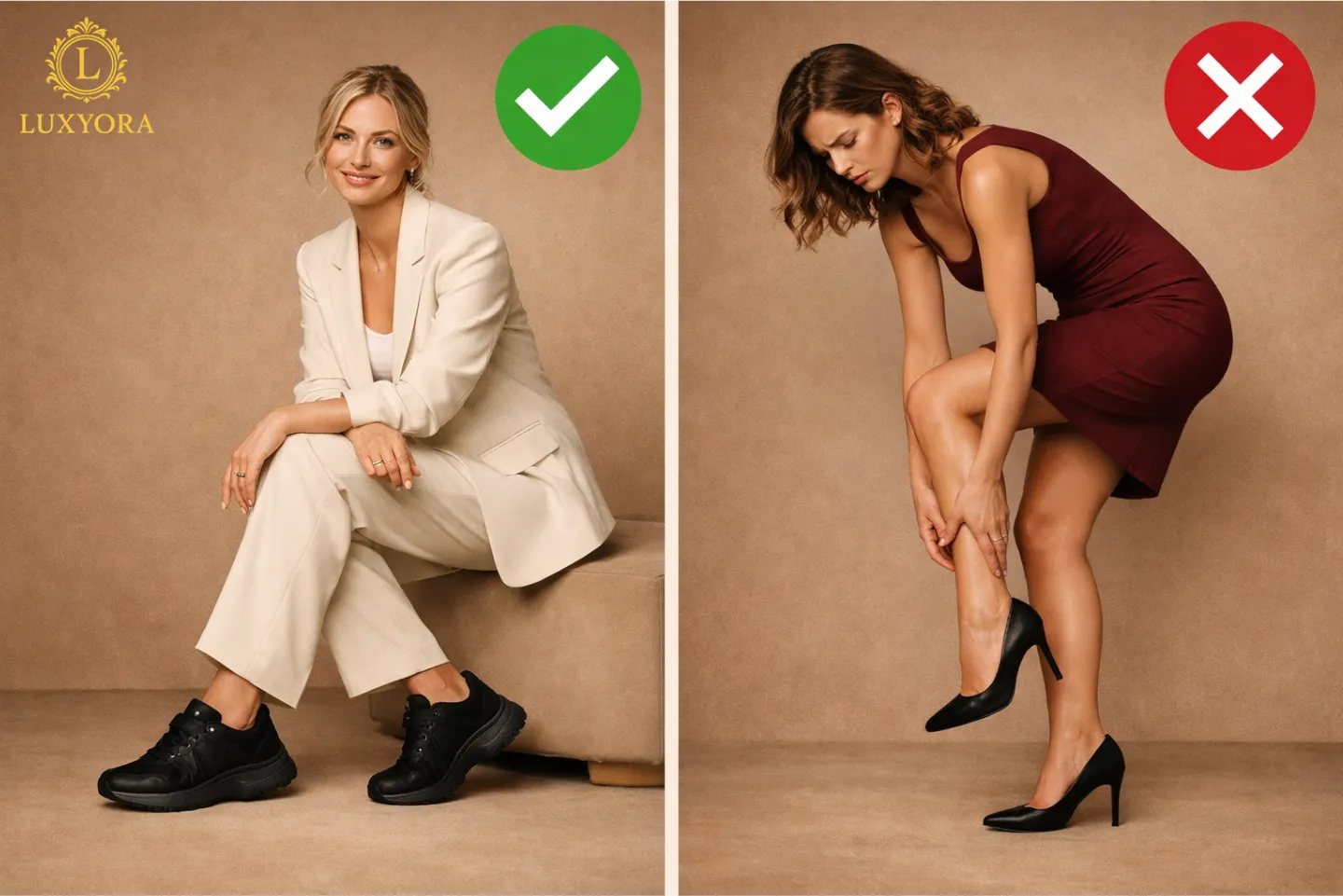
Let’s address the iconic silhouette in the room: heels. They’re culturally coded as glamorous, assertive, even commanding. And many wearers genuinely report feeling taller, sharper, and more “on.” That part is real because footwear is symbolic, and symbolic cues influence how we feel and behave. When you choose a shoe that means something to you, you tend to inhabit that meaning.
But the body has its own opinions.
As heel height increases, your posture and gait change. The foot shifts into a more pointed position, your balance strategy adapts, and your joints compensate. In plain terms, the higher the heel, the more your body has to work to keep you stable. That doesn’t automatically erase confidence; some people feel incredible in heels, but it does explain why “power” can sometimes come with fatigue, tight calves, and the occasional silent prayer on a cobblestone street.
The most physically confident heel moments usually come from a sweet spot: stable construction, secure fit, and a heel shape that actually respects gravity (think supportive footbed, balanced pitch, and a heel that doesn’t feel like a toothpick).
Comfort is not the opposite of allure, it’s the secret to it
Luxury is often described as a feeling, and few feelings are as luxurious as ease. If you’ve ever worn a shoe that looks spectacular but makes you walk like you’re negotiating a narrow ledge, you already know: discomfort steals presence. It turns your attention inward, away from the conversation, away from the view, away from the moment. You’re not fully “there”, you’re managing.
On the other hand, shoes that feel supportive tend to unlock a kind of magnetic calm. You stand longer. You move more. You dance without calculating your next step. Even athletes show measurable performance-related benefits when footwear feels more comfortable because comfort reduces strain and supports efficient movement. In everyday life, that translates to a different kind of glamour: the kind that looks like you’re unbothered, because you are.
Shoes as identity: the quiet confidence of self-recognition
Physical confidence isn’t only about biomechanics; it’s also about self-perception. Shoes are one of the most visible “identity signals” we wear. They can say polished, rebellious, romantic, minimalist, and futuristic. They can whisper discretion or announce taste. And when your outward signals align with your inner sense of self, you tend to move with more certainty.
This is the underrated magic of a truly great pair: you don’t just wear them, you recognise yourself in them.
That recognition matters. Psychological research on what we wear suggests that clothing (and yes, footwear as part of the full look) can influence how we think and feel, partly because of the meanings we attach to it. When the meaning is “I am capable,” “I am refined,” or “I belong here,” the body often follows.
The luxury confidence formula: three pillars
If you’re choosing footwear for physical confidence, not just aesthetics, think in threes:
1) Stability (your relationship with the ground)
Look for a sole that grips without clinging, a heel that feels anchored, and a construction that doesn’t ask your toes to do the job of your entire lower body.
2) Fit (your relationship with your own anatomy)
A shoe should match your foot’s length and width, hold the heel securely, and support your arch without forcing it. Fit is personal, and true luxury respects that.
3) Expression (your relationship with your identity)
Confidence multiplies when your shoes feel like “you.” The most powerful pair is rarely the loudest; it’s the one that makes you stand taller because it feels honest.
When these three align, you don’t just look composed. You feel composed. And that is the kind of confidence people notice instantly, even if they can’t name it.
The Luxyora Phylosophy: Luxury should never demand discomfort as proof of beauty. The most iconic confidence is the kind that lets your body breathe, move, and arrive exactly as you are.
References:
- Adam, H., & Galinsky, A. D. (2019). Reflections on enclothed cognition: Commentary on Burns et al. Journal of Experimental Social Psychology, 83, 157–159.
- Chen, Y., Li, J. X., & Wang, L. (2020). Influences of heel height on human postural stability and functional mobility between inexperienced and experienced high heel shoe wearers. PeerJ, 8, e10239.(Reference) (PubMed)
- Crutzen, C., & Adam, S. (2022). “What if it’s not just an item of clothing?” A narrative review and synthesis of the white coat in the context of aged care. Psychologica Belgica, 62(1), 62–74.(Reference) (PubMed)
- Puszczalowska-Lizis, E., Koziol, K., & Omorczyk, J. (2021). Perception of footwear comfort and its relationship with the foot structure among youngest-old women and men. PeerJ, 9, e12385.(Reference) (PubMed)
- Tedeschi, R., Giorgi, F., & Donati, D. (2024). Footwear and foot health: Unveiling the role of proper shoe fit in preventing podiatric issues and enhancing well-being. Applied Sciences, 14(21).(Rreference) (zh.mindat.org)
- Van Alsenoy, K., van der Linden, M. L., Girard, O., & Santos, D. (2023). Increased footwear comfort is associated with improved running economy: A systematic review and meta-analysis. European Journal of Sport Science, 23(1), 121–133.(Reference) (PubMed)
- Wiedemeijer, M. M., & Otten, E. (2018). Effects of high heeled shoes on gait: A review. Gait & Posture, 61, 423–430.(Reference) (PubMed)