Common Watch Terms Explained: Bezel, Crown & Complications | Luxyora
If you’ve ever fallen down a watch term rabbit hole, one “just browsing” session that turns into comparing dial textures at midnight, you’ve probably met the great wall of watch jargon. Words like bezel, crown, and complications get tossed around like everyone was born knowing them. But once you understand a few core watch terms, shopping (and chatting) becomes effortlessly more fun and a lot more luxurious.
Consider this your chic decoding guide: the essentials you’ll see in listings, spec sheets, and boutique conversations, explained like a friend who actually wants you to feel confident.
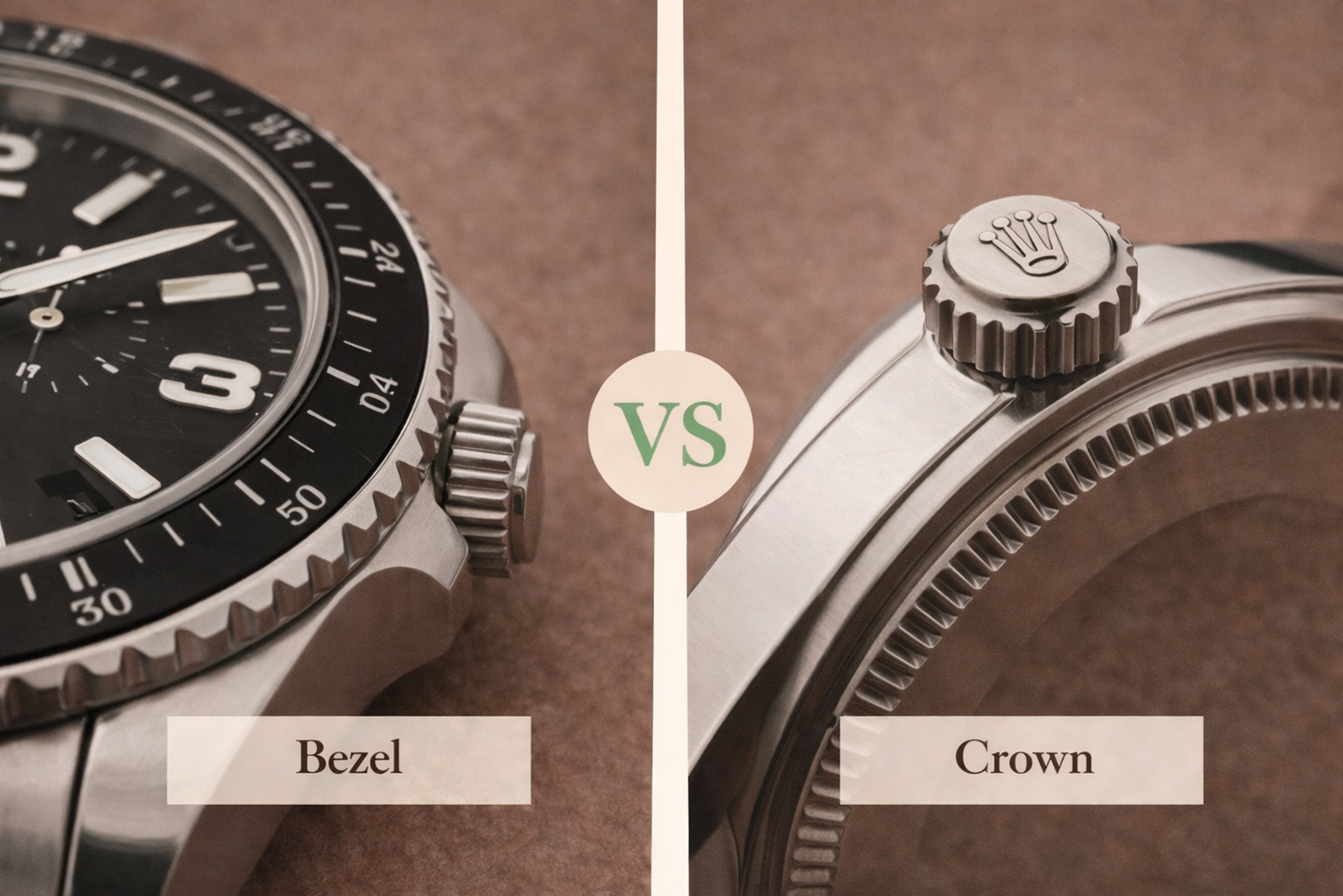
Bezel: The Frame with a Secret Life
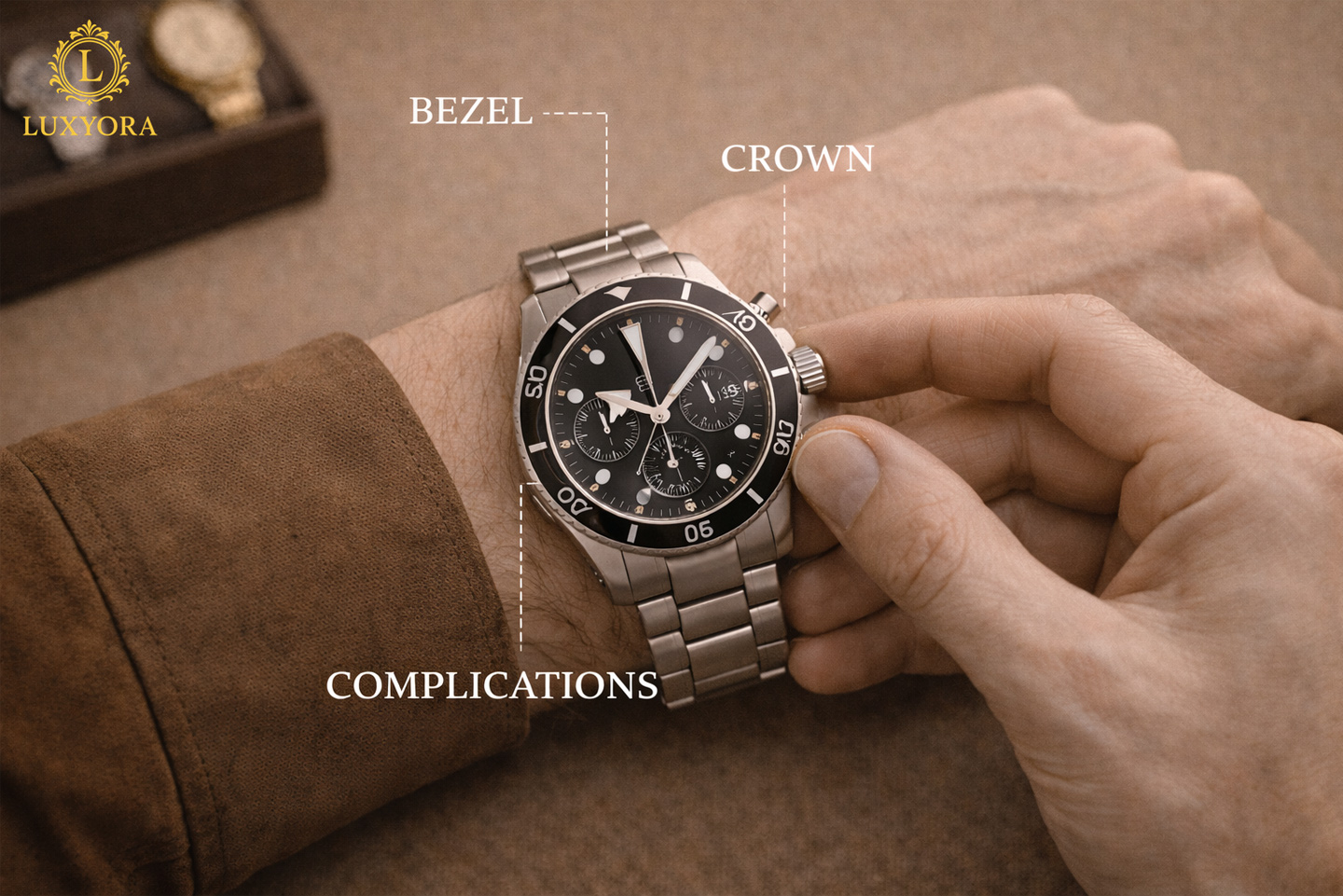
The bezel is the ring that surrounds the crystal (the “window” over the dial). Think of it as the watch’s framing device, like the right sunglasses for a face. It can be purely aesthetic, but it can also be functional, and that’s where things get interesting.
Common bezel types you’ll see:
- Fixed bezel: Classic and clean. It doesn’t move. Perfect for dress watches and minimalist everyday pieces.
- Rotating bezel: Designed to measure elapsed time. Most famously seen on dive watches.
- Unidirectional bezel: A rotating bezel that turns only one way (usually counterclockwise). This is a safety feature for divers, so the bezel can’t be accidentally moved in a direction that would make them think they have more time than they do.
- Bidirectional bezel: Rotates both ways. Useful for timing, travel, and general convenience, and common on pilot or GMT-style watches.
- Tachymeter bezel: Often found on chronographs, it’s used to calculate speed over a known distance (the “motorsport” energy is part of the charm).
Style tip: The bezel’s thickness changes a watch’s vibe. A thin bezel makes the dial look larger and more modern; a chunky bezel can feel sportier and bolder even at the same case size.
Crown: The Control Center
The crown is the small knob on the side of the case used to set the time and date and (in many mechanical watches) to wind the movement. It’s small, but it’s one of the most important “function points” on the entire watch.
Crown positions (typical setup):
- Pushed in: The watch runs normally.
- First pull: Often sets the date (and sometimes day).
- Second pull: Sets the time.
Crown types you’ll hear about:
- Push-pull crown: This is the standard type – pull it out, set, push it back in. Elegant and simple.
- Screw-down crown: A crown that threads into the case for a tighter seal, helping with water resistance. You unscrew it to adjust the watch, then screw it back down to lock it in place.
Crown guards: Those protective “shoulders” around the crown on many sport watches. They exist to prevent accidental bumps and to reinforce a tool-watch look.
Luxury reality check: A screw-down crown doesn’t make a watch invincible, but it signals that the watch is designed with water resistance and ruggedness in mind.
Complications: Anything Beyond Telling Time
In watch language, a complication is any function beyond showing hours, minutes, and seconds. The word sounds dramatic (and honestly, it’s meant to), but complications range from extremely simple to jaw-droppingly complex.
Beginner-friendly complications:
- Date window: The most common complication, and arguably the most useful.
- Day-date: Adds the day of the week along with the date.
- GMT / dual time: Lets you track a second time zone. It is ideal for travel, long-distance love, or global work schedules.
- Chronograph: A stopwatch function, usually with subdials and pushers.
- Moonphase: A romantic, artistic complication showing the lunar cycle – less “need” and more “want”, which is a valid luxury category.
High-horology complications (for the dreamers):
- Perpetual calendar: Adjusts for different month lengths automatically.
- Minute repeater: Chimes the time.
- Tourbillon: A complex regulating mechanism often admired as a craftsmanship theatre.
Complications influence not only price, but also thickness, dial layout, and how “busy” or “clean” the watch looks. If you love minimal styling, you may prefer one tasteful complication (like a date) over a dial full of subdials.
A Few More Terms That Make You Sound Like You Know What You’re Doing
Crystal
The crystal is the clear cover over the dial. Common materials include:
- Sapphire crystal: Highly scratch-resistant and frequently used in luxury watches.
- Mineral crystal: Durable, more budget-friendly, but typically scratches more easily than sapphire.
Dial, Indices, Hands
- Dial: The face of the watch.
- Indices: The hour markers (batons, numerals, diamonds, dots).
- Hands: Hour, minute, and second hands.
If you see lume, that’s the glow-in-the-dark material applied to hands and/or indices for legibility at night.
Lugs and Lug-to-Lug
Lugs are the “arms” that connect the strap/bracelet to the case. Lug-to-lug is the distance from the top lug tip to the bottom lug tip. This is one of the biggest determinants of how a watch wears on your wrist.
Movement
The movement is the engine inside the watch:
- Quartz: Battery-powered, accurate, low maintenance.
- Mechanical (manual wind): You wind it by hand.
- Automatic: Mechanical, but winds itself via wrist motion.
Power Reserve
A mechanical watch’s power reserve is how long it will run when fully wound and left alone. If you rotate watches often, longer power reserve can feel like pure convenience.
Water Resistance (WR)
Usually shown in meters (m) or ATM. It’s a rating tied to pressure and sealing, not a blank check for every water activity. Watchmakers and standards bodies publish guidelines, but the smartest approach is simple: match your watch to your real life and follow brand care advice.
How to Use These Terms When You Shop
If you remember nothing else, remember this trio:
- Bezel tells you style and (sometimes) function.
- Crown tells you usability and often hints at water-ready design.
- Complications tell you what the watch does beyond time and how expressive the dial will feel.
Luxury isn’t about memorising vocabulary. It’s about understanding the details well enough to choose intentionally and wearing that choice like it’s always been yours.
Luxyora Philosophy: The best watch knowledge isn’t technical. It’s empowering. When you understand the language of a timepiece, you stop buying trends and start collecting meaning.
References:
- Baldassarre, T. (2023, August 17). Watch complications: A comprehensive guide. Teddy Baldassarre.
- Grand Seiko. (n.d.). Unidirectional rotating bezel (instruction manual excerpt). Retrieved December 31, 2025, from Grand Seiko instructions site.
- Kapoor Watch Co. (2024, December 10). Types of watch bezels: Function & design explained. Kapoor Watch.
- Momentum Watch. (2018, May 17). What is a screw down crown? Momentum Watch.
- Schmidt, R. (2018). The wristwatch handbook: A comprehensive guide to mechanical wristwatches. ACC Art Books.
- Vaer Watches. (2024, July 1). What is a screw-down crown on a watch? Vaer Journal.
- Ethos Watches. (2023, October 1). What are watch complications? The Watch Guide (Ethos).