India’s Apparel Market Set to Reach US$146 Billion by 2029: What It Means for Luxury Fashion
Sabyasachi’s Delhi flagship covers 26,000 square feet at The Citadel in Mehrauli and reportedly holds about 120 chandeliers.
CMAI and the research firm 1Lattice published the Indian Apparel Market Size: A Consumer Research Report 2025, drawing on responses from 10,929 consumers across 16 states. It values India’s domestic apparel market at US$95.7 billion for CY2025 and projects US$146.3 billion by CY2029. India already ranks as the fourth-largest apparel market in the world, and the CY2025 figure compares with US$49.3 billion in CY2020.
India’s Apparel Market Growth Is Concentrated Outside Major Cities
Rural India accounts for US$55.9 billion of CY2025 apparel spending, according to CMAI and 1Lattice, roughly 58% of the total. Metro and Tier-1 cities contribute US$14.2 billion. Tier-2 adds US$8.5 billion, and Tier-3 towns and smaller markets add US$17.1 billion. About 85% of the spending falls outside the metro and Tier-1 cities, and rural spending alone is almost four times the metro and Tier-1 figure.
Casualwear is the largest apparel category, accounting for 31% of the market, followed by ethnic wear at 27%. CMAI president Santosh Katariya has said that Tier-2 and Tier-3 cities already contribute heavily, and that rising aspirations there are creating demand for a wider choice of brands and formats. The association expects a large part of the growth to come from first-time branded consumers and from shoppers moving from unorganised to organised retail.
Why Physical Retail Still Matters in India’s Apparel Market
India buys most of its clothes in shops. Offline channels captured 83% of CY2025 apparel spending, a US$79.4 billion pool, and exclusive brand outlets accounted for around half of it. Web sales totalled US$16.3 billion, four-fifths of which flowed through marketplaces. That leaves online with about 17% of the total. The report describes digital as a branch of the shopper’s journey that still leads back to the store.
Inside India’s Luxury Fashion Flagships: Sabyasachi, Abu Jani Sandeep Khosla and Péro
Sabyasachi Mukherjee opened the Mehrauli store on 25 August this year. It is more than double the size of his previous Delhi store, and it reportedly holds 300 original paintings from the Sabyasachi Art Foundation. The design takes vintage travel as its theme. Guests move past rooms evoking steamship cabins and arrive at a tramcar installation guarded by a life-size Bengal tiger. A high jewellery salon opens off one corridor. The wallpaper and upholstery were designed by Sabyasachi himself for Nilaya by Asian Paints, and a Chowringhee-inspired corridor and a passage modelled on Hogg’s Market bring Calcutta into Delhi.
Abu Jani Sandeep Khosla chose a different register to mark forty years in business. The brand has remade the Framjee Cawasjee Institute, across from Metro Cinema in South Mumbai, as a 20,000-square-foot space finished in gold, where bamboo racking sits beside hundreds of small jharokas. Its jewellery vault shares the address with an archive that includes the mirrorwork ghagra from Devdas.
In Delhi’s Lodhi Colony Market, Péro opened Pérodise, its first flagship, after 17 years of pop-ups and multi-brand retail. It measures 1,500 square feet inside, with another 2,500 outdoors, and a flexible display system allows the store to become a gallery or a venue for talks. The terracotta roof tiles came from potters in Odisha.
Indian Craftsmanship and Ethnic Wear Shape Apparel Demand
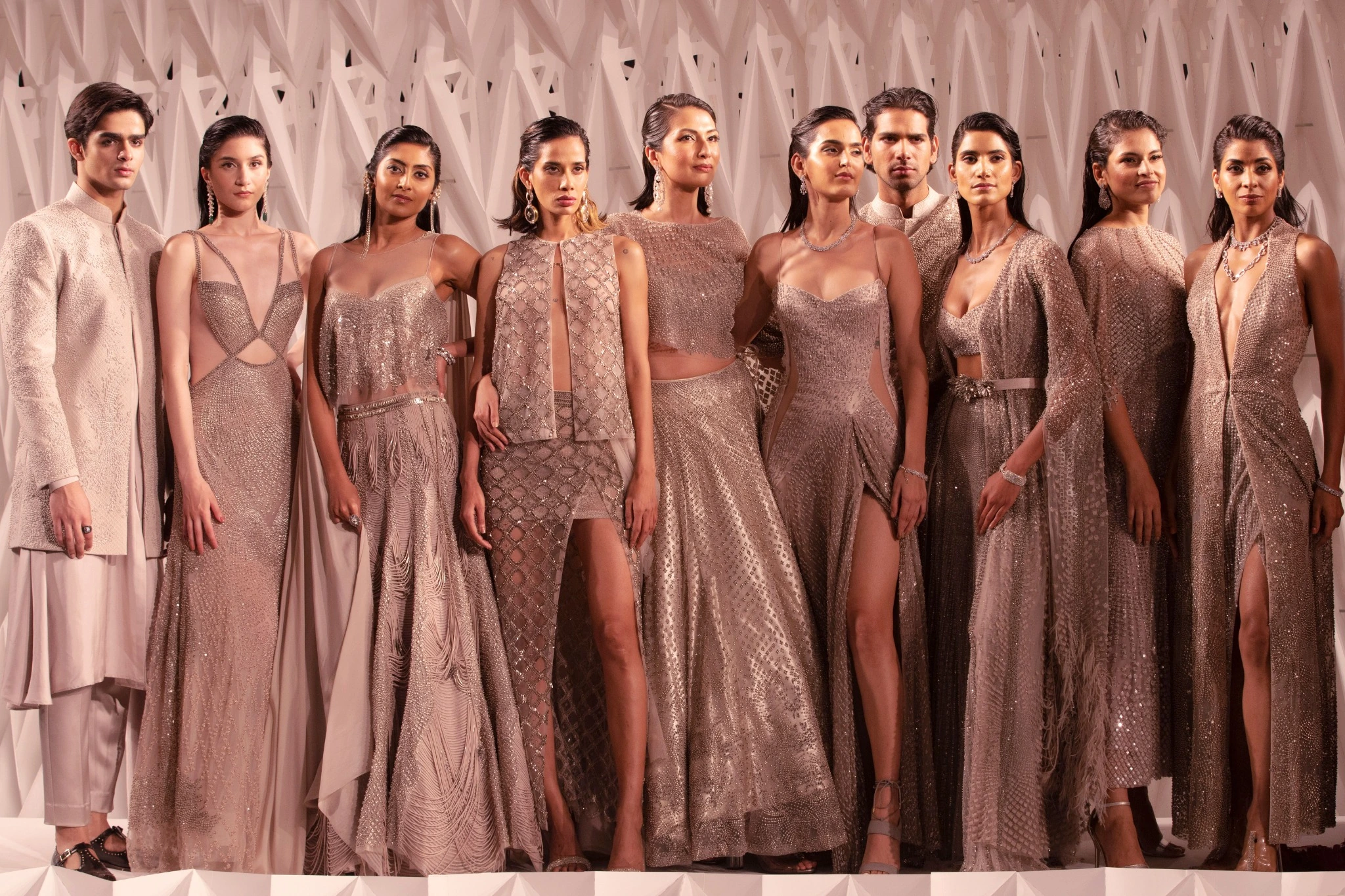
Ethnic wear makes up about 60% of womenswear in the CMAI study, or US$21.2 billion, with sarees and salwar suits among the largest segments. Rahul Mehta, the association’s chief mentor, sees womenswear as grounded in ethnic dress that keeps adapting through new silhouettes and Indo-Western combinations.
CMAI estimates the womenswear market at US$35.6 billion in CY2025 and forecasts annual growth of 8.9% through CY2029. Menswear, still the biggest segment at US$38.5 billion, is projected to grow at 8.5%, with weddings sustaining demand for sherwanis and bandhgalas. Kidswear, at 9.4%, is expected to grow fastest of all.
Raw Mango and Anita Dongre Take Indian Fashion to International Markets
Raw Mango began with four weavers in Chanderi. A Global Indian profile from April 2025 puts its artisan workforce at 450. Its first Kolkata flagship, which opened in December 2025 in an early 20th-century Art Deco house in Ballygunge, spans 4,800 square feet. Aditya Melekalam of Squadron 14 designed it, and its sculptures were made with an artisan known for Durga Puja installations. The space is built around the idea of an adda, the Bengali custom of unhurried, wide-ranging talk.
Anita Dongre’s Beverly Hills store on Wilshire Boulevard opened on 1 November 2025, making her the first Indian designer to open a flagship in the district. At 3,000 square feet, it is her fourth store outside India, following openings that include New York and Dubai, and the thirteenth worldwide according to Harper’s Bazaar India. Dongre wanted a presence on both US coasts and looked for a couple of years before finding the site. Pichhwai walls, hand-embellished over several months by Rajasthan artisans, set the tone.
Luxury Fashion Retail Beyond India’s Metros: Chennai and Bengaluru
Raw Mango’s Chennai store covers 5,400 square feet in a building that blends Art Deco with Chettinad architecture. For its first experience store, The Postbox chose a Tamil home four decades old in the city’s T Nagar, covering 4,000 square feet. Founder Nikhil Joseph spent seven months restoring the property and used Madras checks sourced from local cooperative weavers. In Bengaluru, Sabyasachi’s boutique at The Leela Palace Colonnade measures 3,800 square feet, part of a network that now spans six cities.
India’s Apparel Spending Reveals a Gap in Luxury Retail Distribution
The Indian stores described here are in Delhi, Mumbai, Kolkata, Chennai and Bengaluru, all large cities, while about 85% of the country’s apparel spending comes from outside the metro and Tier-1 cities, according to the report’s breakdown. The report sizes apparel as a whole, not luxury, so it cannot say how much of that spending goes to high-end labels. What it does show is where the customers are: Tier-2, Tier-3 and rural markets together account for US$81.5 billion of the CY2025 total.
Katariya has named the industry’s next task as “deepening distribution and retail presence across these markets”, with propositions tailored to the emerging Indian consumer.
References: