From Timekeeping to Data Tracking: The New Role of Smartwatches | Luxyora
There was a time when wearing a watch meant one thing: you cared about being on time, and you cared enough to show it. A watch was a miniature declaration of values: discipline, taste, maybe a little romance for old-world mechanics. But the smartwatch has quietly rewritten that script. Today, the most powerful thing on your wrist might not be a movement at all; it might be a stream of data in motion.
Smartwatches didn’t arrive to replace style. They arrived to replace guesswork. How tired are you, really? Did you recover from yesterday’s workout? Is your heart behaving normally? Are you stressed or under-caffeinated? The modern smartwatch doesn’t simply “tell time.” It tells the truth (or at least tries). And that shift from accessory to advisor has become one of the defining luxury-tech evolutions of the last decade.
The wrist becomes a dashboard
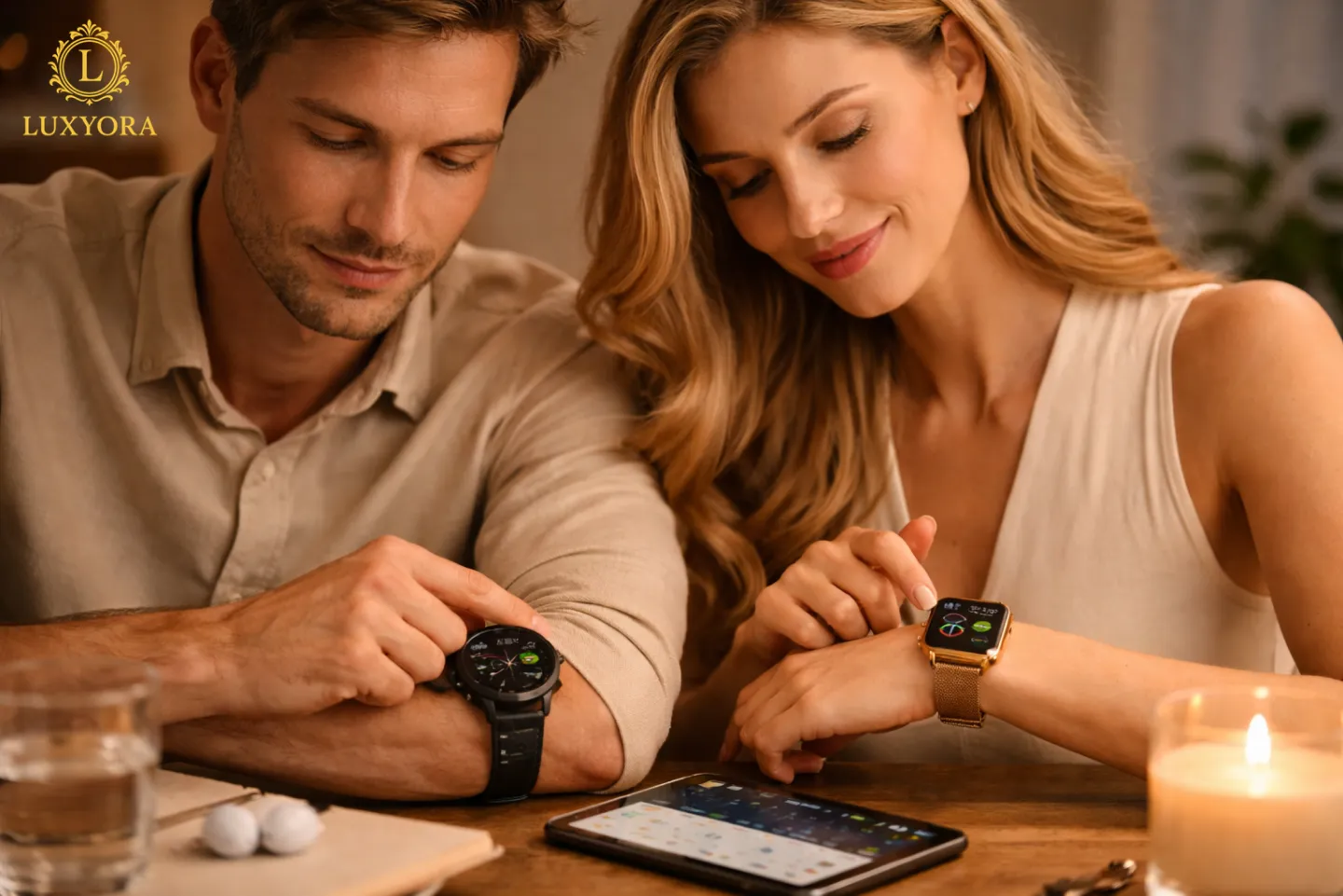
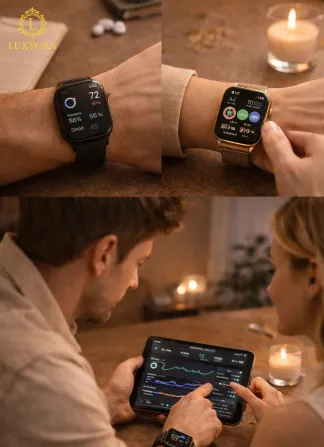
The magic starts with sensors. The typical smartwatch suite now includes optical heart-rate monitoring (often via photoplethysmography), accelerometers and gyroscopes for motion, GPS for location and pace, and, on certain models, advanced features like ECG recordings, skin temperature sensing, and blood oxygen estimation. You’re not just wearing a device; you’re wearing a compact lab that interprets your day in numbers.
This is why smartwatches feel so addictive. They turn the invisible into the visible. A night of “I slept fine” becomes a breakdown of sleep stages and consistency. A vague sense of sluggishness becomes a recovery score or a trend line. A walk becomes steps, pace, elevation, heart-rate zones, and calories burned. Suddenly, life looks measurable, and what’s measurable becomes tempting to optimise.
As smartwatches evolve from simple timekeepers into personal data companions, the conversation around wearability has shifted. Performance matters, but so does how naturally the watch belongs on your wrist. Before focusing on sensors and specifications, there’s another detail that changes everything: Choosing the Right Watch for Your Wrist Size.
Health tracking moves from novelty to “soft medical”
One of the most important shifts in smartwatch culture is the shift in credibility. Early wearables were fitness-forward steps and workouts, mostly. Now, the conversation has moved to health monitoring, which brings higher stakes.
Take ECG features. In the U.S., the Apple Watch ECG app received FDA De Novo clearance in 2018, marking a turning point in how consumer wearables could legitimately participate in health screening conversations. Large-scale research has also explored smartwatch-based irregular rhythm notifications for identifying atrial fibrillation, showing how consumer devices can be used in massive, real-world studies with user-owned hardware.
None of this means a smartwatch replaces a clinician. But it does mean your wrist can nudge you into awareness earlier than you might otherwise be, especially for issues that hide in plain sight. That’s the new luxury: not just owning beautiful objects, but owning tools that reduce uncertainty.
The rise of “everyday biometrics”
Here’s the subtle power move smartwatches made: they normalised biometrics. Heart rate used to be something you checked at a doctor’s appointment or during a workout. Now it’s ambient, always there, always updating. Stress estimates, breathing prompts, guided mindfulness, sleep coaching, cycle tracking, and recovery metrics are increasingly packaged as lifestyle features, delivered with glossy UI and a reassuring tone that feels more personal stylist than medical device.
And yet, accuracy is complicated. Research shows that wrist-based optical sensors can be very effective in certain conditions and contexts, though performance can vary with movement, device fit, and physiological differences. Sleep tracking is similar: useful for patterns and trends, less reliable as a perfect mirror of sleep stages compared to clinical gold standards.
The best way to think of smartwatch biometrics is as a long-term relationship, not a one-night stand. It’s less about obsessing over today’s score and more about noticing month-over-month shifts. The real value is the narrative your data builds over time.
From “notifications” to identity
There’s also the cultural layer: smartwatches aren’t only functional. They’re deeply personal and quietly performative.
A mechanical watch signals heritage and taste; a smartwatch signals intention. It says, “I’m managing something.” Sometimes that something is health. Sometimes it’s work. Sometimes it’s the modern condition of being too online and trying to stay afloat. Either way, the smartwatch has become a kind of identity technology: a sleek, socially acceptable way to say you’re tracking your life, shaping your habits, and staying connected without constantly holding your phone like a security blanket.
And yes, aesthetics matter. The smartest brands understand that the wrist is prime fashion real estate. Materials, finishes, band choices, and watch faces have turned smartwatches into shape-shifters, sporty in the morning, polished at night, minimalist when you want to look quietly expensive. The smartwatch didn’t erase style; it recruited it.
The new question: who owns “you,” in data form?
All this tracking comes with a modern complication: privacy. The smartwatch is intimate by design. It may capture health-adjacent data, location patterns, daily routines, and behavioural signals that can reveal more about you than you’d ever share at a dinner party.
Scholars and regulators have increasingly raised concerns about how wearable data is collected, used, shared, and protected, especially because health-related data can fall into sensitive categories under privacy frameworks such as the GDPR. Even beyond laws, the emotional reality is simple: wearable data can feel like an extension of the self. And when something feels like “you,” the idea of it being traded, inferred upon, or misinterpreted becomes unsettling.
Luxury in the smartwatch era isn’t only the device. It’s the governance around it: transparency, user control, and responsible design that treats data as a privilege, not a product.
Where this goes next: your watch as a quiet concierge
So what’s the new role of smartwatches? In a word: interpretation.
The next frontier is less about collecting more data and more about making data feel human, turning raw signals into practical guidance. Not just “your heart rate was higher,” but “you tend to spike on Tuesday afternoons; consider a short walk before your 3 p.m. meeting.” Not just “your sleep was fragmented,” but “your late caffeine correlates with wake-ups; try moving it earlier.”
This is where smartwatches start to feel like a luxury concierge for your body: always present, never loud, occasionally lifesaving, often helpful, sometimes annoying (because honesty can be). The dream is a device that understands your patterns, respects your privacy, and makes your life smoother, not more anxious.
The smartwatch began as a modern twist on timekeeping. It’s becoming something else entirely: a curated lens on your health, habits, and choices. And the more beautiful it becomes visually and ethically, the more it earns its place on the wrist.
Luxyora Philosophy: The future of luxury is not just what you wear, it’s what quietly supports your life. Choose smart elegance that respects your body, your privacy, and your pace.
References:
- Canali, S. (2022). Challenges and recommendations for wearable devices in digital health: Data quality, interoperability, and ethical issues. Journal of Medical Internet Research, 24(2), e28798.
- Kim, K. B., & Yoo, S. K. (2023). Photoplethysmography in wearable devices: Trends, challenges, and opportunities. Electronics, 12(13), 2923.
- Perez, M. V., Mahaffey, K. W., Hedlin, H., Rumsfeld, J. S., Garcia, A., Ferris, T., Balasubramanian, V., Russo, A. M., Rajmane, A., Cheung, L., Hung, G., Lee, J., Kowey, P., Talati, N., & Turakhia, M. P. (2019). Large-scale assessment of a smartwatch to identify atrial fibrillation. The New England Journal of Medicine, 381(20), 1909–1917.
- Robbins, R., Seixas, A., Master, L., & others. (2024). Accuracy of three commercial wearable devices for sleep tracking against polysomnography. Sleep Health.
- U.S. Food and Drug Administration. (2018). De Novo classification request for ECG App (DEN180044). Center for Devices and Radiological Health.
- World Health Organization. (2020). Global strategy on digital health 2020–2025. World Health Organization.